

Connectez-vous à Hivenet
Accédez à vos fichiers et gérez votre compte de stockage.
Boutique
Accédez à vos fichiers et gérez votre compte de stockage.
Calculer
Lancez des instances et gérez vos ressources de calcul.
Store et Compute utilisent toujours des comptes distincts aujourd'hui. Nous travaillons sur une connexion unifiée.
Vous avez juste besoin d'envoyer un fichier ?
Utilisez Envoyer directementVous êtes nouveau sur Hivenet ? Commencez
Commencez avec Hivenet
Choisissez ce que vous voulez utiliser en premier.
Boutique
Sauvegardez des photos et des fichiers sur tous vos appareils.
Calculer
Lancez le calcul GPU en libre-service pour les tâches exigeantes.
Store et Compute utilisent toujours des comptes distincts aujourd'hui. Nous travaillons sur une expérience de compte unifiée.
Vous avez besoin de Hivenet pour votre entreprise ?
Parlez au service des ventesVous avez besoin d'envoyer un fichier ?
Ouvrir EnvoyerVous avez déjà un compte ? Connectez-vous
When a dedicated LLM endpoint becomes cheaper than paying per token
There is a point where paying for every token stops being the cheap way to buy AI inference.
For Qwen3.6-27B, current public prices make that point visible.
Take a production workload with three input tokens for every output token. Compare the published per-token prices from several Qwen3.6-27B providers with a Hivenet medium dedicated endpoint starting at €2.10 per hour.
The result is a crossover zone.
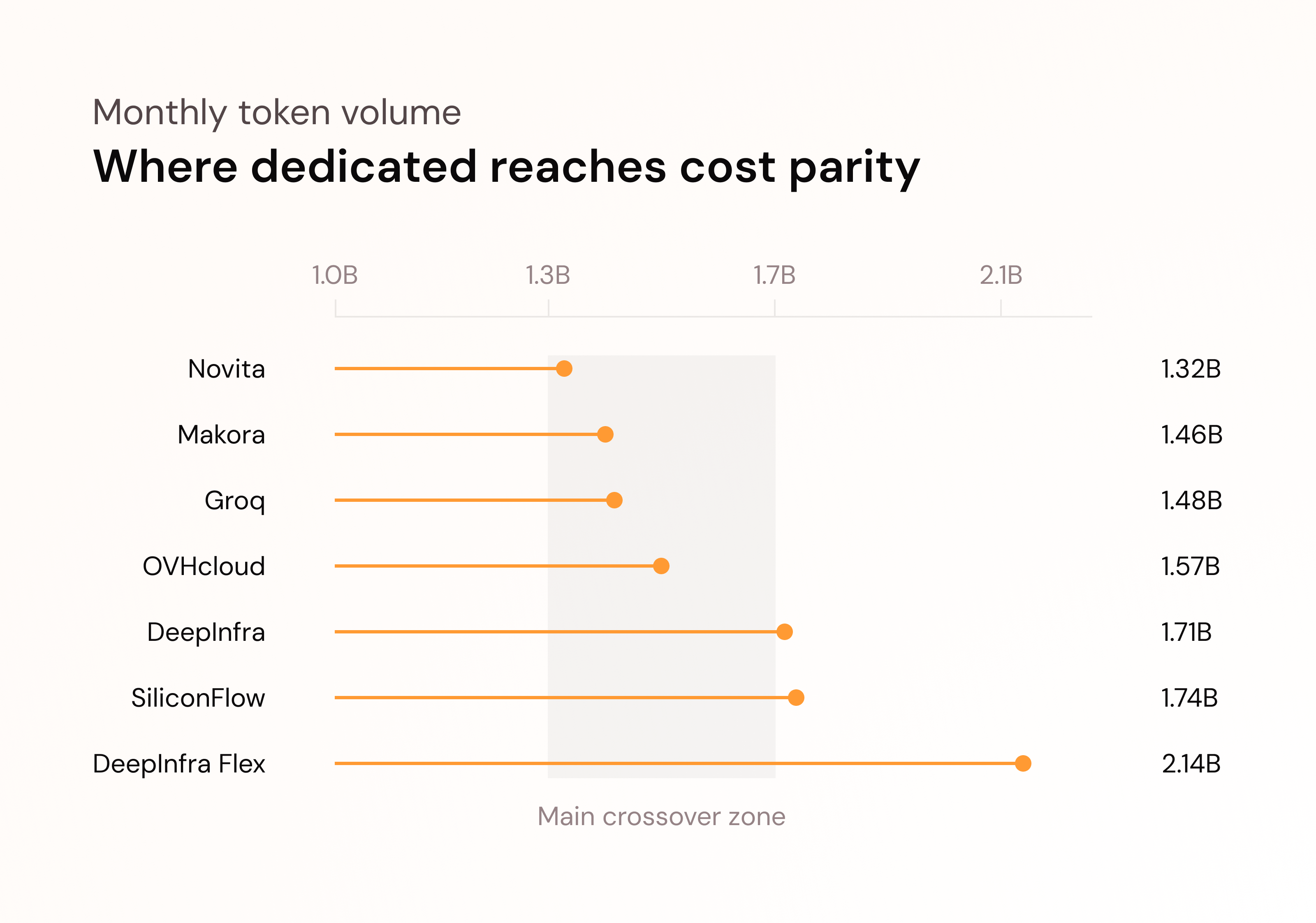
With the standard per-token prices we could verify, dedicated Hivenet capacity reaches the same monthly cost at roughly 1.3 to 1.7 billion tokens per month, depending on the provider.
One discounted, lower-priority tier pushes the crossover to about 2.14 billion tokens.
Below those volumes, paying per token can be the cheaper buy.
Above them, the economics start moving toward dedicated capacity.
That is when an API bill becomes an infrastructure question.
The token meter has one unavoidable property
Per-token pricing is excellent at low utilization.
If your application uses nothing, you pay almost nothing. If traffic doubles, the provider absorbs the work of making enough shared infrastructure available and your bill simply follows consumption.
That flexibility is worth paying for.
The problem is that the relationship never changes.
Twice the billable tokens means roughly twice the token cost. Ten times the tokens means roughly ten times the cost, assuming the workload mix and price stay constant.
A dedicated endpoint behaves differently.
Hivenet Inference API uses per-replica pricing billed by the second. A medium endpoint for mid-sized Qwen-class workloads currently starts at €2.10/hour.
Run that endpoint continuously for a 730-hour month and the starting cost is:
€1,533.
Send more tokens through the same capacity and the replica does not start charging a token fee on top.
That difference is why utilization changes the economics.
Current Qwen3.6-27B prices put numbers on the crossover
Consider six providers that publish per-token access to Qwen3.6-27B.
Novita AI currently lists the model at $0.60/M input and $3.60/M output.
Makora lists its NVFP4 version at $0.4671/M input and $3.4592/M output.
Groq charges $0.60/M input and $3.00/M output.
OVHcloud lists €0.40/M input and €2.70/M output.
DeepInfra lists its standard tier at $0.32/M input and $3.20/M output.
SiliconFlow lists $0.30/M input and $3.20/M output.
Those prices look close on a provider page. At production volume, the differences compound.
To compare them consistently, use the same workload for every provider: three input tokens for every output token.
That produces blended rates ranging from roughly $1.025 to $1.35 per million tokens across the standard dollar-priced APIs, while OVHcloud comes to €0.975/M.
Now there is something useful to compare with the €1,533 monthly starting cost of a continuously running Hivenet endpoint.
The standard crossover zone is about 1.3–1.7 billion tokens
At Novita's current price, the per-token bill reaches the equivalent Hivenet monthly cost at roughly 1.32 billion tokens.
With Makora, it is around 1.46 billion.
Groq lands at approximately 1.48 billion.
OVHcloud reaches the crossover at roughly 1.57 billion.
DeepInfra's standard tier comes in around 1.71 billion.
SiliconFlow reaches it at roughly 1.74 billion.
There is no magical significance to one exact point inside that range.
The useful number is the zone.
At around 1.3–1.7 billion monthly tokens, a steady Qwen3.6-27B workload should start comparing dedicated capacity with standard per-token APIs rather than assuming metered inference is cheaper.
That is the sales conversation the chart is designed to make obvious.
The cheapest token tier can move the line
A serious comparison should include the cases that make Hivenet's argument harder, too.
DeepInfra currently offers a Flex tier for Qwen3.6-27B at $0.256/M input and $2.56/M output, below its standard price.
On the same 3:1 workload mix, that works out to about $0.832/M tokens.
Against that tier, the Hivenet crossover moves to roughly 2.14 billion tokens per month.
That does not invalidate dedicated inference.
It tells you that price is connected to service characteristics.
DeepInfra describes Flex as a separate tier from its standard and Priority options. A team willing to trade service priority for a lower token rate should compare that option with dedicated capacity.
A team buying predictable, dedicated production capacity is solving a somewhat different problem.
The important thing is to compare the product you would actually buy, not select whichever provider tier makes a preferred chart look best.
Output-heavy workloads cross earlier
The 3:1 mix is a useful reference case. It is not every application.
Most providers charge much more for output than input.
On SiliconFlow, Qwen3.6-27B currently costs $0.30/M for input and $3.20/M for output.
Groq lists $0.60/M and $3.00/M.
OVHcloud lists €0.40/M and €2.70/M.
So consider two applications using the same total number of tokens.
One processes long documents and returns short structured answers.
The other runs a conversational agent generating long responses.
The second workload consumes more of the expensive side of the token meter.
Its effective per-token price rises.
Its dedicated break-even point arrives sooner.
This is one reason production teams should stop forecasting inference cost from total token volume alone. Input/output mix matters.
A billion tokens spread evenly is different from a billion-token spike
The second important variable is traffic shape.
A monthly total says nothing about whether one replica can handle the work.
A workload that sends requests steadily for 24 hours a day is naturally suited to using reserved capacity well.
A service that creates the same monthly volume during a two-hour daily peak may need substantially more capacity to meet its latency target during those peaks.
That can move the dedicated cost upward.
Concurrency matters. Prompt length matters. Output length matters. Latency targets matter.
The per-token versus dedicated inference decision therefore starts with how the workload behaves, not a single monthly number.
The crossover chart answers an economic question:
At what volume does one continuously running replica cost less than these token meters?
It does not claim:
One replica can serve every workload at that volume.
Those are different questions, and both need an answer before moving production traffic.
There is another lever in the Hivenet price
The comparison above deliberately makes a conservative assumption: the Hivenet endpoint runs 24/7 for the entire month.
Hivenet bills dedicated endpoints by the second.
If your production architecture allows the endpoint to run for fewer than 730 hours in a month, the dedicated cost falls with runtime.
That can move the economic crossover earlier.
There is a trade-off, of course. If the endpoint needs to be ready continuously, then continuous runtime is the correct cost to use.
Again, the workload decides.
The useful feature of replica pricing is that the unit maps directly to infrastructure time. A team can model the cost from the operating pattern it actually expects rather than converting everything into an abstract token rate.
Why Hivenet can make the dedicated model work
Dedicated inference is only compelling if the model uses its underlying hardware efficiently.
Otherwise you are simply reserving expensive idle infrastructure.
That is why the serving configuration matters.
Hivenet's Qwen3.6-27B NVFP4 setup requires half the hardware of full precision.
Across the reported quality benchmarks, the same configuration retains between 95.5% and 100% of full-precision capability.
And our Qwen3.6-27B provider comparison shows why the serving configuration belongs in the buying decision alongside the model name.
That efficiency is what gives dedicated pricing room to become competitive at production volume.
The point is not simply to reserve hardware.
It is to reserve efficient model capacity.
Predictable spend becomes more valuable as AI becomes infrastructure
There is a second benefit once a workload reaches this scale.
A billion-plus monthly tokens is no longer a side experiment.
The AI service is becoming part of the operating budget.
With a token API, spend remains directly attached to consumption. More customers, longer conversations, larger documents, or unexpectedly verbose outputs can all move the bill.
With dedicated capacity, the cost is tied to the replicas you deploy and how long they run.
That makes the budget easier to reason about once traffic is stable enough to size the infrastructure.
It also changes the optimization question.
Instead of asking only how to reduce token consumption, teams can ask:
- Are we using the capacity we are paying for?
- Can this model handle more of the workload?
- Do we need another replica?
- Does the quality bar require a larger model?
- Can we move more traffic onto this endpoint without increasing infrastructure cost?
Those are healthier questions for a production system than treating every generated token as another metered event.
The cheapest answer depends on where you are on the curve
Below the crossover zone, per-token pricing can be excellent.
There is little reason to reserve a continuously available replica for a workload that barely uses it.
Around the crossover, both options deserve a real workload benchmark.
Above it, continuing to pay a token meter without checking the cost of dedicated capacity becomes increasingly difficult to justify.
For Qwen3.6-27B, the current standard-provider comparison puts that zone at roughly:
1.3–1.7 billion tokens per month.
A discounted Flex tier can extend it to around:
2.14 billion tokens.
Your own point may arrive sooner or later.
But if your production AI workload is already in that neighborhood, the useful question is no longer simply which API has the lowest token price?
It is:
Why are we still paying by the token if we are using enough inference to justify the capacity underneath it?
Explore Hivenet Inference API or talk to our team with your current model, monthly input and output volume, traffic profile, latency target, and region. Those five numbers are enough to start finding your real crossover point.
Your next workload belongs on Hivenet.
Pick one AI, compute, or storage workload and see the difference for yourself. Spin it up in minutes, or let our team map your fastest path to production.