
Sign in to Hivenet
Access your files and manage your storage account.
Store
Access your files and manage your storage account.
Compute
Launch instances and manage your compute resources.
Store and Compute still use separate accounts today. We’re working on a unified sign-in.
Just need to send a file?
Use Send directlyNew to Hivenet? Get Started
Get started with Hivenet
Choose what you want to use first.
Store
Back up photos and files across your devices.
Compute
Launch self-serve GPU compute for demanding work.
Store and Compute still use separate accounts today. We’re working on a unified account experience.
Need Hivenet for business?
Talk to salesNeed to send a file?
Open SendAlready have an account? Sign in
Half the hardware changes the economics of AI inference
Most AI inference cost comparisons start at the end of the equation.
They compare token prices, throughput, latency, or hourly rates. Useful numbers, certainly. But before an inference service can generate anything, the model has to fit on the hardware running it.
That is where a large part of the economics is decided.
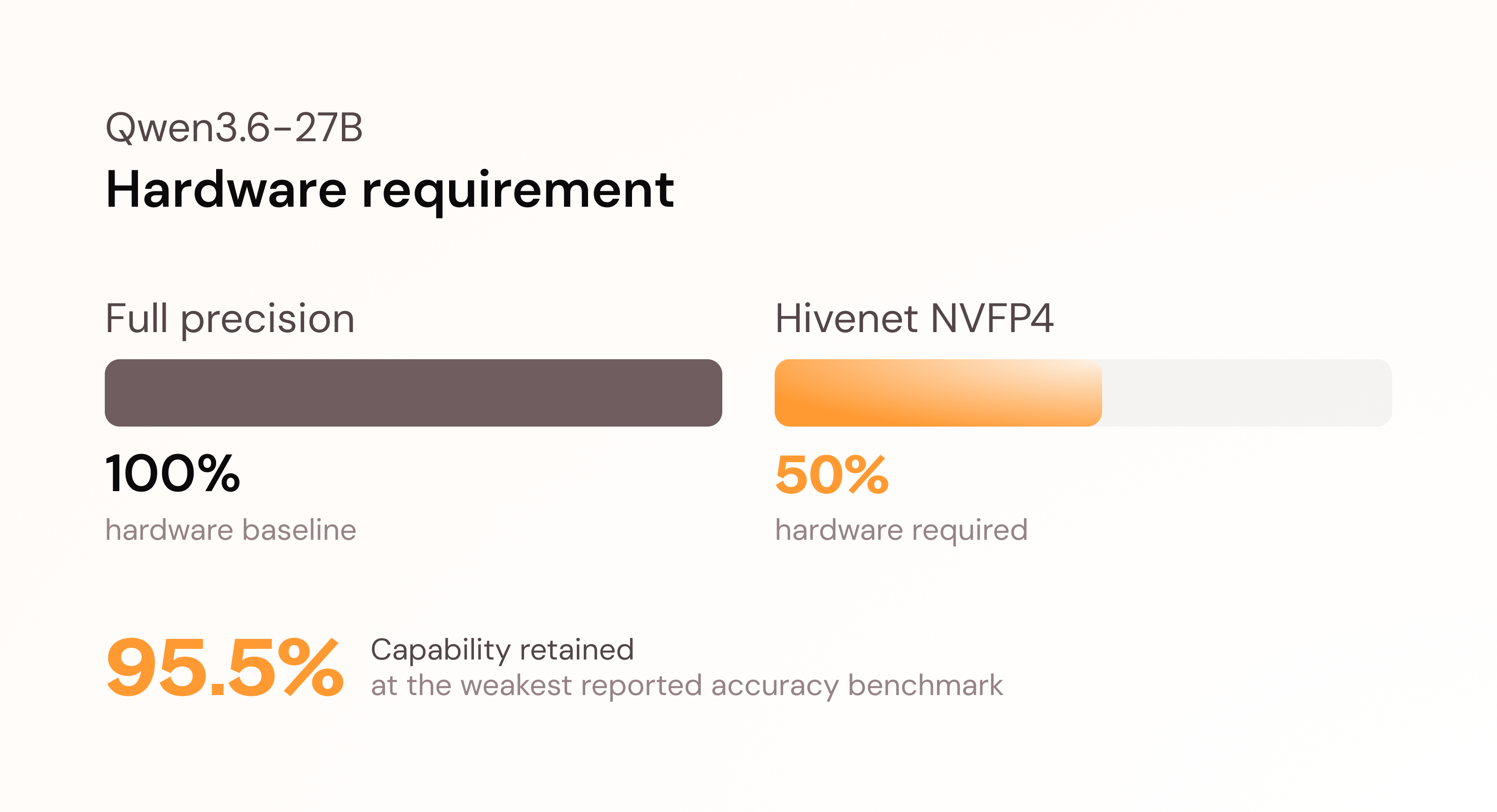
For Qwen3.6-27B, Hivenet's mixed-precision NVFP4 configuration needs half the hardware required to serve the model at full precision.
And we measured what that reduction costs in model capability.
Across the reported benchmark suite, the weakest result retained 95.5% of the full-precision model's capability. Other evaluations came closer still.
That combination matters: materially lower infrastructure requirements, with a measured rather than assumed quality trade-off.
Half the hardware before the first token is generated
A 27B model carries a lot of weight. Literally.
Higher-precision weights consume more memory, which increases the amount of GPU hardware needed simply to load and serve the model. Quantization reduces that memory requirement by representing model weights, and sometimes activations, with fewer bits.
Hivenet takes that further with an NVFP4 mixed-precision configuration built for NVIDIA Blackwell hardware.
NVFP4 is NVIDIA's 4-bit floating-point format for Blackwell GPUs. Rather than treating every part of Qwen3.6-27B identically, our serving configuration keeps more sensitive parts of the model at higher precision.
The practical result is much easier to understand than the implementation:
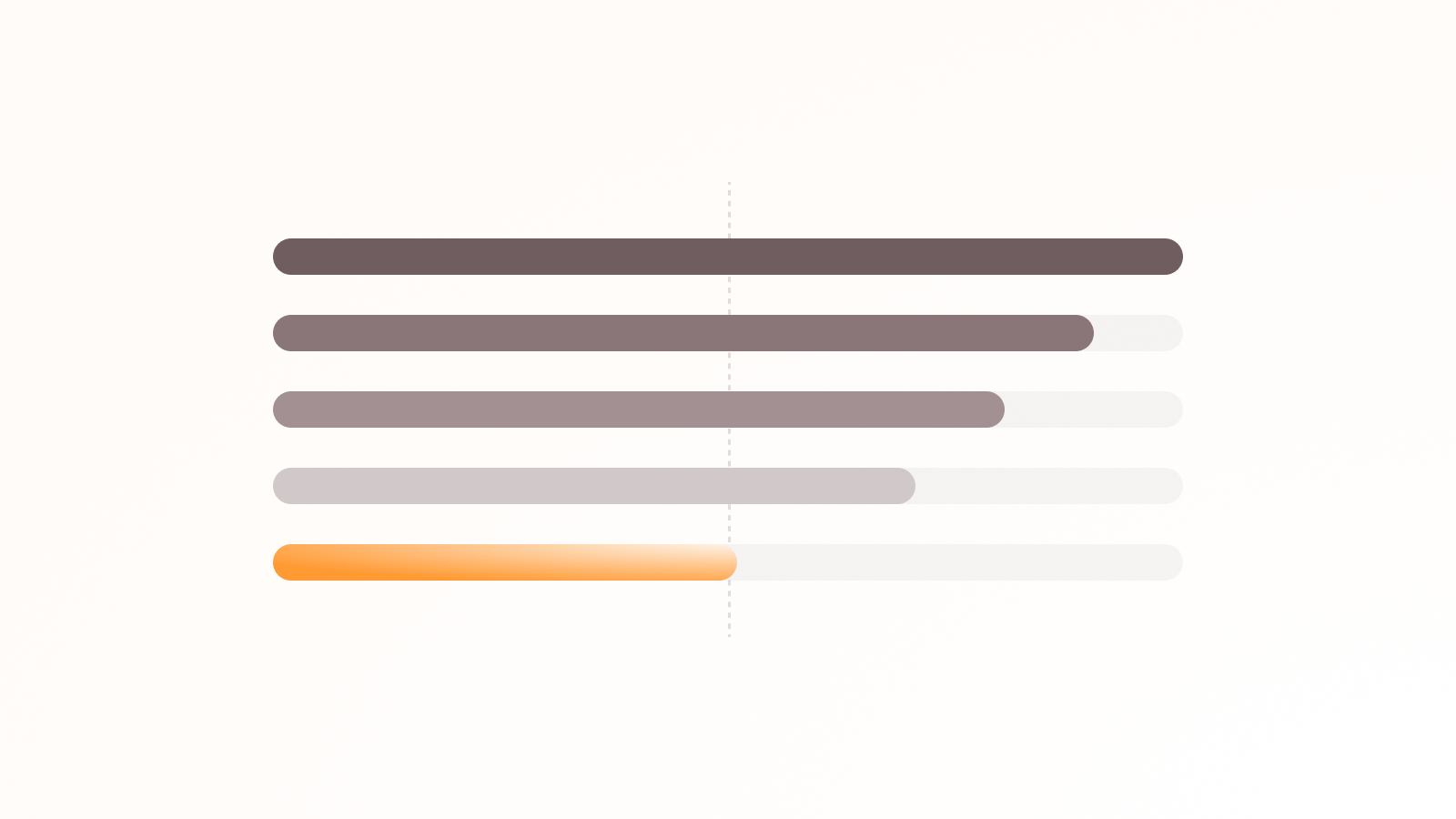
Full precision requires twice the hardware. Hivenet's serving configuration requires half as much.
That changes the cost base before throughput optimization, batching, or request volume enter the picture.
Lower precision is useful only if the model still works
Reducing the hardware requirement is the easy part of the story to sell.
The harder question is the one that matters more:
What happened to the model?
Aggressive quantization can reduce memory use and improve serving economics, but those savings are worthless if model quality falls below what the workload requires.
So we benchmarked it.
Hivenet compared its Qwen3.6-27B NVFP4 configuration with the full-precision model across evaluations covering reasoning, instruction following, tool use, visual understanding, retrieval, and code generation.
The lowest capability-retention result was 95.5%, on LiveCodeBench code generation.
The other reported evaluations retained between 97.3% and 100% of the full-precision result.
We publish the lower results because they are the useful ones. An average would make the trade-off look cleaner, but it would tell a buyer less.
If code generation is central to your workload, 95.5% deserves attention. If your workload is structured extraction, RAG, document processing, classification, or another production task, your own evaluation may tell a different story.
That is the point.
Efficient inference is not about making the model smaller at any cost. It is about finding the lowest infrastructure requirement that still clears your quality bar.
Why this matters once AI reaches production
Infrastructure waste can be easy to ignore during experimentation.
A few development requests will not expose it. A production workload will.
As inference volume grows, every unnecessary resource becomes part of the operating cost. More hardware also means more capacity to provision and more infrastructure sitting underneath every running replica.
Reducing the hardware requirement by half gives the serving layer more room to make the economics work.
It does not mean every workload suddenly costs exactly 50% less. Real inference cost still depends on traffic shape, context length, output length, concurrency, utilization, latency requirements, and the serving stack.
But it removes a large part of the infrastructure requirement before those variables enter the equation.
That is why we think performance per euro is a more useful target than simply chasing the highest possible benchmark number.
Hivenet's Inference API is built around that idea: managed, OpenAI-compatible endpoints for production workloads where model quality, throughput, regional placement, and cost all have to make sense together.
There is no single “fastest” inference provider
AI infrastructure comparisons tend to collapse into one metric.
Tokens per second gets the headline. Or price per million tokens. Or time to first token.
None of those tells you the whole cost of serving a model.
A provider can produce an impressive single-request speed while requiring more infrastructure. Another can offer a low token price for irregular traffic but become less attractive for a steady production workload. A larger model may top more benchmarks while delivering capability your application never uses.
The better question is:
How much useful model performance are you getting from the infrastructure you are paying for?
For teams evaluating inference, that means considering model quality alongside memory requirements, concurrency, latency, throughput, and cost.
Our guide to production LLM inference covers those trade-offs in more detail. The important point here is simpler: optimizing one number is not the same as optimizing the system.
Qwen3.6-27B is a useful test of that idea
Qwen3.6-27B is a dense 27B-class model designed for demanding workloads including coding and multimodal tasks.
It is large enough for infrastructure efficiency to matter, without moving into the very large model classes that require a completely different deployment strategy.
That makes it a useful example of what low-precision inference can achieve when the optimization is measured rather than assumed.
The Hivenet approach is not simply “run everything at 4-bit.”
Different parts of a model respond differently to reduced precision. Our configuration uses mixed precision so the largest efficiency gains can come from the parts of the model that tolerate them, while more sensitive layers remain protected at higher precision.
The result is the combination that matters commercially:
The model is not free of trade-offs. The trade-offs are visible.
That is a much more useful basis for an infrastructure decision.
The cheapest model is the one that does the job efficiently
There is a temptation in AI to treat bigger as automatically better.
For some workloads, it is. Frontier models exist for a reason.
But production AI is increasingly full of repetitive work: document extraction, classification, summarization, RAG, structured generation, support workflows, internal tools, and automation.
Those jobs do not all need the most expensive model available.
Nor do they benefit from paying for unnecessary infrastructure underneath a smaller one.
A well-matched open model running efficiently can give teams another option: enough capability for the task, predictable infrastructure, and better control over the economics as volume grows.
That is where the hardware reduction behind Qwen3.6-27B becomes more than a technical curiosity.
Half the hardware changes what the model costs to operate. Measuring the quality trade-off tells you whether that saving is worth taking.
For the workloads where it is, that is what efficient inference should look like.
---
Explore Hivenet Inference API to run open-source and foundational models through managed, region-pinned endpoints, or talk to our team about the model, volume, latency target, and quality bar you need to hit.
Your next workload belongs on Hivenet.
Pick one AI, compute, or storage workload and see the difference for yourself. Spin it up in minutes, or let our team map your fastest path to production.