

Sign in to Hivenet
Access your files and manage your storage account.
Store
Access your files and manage your storage account.
Compute
Launch instances and manage your compute resources.
Store and Compute still use separate accounts today. We’re working on a unified sign-in.
Just need to send a file?
Use Send directlyNew to Hivenet? Get Started
Get started with Hivenet
Choose what you want to use first.
Store
Back up photos and files across your devices.
Compute
Launch self-serve GPU compute for demanding work.
Store and Compute still use separate accounts today. We’re working on a unified account experience.
Need Hivenet for business?
Talk to salesNeed to send a file?
Open SendAlready have an account? Sign in
How much does LLM inference really cost?
There is no single price for running an LLM.
You can pay for tokens.
You can reserve a managed model endpoint.
Or you can rent the GPUs and run the model yourself.
All three can be described as “LLM inference.” Their pricing units are different because the products underneath them are different.
That creates a common mistake in AI buying: compare one provider's price per million tokens with another provider's GPU-hour, decide which number looks smaller, and assume you found the cheaper option.
You probably haven't.
The real question is:
What does it cost to serve your workload at the quality, latency, throughput, and reliability you actually need?
Once you calculate that, the cheapest path can change considerably.
Start with the three ways to buy inference
Most LLM infrastructure costs fall into three broad models.
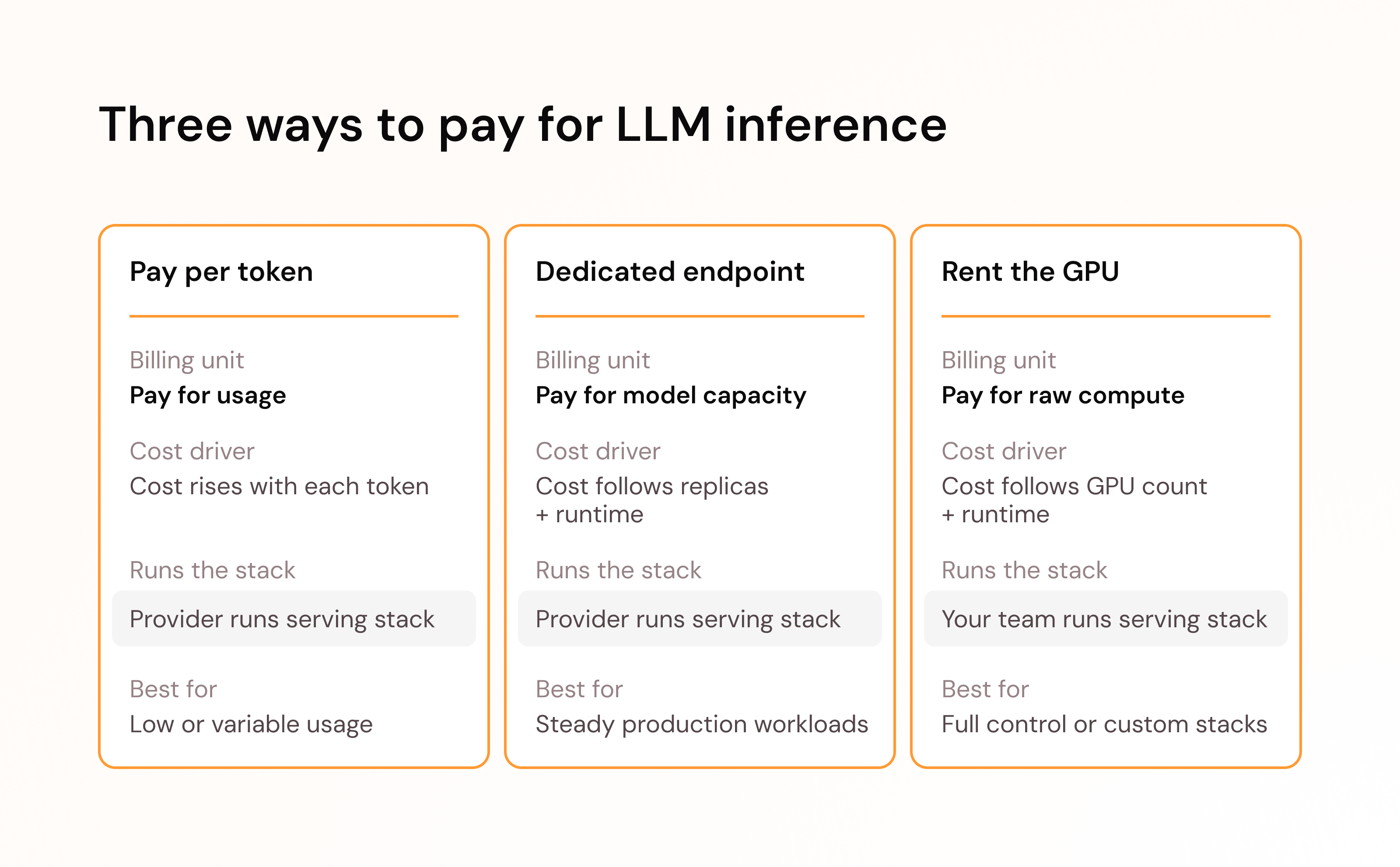
1. Pay per token
This is the familiar API model.
You send input tokens, receive output tokens, and pay according to usage.
The basic calculation is:
Monthly cost = input tokens × input rate + output tokens × output rate
That makes per-token APIs easy to start with because the cost tracks consumption.
Use almost nothing and the bill stays small.
Send ten times as much work and the bill grows with it.
For uncertain or intermittent workloads, that flexibility is valuable.
2. Pay for a dedicated endpoint
A dedicated endpoint changes the unit from consumption to capacity.
With Hivenet Inference API, for example, dedicated endpoints use per-replica pricing billed by the second.
The calculation becomes:
Monthly cost = replicas × endpoint rate × runtime
A medium endpoint for Qwen-class workloads currently starts at €2.10/hour.
Run one continuously for a 730-hour month and the starting infrastructure cost is about €1,533.
There is no token meter on Hivenet's dedicated endpoint path. Your cost follows the capacity you deploy and how long it runs.
That makes the model more attractive as utilization rises.
3. Rent GPUs and run inference yourself
Raw GPU rental moves another layer of responsibility to the buyer.
With GPU/CPU rental from Hivenet, an RTX 5090 currently starts at €0.75 per GPU-hour, billed by the second. citeturn503053view0
The infrastructure calculation looks simple:
GPU cost = number of GPUs × GPU rate × runtime
One RTX 5090 running continuously at €0.75/hour works out to €547.50 for a 730-hour month.
That number can look dramatically cheaper than a managed endpoint.
It is also buying much less.
You have the GPU.
Your team still has to turn it into a reliable inference service.
The cheapest headline rate is often the least complete number
This is the point where many LLM cost calculators become misleading.
They compare:
€0.75/hour
with:
€2.10/hour
and conclude the first is 64% cheaper.
Mathematically, yes.
Operationally, those numbers describe different units.
Hivenet's raw Compute path gives your team the instance and control of the stack. Hivenet's managed inference path operates the serving layer and exposes an OpenAI-compatible endpoint. citeturn321177view0 citeturn503053view0
If you rent the GPU, your actual stack may also need:
- a model checkpoint and serving configuration
- vLLM, TGI, SGLang, llama.cpp, or another serving engine
- a gateway
- authentication
- routing
- monitoring and metrics
- replica management
- failure handling
- upgrades
- someone to keep all of it working
None of those things makes self-managed inference a bad deal.
For teams that already have the infrastructure expertise, need deep customization, or want full control over the serving environment, raw GPUs can be exactly the right choice.
But engineering work does not become free because it does not appear on the cloud invoice.
A one-billion-token example shows why the unit matters
Consider a production workload processing 1 billion tokens per month.
Assume:
- 750 million input tokens
- 250 million output tokens
- continuous availability
Now compare three ways to buy the infrastructure.
Per-token API
OVHcloud's published Qwen3.6-27B pricing in our current comparison is €0.40 per million input tokens and €2.70 per million output tokens. The same rates underpin the European pricing analysis in our source work. fileciteturn2file0
The calculation is:
750 × €0.40 = €300
plus:
250 × €2.70 = €675
Total:
€975/month
At this volume, the per-token API is still below the continuous cost of a Hivenet medium dedicated endpoint.
Hivenet dedicated endpoint
A medium Qwen-class endpoint starts at €2.10/hour. Hivenet bills dedicated endpoints per replica and by actual runtime rather than by token. citeturn321177view0
For continuous operation:
€2.10 × 730 = €1,533
Total:
from €1,533/month
One replica has to be sufficient for the workload's concurrency and latency requirements. If more capacity is required, the cost rises.
Raw RTX 5090 capacity
One Hivenet RTX 5090 currently starts at €0.75/hour. citeturn503053view0
For continuous operation:
€0.75 × 730 = €547.50
Raw infrastructure cost:
from €547.50/month
It is the smallest number on the page.
It should not automatically win.
You still need to determine whether the model and serving configuration fit that hardware and whether your team wants to operate the serving stack.
That is the cost most simple calculators leave out.
Use total cost, not just cloud cost
There are four parts of LLM inference cost worth calculating separately.
Infrastructure or API spend
This is the visible bill.
Tokens, replicas, GPUs, storage, networking, or whichever unit the provider charges.
It is the easiest part to compare.
Utilization
A dedicated endpoint or GPU can be cheap per unit of work when it stays busy.
It can be expensive when it sits idle.
Per-token APIs reverse that relationship. Low utilization is their strength because you are not reserving the underlying capacity.
This is why pay-per-token and dedicated inference become different economic choices rather than two interchangeable pricing pages.
Operational cost
If your team manages the serving stack, someone has to build and maintain it.
The relevant question is not whether your engineers can run vLLM.
It is what else they would be doing if they did not have to.
For a company building AI infrastructure as a core capability, the work may be strategic.
For a company whose actual product happens to use an LLM, it may be overhead.
Model efficiency
The same workload can require different infrastructure depending on how the model is served.
This is where quantization and serving optimization turn into commercial factors.
Hivenet's Qwen3.6-27B NVFP4 configuration uses half the hardware required by full precision.
Across the reported accuracy evaluations, it retains between 95.5% and 100% of full-precision capability.
A cost calculator that ignores the model configuration underneath the endpoint misses part of the economics.
Per-token pricing is often cheapest before utilization builds
At low volume, a token API has an obvious advantage:
You do not pay for idle capacity.
Suppose your workload falls from 1 billion tokens to 100 million.
Using the same OVHcloud pricing and 3:1 mix, the example bill falls from €975 to about:
€97.50
A continuously running €2.10/hour endpoint would still cost €1,533.
A continuously running €0.75/hour GPU would still cost €547.50 before operating costs.
For a prototype or sporadic application, there is no mystery here.
The token API wins the direct cost comparison by a wide margin.
That is why starting with consumption pricing is often sensible.
The economics change only when usage does.
Dedicated endpoints improve as the capacity gets used
Now move in the other direction.
At two billion tokens per month, the same OVHcloud example reaches approximately:
€1,950
At three billion:
€2,925
The Hivenet medium endpoint's starting monthly cost is still €1,533 if one replica can carry that traffic and remains running continuously.
This is the crossover effect we explored in when dedicated inference becomes cheaper than paying per token.
Across the standard Qwen3.6-27B token providers we checked, the crossover falls at roughly 1.3–1.7 billion tokens per month under the same 3:1 workload assumption.
Dedicated capacity is not inherently cheap.
Used dedicated capacity can be cheap.
That distinction matters.
Raw GPU rental can win when your team wants the work
There is another point where the calculation can change.
A technical team may already have:
- infrastructure automation
- serving expertise
- monitoring
- deployment pipelines
- model evaluation
- GPU scheduling
- people responsible for production ML systems
For that organization, self-managing a model may add little marginal operational cost.
Raw GPU rental can then become extremely attractive.
Hivenet's current Compute offering explicitly separates that use case from managed inference: use Compute when you want full control over the instance and serving stack; use Inference API when you want Hivenet operating the model endpoint. citeturn321177view0turn503053view0
That gives buyers a useful choice rather than forcing every workload into the same product.
If your team wants to run vLLM itself, rent the GPU.
If your team wants to call the model through an API, price the managed endpoint.
Availability changes the math too
Most simple monthly calculations assume 24/7 infrastructure.
Your workload may not need that.
Hivenet bills both Compute and dedicated inference by runtime rather than forcing a full monthly commitment. The Inference API uses per-replica, per-second billing, while Compute also uses per-second billing. citeturn321177view0turn503053view0
That means the 730-hour examples are deliberately conservative.
If an internal batch workflow only needs inference for eight hours a day, the runtime cost can be very different.
If a customer-facing product has to answer requests at 3 a.m., continuous availability may be unavoidable.
Again, the workload decides.
Your cost calculator needs at least seven inputs
A useful LLM inference calculation should collect more than monthly tokens.
At minimum, know:
InputWhy you need itMonthly input tokensDetermines metered input costMonthly output tokensOften the more expensive part of metered APIsTraffic distributionDetermines how efficiently dedicated capacity can be usedPeak concurrencyHelps size replicas or GPUsPrompt/context lengthAffects memory and serving performanceLatency targetCan change required capacityAvailability requirementDetermines how many hours capacity must stay running
Then add the question that does not fit neatly into a spreadsheet:
Do we want to operate the inference stack ourselves?
That answer determines whether raw GPU rental and managed inference are genuinely substitutes for your team.
The cheapest model can still be the expensive choice
Infrastructure is only useful if the model does the job.
Suppose Model A costs half as much as Model B but fails your workflow often enough that requests need retries, human review, or escalation to Model B.
The cheap call just became more expensive.
The same logic applies to aggressive quantization.
Saving hardware while moving below the application's quality threshold is not efficiency.
This is why Hivenet measures model quality alongside serving efficiency rather than presenting infrastructure cost as an isolated win.
For Qwen3.6-27B, the weakest result in our reported quantization benchmark retains 95.5% of full-precision capability. fileciteturn2file0
That gives a buyer something concrete to evaluate against their own acceptance threshold.
Sometimes the biggest saving comes from using a different model
There is one more lever before you optimize the infrastructure.
Ask whether every request needs the model it currently receives.
A company can spend weeks reducing the serving cost of a frontier model while routing simple extraction, classification, RAG, and summarization calls through capability they barely use.
Our analysis of which frontier-model calls a 27B model can handle for less looks at that problem directly.
The most effective cost architecture may combine several approaches:
EASY / REPEATABLE WORK
        ↓
efficient 27B model

HARD / AMBIGUOUS WORK
        ↓
frontier model

STEADY HIGH-VOLUME TRAFFIC
        ↓
dedicated capacity

VARIABLE / LOW-VOLUME TRAFFIC
        ↓
per-token API
Model selection and infrastructure selection are part of the same cost problem.
A better LLM cost calculation starts with the workload
There is no universally cheapest way to run inference.
Per-token APIs are hard to beat when usage is low and unpredictable.
Dedicated endpoints become more interesting when production traffic is steady enough to use the capacity.
Raw GPU rental can deliver the lowest direct infrastructure cost when your team wants the control and is prepared to run the stack.
The mistake is comparing the billing units before comparing the jobs they perform.
So before choosing an inference provider, write down:
How much do we use?
When do we use it?
How hard is the traffic to serve?
What quality do we need?
Who do we want operating the stack?
Then calculate the cost.
That gives you a number worth comparing.
Explore Hivenet Inference API for managed dedicated capacity, compare GPU/CPU rental if you want to operate the stack yourself, or talk to our team with your current model, token volume, traffic pattern, and latency target. We can help you model the three paths against the workload you actually run.
Your next workload belongs on Hivenet.
Pick one AI, compute, or storage workload and see the difference for yourself. Spin it up in minutes, or let our team map your fastest path to production.