
Sign in to Hivenet
Access your files and manage your storage account.
Store
Access your files and manage your storage account.
Compute
Launch instances and manage your compute resources.
Store and Compute still use separate accounts today. We’re working on a unified sign-in.
Just need to send a file?
Use Send directlyNew to Hivenet? Get Started
Get started with Hivenet
Choose what you want to use first.
Store
Back up photos and files across your devices.
Compute
Launch self-serve GPU compute for demanding work.
Store and Compute still use separate accounts today. We’re working on a unified account experience.
Need Hivenet for business?
Talk to salesNeed to send a file?
Open SendAlready have an account? Sign in

What 4-bit inference actually costs in model quality
4-bit inference comes with an attractive promise: run a capable model with far less memory and hardware.
The obvious question is what you lose.
That question matters because the cheapest model to serve is still expensive if it stops doing the job you chose it for. A smaller hardware footprint has value only when model capability remains inside a range your workload can accept.
So rather than describe our Qwen3.6-27B quantization as “near-lossless,” we measured it.
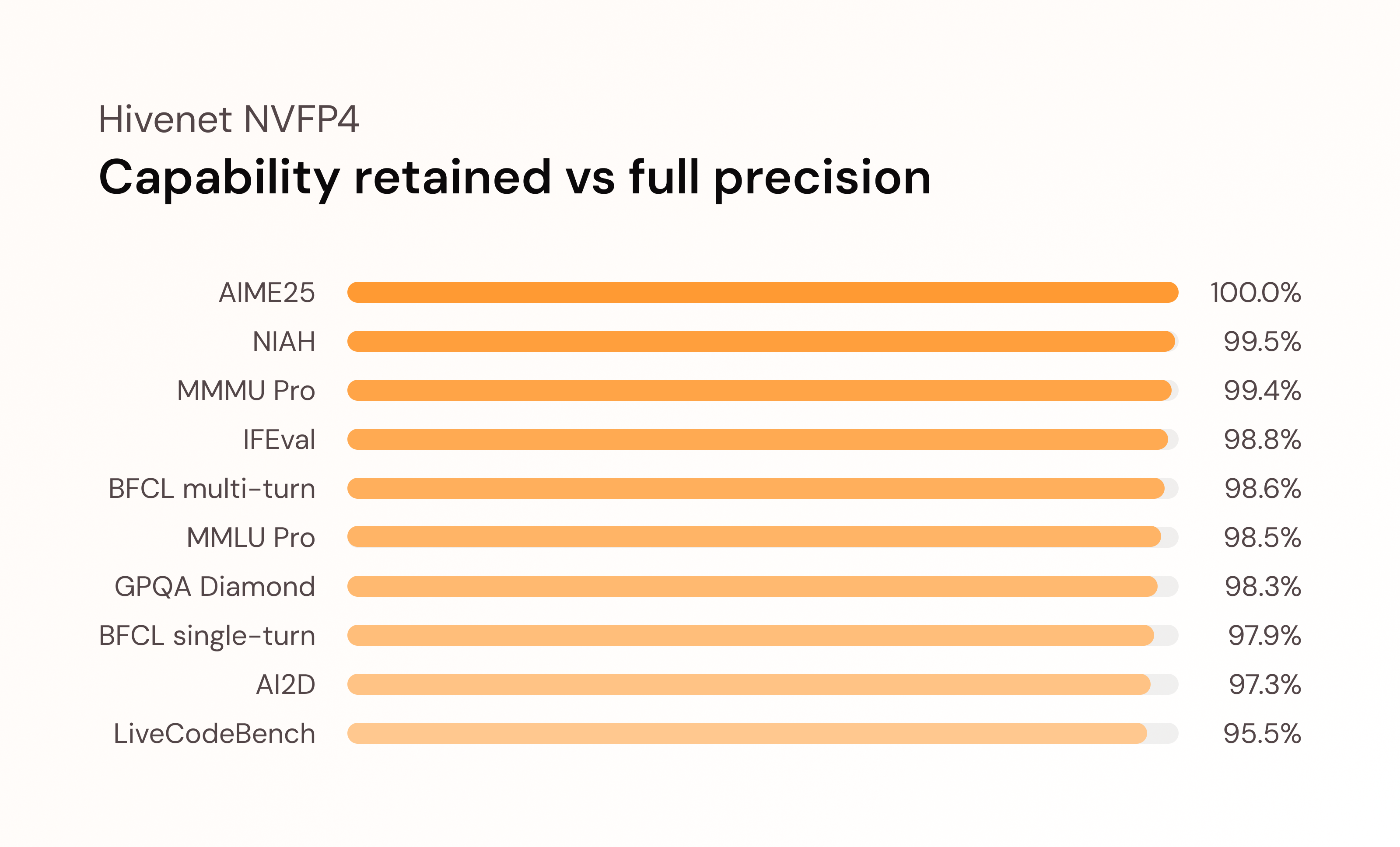
Across ten accuracy benchmarks, Hivenet's mixed-precision NVFP4 configuration retained between 95.5% and 100% of the full-precision model's capability.
The weakest result was code generation. The strongest showed no measured loss.
Those are the numbers we think buyers should see.
4-bit saves hardware. Here is the quality bill.
Quantization reduces the precision used to represent parts of a model. Fewer bits generally mean less memory, which can make a substantial difference to the infrastructure required for inference.
With Qwen3.6-27B, Hivenet's NVFP4 configuration requires half the hardware of full precision.
But “4-bit” alone tells you surprisingly little about the model you end up running.
How the model is quantized matters. Different layers respond differently to reduced precision, and treating every part of a model the same can trade away capability that was worth keeping.
Our configuration uses mixed precision. A sensitivity search determines where 4-bit NVFP4 can be used and where more accuracy-sensitive parts of the model should stay protected at higher precision.
NVFP4 itself is a 4-bit floating-point format supported on NVIDIA Blackwell hardware. If you want the deeper technical explanation, our guide to NVFP4 on Blackwell covers the format and why mixed precision matters.
For a buyer, the result is easier to read:
half the hardware, with a measured quality cost rather than an unspecified one.
The weakest result is 95.5%, not “about 99%”
There is a tempting way to market these results.
Average everything together, round generously, and say that 4-bit retains roughly 99% of model quality.
We do not think that is useful.
The benchmark spread matters because workloads are different.
On AIME25, the measured result was unchanged from full precision. NIAH and MMMU Pro retained more than 99%. MMLU Pro and GPQA Diamond were above 98%. AI2D retained 97.3%.
Then there is LiveCodeBench.
On that code-generation benchmark, capability retained fell to 95.5%, the weakest result in the suite.
If your application depends heavily on difficult code generation, that number deserves more attention than an average across unrelated tests.
If you are building a RAG system, document workflow, agent, multimodal application, or another production service, a different part of the benchmark spread may be more relevant.
That is why there is no single honest answer to “how much quality does 4-bit lose?”
For this configuration, the answer is: between no measured loss and a 4.5% relative capability loss across the accuracy benchmarks we ran.
You can see where.
What the benchmark covers
We tested the NVFP4 configuration against full precision on the same setup using the same seeds.
The suite spans several kinds of model behavior rather than relying on one headline benchmark:
AreaExamples in the benchmarkReasoning and knowledgeAIME25, MMLU Pro, GPQA DiamondLong-context retrievalNIAHInstruction followingIFEvalTool useBFCL single-turn and multi-turnMultimodal understandingMMMU Pro, AI2DCode generationLiveCodeBench
That breadth matters because quantization does not necessarily affect every capability equally.
A configuration that looks excellent on general knowledge can still lose more ground on coding. A model that holds up on short-form reasoning may behave differently with tools or long context.
Benchmarks cannot tell you whether a model will pass your production acceptance tests. They can show where to look.
For teams comparing models or serving configurations, our guide to reading LLM inference benchmarks explains why model quality, latency, throughput, concurrency, and cost need to be evaluated together.
This is where mixed precision earns its keep
There are two crude ways to approach inference optimization.
Keep everything at high precision and accept the hardware cost. Or reduce precision everywhere and hope the model survives the compression.
Mixed precision gives you another option.
Instead of asking whether Qwen3.6-27B should be “full precision” or “4-bit,” the useful question is which parts of the model actually need the extra precision.
Hivenet's quantization process uses layer sensitivity to make that decision.
That allows the larger 4-bit saving to be taken where the model tolerates it while protecting parts that are more sensitive to the reduction.
It is one reason the phrase “4-bit model” should not be treated as a complete specification.
Two providers can serve the same Qwen3.6-27B base model, both describe their version as quantized, and still be running meaningfully different configurations underneath.
The precision choice is part of the product.
So is knowing what that choice did.
The real trade is quality for efficiency, not quality for its own sake
A 95.5% result would be difficult to judge in isolation.
The other half of the comparison is what Hivenet gets in return.
The NVFP4 configuration needs half the hardware required by full precision for this model.
That changes the economics of serving it. Fewer resources are needed just to keep the model available before traffic volume, batching, throughput, and utilization enter the calculation.
Would we accept a 4.5% benchmark loss for no practical benefit? No.
Would we evaluate that trade in return for cutting the underlying hardware requirement in half? Absolutely.
And the answer can still be no for a particular workload.
If a coding application needs every point LiveCodeBench can preserve, higher precision may be the better choice. If the production acceptance threshold is comfortably below the measured NVFP4 result, paying for twice the hardware may buy capability the application does not need.
The right decision comes from putting the two numbers beside each other.
What does the optimization save, and what does it cost?
For Qwen3.6-27B on Hivenet, both sides are measurable.
You do not have to take our word for the configuration
There is another part of this work that matters to teams evaluating production AI: the model is inspectable.
The HivenetQuant Qwen3.6-27B NVFP4 model publishes the weights and the quantization recipe rather than reducing the implementation to a product label.
The public serving build is a faithful rebuild from the same quantization search plan used for the benchmark checkpoint rather than a byte-for-byte copy of that checkpoint. We make that distinction explicit because reproducibility should describe what can actually be reproduced.
You can inspect how the model was quantized, see which precision choices were made, and evaluate the result against your own workload.
That is particularly useful with open-weight models. The ability to access the model gives teams an opportunity proprietary APIs rarely offer: test the exact serving trade-offs rather than accepting a provider's summary of them.
If you would rather deploy the model yourself, our guide to running Qwen3.6-27B with vLLM covers the self-managed path.
A benchmark should help you decide, not remove the decision
There is no universal threshold where quantization becomes “good enough.”
A customer-support system, coding agent, document extractor, research assistant, and multimodal workflow do not place the same value on the same model capabilities.
That is why the 95.5% figure is useful.
It shows the bottom of the measured range rather than hiding it. You can then decide whether that trade belongs inside your application's quality budget.
For many production workloads, using half the hardware while retaining at least 95.5% of base capability across this benchmark suite is a compelling starting point.
For some, it will not be enough.
Either answer is better than choosing a serving configuration without knowing what its efficiency cost.
Hivenet's approach is to make that trade visible, then let the workload decide.
Inspect the HivenetQuant model and weights, or talk to our team about the quality, throughput, region, and cost targets your production workload needs to hit.
Your next workload belongs on Hivenet.
Pick one AI, compute, or storage workload and see the difference for yourself. Spin it up in minutes, or let our team map your fastest path to production.