
Sign in to Hivenet
Access your files and manage your storage account.
Store
Access your files and manage your storage account.
Compute
Launch instances and manage your compute resources.
Store and Compute still use separate accounts today. We’re working on a unified sign-in.
Just need to send a file?
Use Send directlyNew to Hivenet? Get Started
Get started with Hivenet
Choose what you want to use first.
Store
Back up photos and files across your devices.
Compute
Launch self-serve GPU compute for demanding work.
Store and Compute still use separate accounts today. We’re working on a unified account experience.
Need Hivenet for business?
Talk to salesNeed to send a file?
Open SendAlready have an account? Sign in

Which frontier-model calls can a 27B model handle for less?
The most expensive LLM routing strategy is also one of the simplest:
Send every request to your best model.
It works. It is easy to build. And once usage reaches production scale, it can leave you paying frontier-model prices for work that never needed frontier capability.
A difficult coding problem may justify the strongest model you can access.
Extracting six fields from an invoice may not.
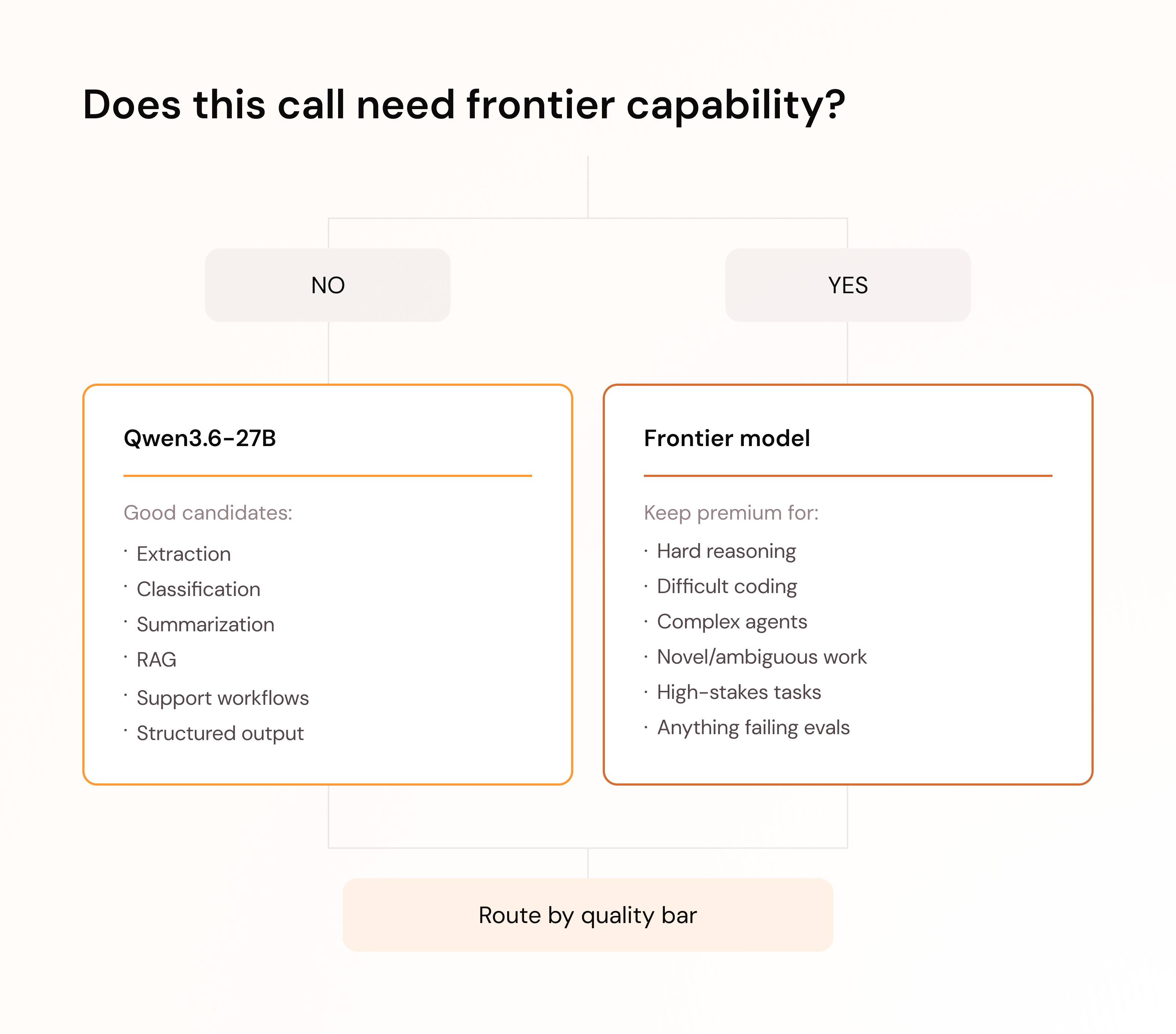
The same goes for classification, routine summarization, document questions, RAG, support automation, and many structured workflows. What matters is whether a less expensive model clears the quality bar for that particular job.
That creates another way to reduce AI costs.
Do not ask which single model should run everything.
Ask which calls actually need the expensive one.
Frontier models are better at hard things. That is why they cost more.
There is no useful argument that a 27B open-weight model is simply equal to today's best frontier systems.
It is not.
OpenAI positions GPT-5.6 Sol for complex professional work, advanced coding, reasoning, science, and agentic tasks.
Claude Sonnet 5 is designed for coding, agents, computer use, and demanding professional workflows.
Gemini 3.6 Flash combines advanced reasoning, coding, multimodal work, and long-context capabilities at a lower-cost Flash tier.
Those models earn their place when a request needs what they can do.
The mistake is assuming that every request does.
A 27B model already clears a surprisingly high bar
Qwen3.6-27B is a dense 27B multimodal model rather than a tiny classifier dressed up as an LLM.
Qwen's published evaluation reports include:
BenchmarkQwen3.6-27BMMLU-Pro86.2%GPQA Diamond87.8%LiveCodeBench v683.9%MMMU-Pro75.8%SWE-bench Pro53.5%
Those figures do not put Qwen3.6-27B at the top of every leaderboard.
For perspective, OpenAI currently reports GPT-5.6 Sol at 94.6% on GPQA Diamond, 83.0% on MMMU-Pro, and 64.6% on SWE-bench Pro.
Google reports 58.7% on SWE-bench Pro for Gemini 3.6 Flash.
Different vendors use their own evaluation setups, so these figures should not be treated as one independent head-to-head benchmark.
They do show the shape of the decision.
The gap is real. It is also workload-dependent.
If your production task needs the extra points, pay for them.
If it does not, those points are an expensive thing to buy millions of times.
Hivenet keeps most of the base model while reducing the infrastructure underneath it
There is another layer to this comparison.
Hivenet does not serve Qwen3.6-27B at full precision.
Our mixed-precision NVFP4 configuration is designed to reduce the hardware needed for inference while protecting more accuracy-sensitive parts of the model at higher precision.
In our benchmark suite, the quantized configuration retained between 95.5% and 100% of full-precision capability across the ten reported accuracy evaluations.
On GPQA Diamond, capability retained was 98.3%.
On MMMU-Pro, it was 99.4%.
The weakest result was LiveCodeBench, at 95.5%.
Our benchmark-by-benchmark look at 4-bit quality shows the full spread.
The same configuration requires half the hardware of full precision.
That combination is what makes a 27B endpoint commercially interesting: enough capability for a broad class of production work, running on an infrastructure footprint designed around efficiency.
Start with the calls that are easiest to evaluate
The safest workloads to move away from a frontier model are usually the ones where success can be defined clearly.
Structured extraction
If the job is to pull a customer name, invoice number, date, total, currency, and six line items from a document, you can build an evaluation set and measure whether the model gets them right.
You do not need to debate whether one model “feels smarter.”
You need an extraction accuracy threshold.
If Qwen clears it, routing every document through a more expensive frontier model is difficult to justify.
Hivenet already positions Qwen endpoints for production extraction and document automation, which are strong candidates precisely because their outputs can be tested.
Classification and routing
Classification tasks often have bounded outputs:
- category
- priority
- department
- sentiment
- moderation label
- intent
- next workflow
These are good places to evaluate a 27B model.
A frontier model may score higher in a general reasoning benchmark while producing no meaningful improvement on your ten-label routing task.
Your own confusion matrix matters more.
RAG and document Q&A
In a well-designed RAG system, much of the knowledge comes from the retrieved context rather than the model's parametric memory.
The model still needs enough reasoning and instruction-following ability to use that context correctly.
It may not need frontier-level capability on every request.
RAG is therefore a natural workload for tiered routing: use an efficient model for questions it handles reliably and escalate harder cases when the evidence or reasoning demands it.
Routine summarization
Summarization can become surprisingly expensive because it consumes large input volumes.
Meeting transcripts.
Support conversations.
Reports.
Documents.
Search results.
Research material.
If the required output is a consistent summary rather than a highly nuanced piece of analysis, a capable open-weight model deserves an evaluation before those input tokens are sent to a premium API indefinitely.
Support and internal workflows
A support assistant grounded in company documentation, an internal knowledge tool, or a workflow that turns natural-language requests into structured actions may operate within a relatively constrained domain.
Those constraints can work in your favor.
The narrower the task, the easier it becomes to define what good performance looks like and test whether a less expensive model achieves it.
Keep frontier models for the requests that fail the test
Model routing should not become another form of cost cutting where quality is somebody else's problem.
Some calls belong on frontier models.
Hard reasoning is an obvious example.
So is difficult coding, especially when the model has to understand a large codebase, plan a complex change, use tools over many steps, and recover from errors.
Novel problems with no clear evaluation history deserve more caution.
So do high-stakes tasks where a small quality improvement has material value.
And if your own evaluation shows Qwen fails too often on a workload, the decision is already made.
Use the better model.
A sensible routing system does not try to make the cheaper model win every request.
It gives the expensive model fewer easy ones.
The price difference becomes large at production volume
This is where the routing decision stops being theoretical.
Take an illustrative workload of 1 billion tokens per month, with three input tokens for every output token.
At current standard uncached API prices:
- GPT-5.6 Luna comes to about $2,250
- Gemini 3.6 Flash comes to about $3,000
- GPT-5.6 Terra comes to about $5,625
- Claude Sonnet 5's standard rate comes to about $6,000
- GPT-5.6 Sol comes to about $11,250
A Hivenet medium dedicated endpoint for Qwen-class workloads currently starts at €2.10/hour.
Running continuously for a 730-hour month gives a starting infrastructure cost of €1,533.
At the August 19 exchange rate, that is roughly $1,779.
There is an important condition: one replica must actually be able to carry the workload while meeting its latency and concurrency requirements. If it cannot, you need more capacity and the comparison changes.
Frontier APIs can also reduce effective costs through caching, batching, and other pricing tiers.
So this is not a universal savings calculator.
It shows why the routing decision deserves one.
At production volume, the premium attached to model choice can become thousands of dollars every month.
The best cost optimization may be a model hierarchy
The natural architecture is not necessarily:
FRONTIER MODEL
      ↓
EVERYTHING
It can be:
                 REQUEST
                    │
                    ▼
             CAN QWEN HANDLE IT?
                /          \
              YES          NO
               │            │
               ▼            ▼
          QWEN3.6-27B    FRONTIER MODEL
               │            │
          lower-cost     premium capability
          capacity       where it matters
That hierarchy can be as simple or sophisticated as the workload demands.
Some teams can route by endpoint or application.
Others can route by prompt type.
More mature systems may evaluate confidence, complexity, customer tier, latency requirements, or previous failures before choosing a model.
The principle stays the same.
Model capability should follow task difficulty.
Your most expensive model should have to earn the request.
This is also a cleaner way to migrate from an expensive API
Teams with large frontier-model bills sometimes treat migration as an all-or-nothing project.
That creates unnecessary risk.
You do not have to replace the existing API.
Start with one workload.
Build a representative evaluation set.
Run it against your current model and Qwen3.6-27B.
Measure the outputs using the acceptance criteria that matter to the application.
If Qwen clears the bar, move that traffic.
Then test the next workload.
Your frontier provider remains available for everything that does not move.
This approach makes AI cost optimization incremental rather than ideological.
It also creates something valuable that most teams should have anyway: a clearer picture of which model capabilities their applications actually depend on.
Dedicated capacity changes the economics once enough traffic moves
Routing more calls to a 27B model also changes how you should buy that inference.
For sporadic workloads, paying per token can still be the sensible choice.
As volume becomes steady, dedicated inference starts competing with token-metered APIs.
And a dedicated endpoint is different from simply renting a GPU. Hivenet operates the serving layer, including the runtime, router, gateway, replicas, observability, and endpoint, while your application uses an OpenAI-compatible API. We explain that distinction in what a dedicated Qwen endpoint actually buys.
That gives teams a practical migration path:
frontier API → evaluate workload → route suitable calls → consolidate steady traffic onto dedicated capacity.
No rewrite of the entire AI stack is required before the first savings appear.
Stop paying for capability the request does not use
Frontier models are extraordinary tools.
That is a bad reason to use one for everything.
The model that performs best on the hardest benchmark can still be the wrong economic choice for a production task whose outputs are narrow, repeatable, and easy to evaluate.
A capable 27B model does not need to beat the frontier everywhere.
It needs to beat your acceptance threshold on the calls you give it.
When it does, the economics can change considerably.
Keep frontier models for the work where their additional capability earns its price.
Move the rest to infrastructure built to run the model you actually need.
Explore Hivenet Inference API, or talk to our team with a sample workload, current model, token volume, latency target, and quality threshold. The fastest way to find the savings is to test which calls do not need the premium in the first place.
Your next workload belongs on Hivenet.
Pick one AI, compute, or storage workload and see the difference for yourself. Spin it up in minutes, or let our team map your fastest path to production.