

Sign in to Hivenet
Access your files and manage your storage account.
Store
Access your files and manage your storage account.
Compute
Launch instances and manage your compute resources.
Store and Compute still use separate accounts today. We’re working on a unified sign-in.
Just need to send a file?
Use Send directlyNew to Hivenet? Get Started
Get started with Hivenet
Choose what you want to use first.
Store
Back up photos and files across your devices.
Compute
Launch self-serve GPU compute for demanding work.
Store and Compute still use separate accounts today. We’re working on a unified account experience.
Need Hivenet for business?
Talk to salesNeed to send a file?
Open SendAlready have an account? Sign in
Pay per token or reserve the model?
The easiest way to buy AI inference is also the easiest way to understand it:
Send tokens. Pay for tokens.
That model works extremely well when usage is small, uncertain, or intermittent. You do not have to care how much infrastructure is sitting behind the API, and you do not pay for capacity while your application is quiet.
But production workloads change the equation.
Once an application is sending requests throughout the day, a token meter stops protecting you from unused infrastructure and starts charging you for every additional unit of work.
At that point, another pricing model becomes worth comparing: dedicated inference capacity.
Instead of paying for each token, you pay for a running endpoint and use the capacity available to it.
Neither model is automatically cheaper.
The better one depends on how your workload behaves.
Pay per token when uncertainty is still your biggest cost
Per-token APIs are popular for good reasons.
Providers such as OVHcloud and SiliconFlow publish input and output prices for models such as Qwen3.6-27B. Your bill rises or falls with consumption.
That makes the model particularly attractive when you are:
- testing whether an AI feature will work
- building a prototype
- running an application with irregular traffic
- serving a small number of requests
- unsure which model you will keep
- expecting long periods with little or no usage
The main advantage is not necessarily the lowest possible unit cost.
It is low commitment.
If nobody calls the model tonight, you are not paying for a replica waiting for them.
For an early-stage workload, that can matter far more than squeezing the last few percent out of inference economics.
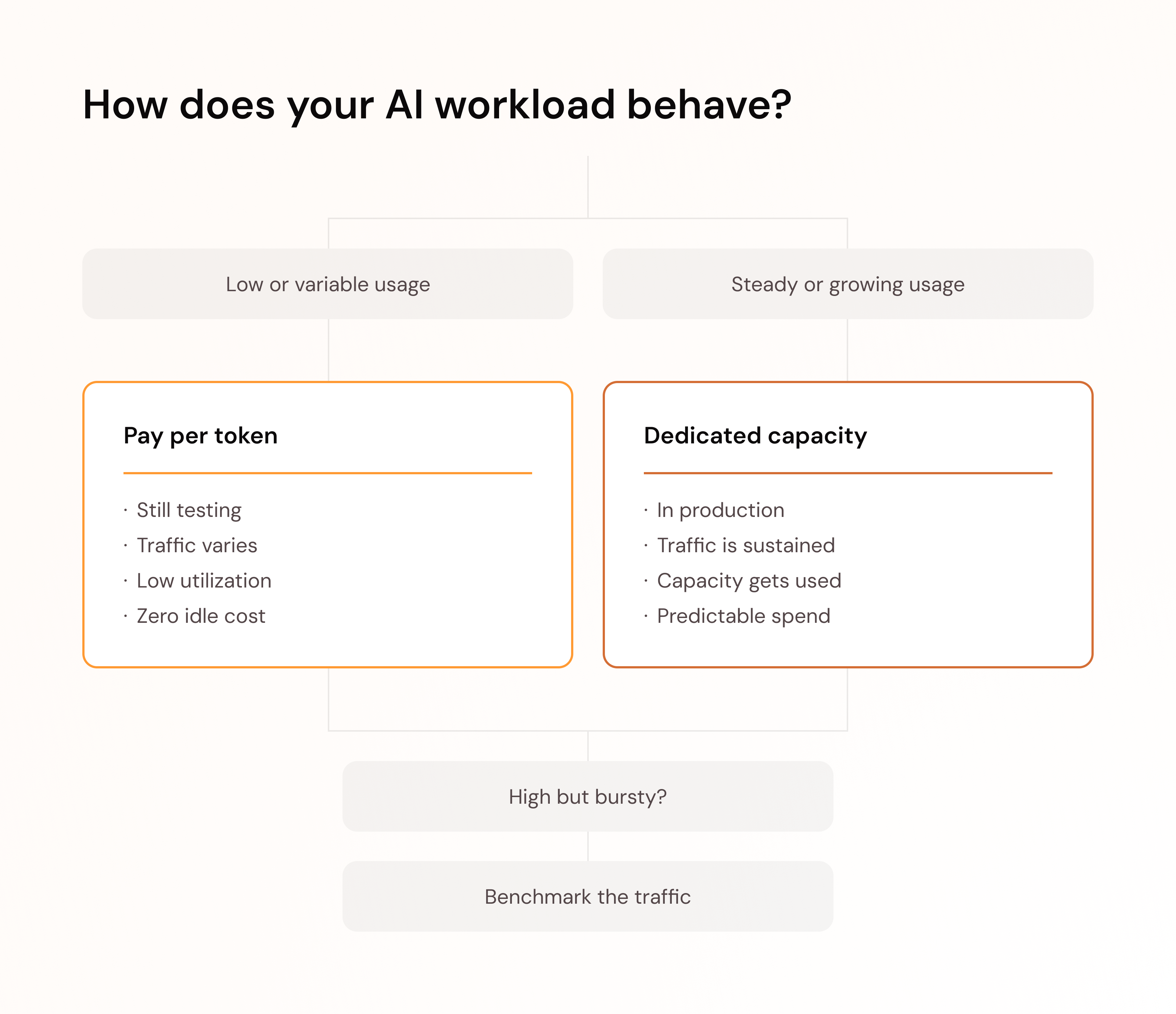
Dedicated capacity starts making sense when the experiment becomes a system
Now imagine the application six months later.
It has users. Requests arrive every day. The model choice has stabilized. Your team knows roughly how much traffic it serves, what latency users expect, and what the monthly API bill looks like.
The risk has changed.
Unused capacity matters less because the capacity is being used.
Instead, the token meter itself starts becoming the variable.
That is the workload Hivenet’s Inference API is designed around.
Hivenet uses per-replica pricing billed by the second for dedicated endpoints. There is no token meter on the dedicated endpoint path. Pricing depends on the model tier and replica setup, with medium endpoints for Qwen-class workloads currently starting at €2.10 an hour.
At that starting rate, a replica running continuously for a 730-hour month works out to about €1,533.
Whether that is cheaper than a token API depends on how much work you put through it.
But once the capacity is already paid for, another million tokens does not create another million-token line item.
That is the economic difference.
Think about utilization, not token volume alone
A large monthly token number can make dedicated inference look attractive.
It is not enough by itself.
Consider two applications that each generate one billion tokens a month.
The first runs steadily, all day, every day.
The second is almost idle for three weeks and then processes most of the month's traffic during a few enormous batch jobs.
Same token count. Completely different infrastructure problem.
Dedicated endpoints work best when your workload can use the capacity consistently enough to justify having it available.
That depends on several things:
QuestionWhy it mattersIs traffic steady or highly bursty?Steady demand makes dedicated capacity easier to use efficientlyHow much of the bill is output?Output tokens are often priced substantially higher than input tokens on metered APIsWhat concurrency do you need?Concurrent demand determines how much serving capacity is requiredHow long are your prompts?Context affects memory use and serving behaviorWhat latency do users expect?Tighter latency targets can require more capacityCan one replica carry the workload?Dedicated economics change if several replicas are neededDoes the endpoint need to stay in one region?Regional placement can be part of the infrastructure decision
This is why a good inference cost comparison starts with workload data rather than a pricing page.
Output-heavy applications should look at this sooner
Token pricing often charges very different rates for reading and generating text.
Take the European Qwen3.6-27B example we examined in our comparison of Hivenet and OVHcloud inference pricing.
OVHcloud currently charges €0.40 per million input tokens and €2.70 per million output tokens for Qwen3.6-27B.
That is a large difference.
A document-processing system that reads lengthy inputs and returns a few structured fields will therefore have different economics from a conversational application that generates long answers.
As output grows, so does the effective blended token rate.
Dedicated capacity does not distinguish between an input token and an output token on the bill. The cost follows the replica and its runtime instead.
For generation-heavy production workloads, that difference can become important surprisingly quickly.
There is a point where the meter stops helping you
In the same European comparison, we used a workload with three input tokens for every output token.
At OVHcloud's published rates, that creates a blended price of €0.975 per million tokens.
Against a Hivenet medium endpoint at €2.10/hour running continuously, the two simplified cost curves meet at roughly 1.57 billion tokens per month, assuming one Hivenet replica can carry the workload.
Below that level, the token-metered option costs less in the example.
Above it, the dedicated replica starts costing less.
That number is not a universal threshold. Change the token mix, replica requirement, traffic shape, or provider and it moves.
Its usefulness is in showing what happens when utilization rises.
A token API starts near zero and gets progressively more expensive as you consume it.
A dedicated endpoint starts with a capacity cost and becomes progressively more economical as you use more of what you already bought.
The question is where your workload sits on those two curves.
Predictability has value too
Cost optimization is only part of the decision.
Production teams also have to budget.
A token-metered bill can change with request volume, prompt length, model behavior, user growth, and the amount of text generated. A successful product can therefore produce an unusually awkward outcome: the better adoption gets, the less predictable the infrastructure bill becomes.
Dedicated capacity changes that relationship.
You know what replica capacity is running and what it costs while it runs.
That can make forecasting easier for teams that already understand their production demand.
It also makes performance planning more concrete. Instead of treating the underlying infrastructure as an abstraction, you can size replicas against throughput, concurrency, latency, and availability requirements.
For businesses already spending meaningful amounts on AI APIs, predictability can be as useful as a lower theoretical unit price.
Dedicated should also mean dedicated
There is another reason to look beyond the billing unit.
A dedicated endpoint is a different product from a shared token API.
With Hivenet Inference API, the endpoint has dedicated replica capacity, a single-tenant routing path, and a selected deployment region. Hivenet operates the router, gateway, runtime, replicas, observability, and endpoint layer while the application connects through an OpenAI-compatible API.
That means teams can get infrastructure-level predictability without taking on the serving stack themselves.
For workloads with regional requirements, the endpoint can also be pinned to an available deployment path in France, the UAE, or the US.
Those characteristics may not matter during experimentation.
They tend to matter more once an AI feature has customers, internal dependencies, security reviews, budgets, and uptime expectations attached to it.
Efficient models improve dedicated economics
Dedicated pricing only works well if the infrastructure underneath it is used efficiently.
This is where Hivenet's Qwen3.6-27B work matters.
Our NVFP4 serving configuration needs half the hardware required by full precision.
Across the reported accuracy benchmarks, it retains between 95.5% and 100% of full-precision capability.
And because different Qwen providers make different serving choices, the model name by itself does not tell you how efficiently the endpoint underneath it is configured.
That matters because dedicated inference puts the infrastructure economics closer to the buyer.
If the model can run efficiently on less hardware while still clearing the required quality bar, the capacity you reserve becomes easier to justify.
Five questions will usually tell you which way to go
If you are deciding between a token-metered API and dedicated inference, start here.
1. Is the workload already in production?
If you are still experimenting, the flexibility of per-token pricing is difficult to beat.
2. Does meaningful traffic arrive every day?
The more consistently the endpoint is used, the stronger the case for paying for capacity instead of individual tokens.
3. Is your monthly API bill becoming material?
Once inference is a real operating expense, model and infrastructure efficiency deserve the same scrutiny as any other production cost.
4. Do you know your latency, concurrency, and regional requirements?
Those requirements make it possible to size dedicated capacity intelligently.
5. Would a predictable capacity bill help more than a zero-idle-cost model?
That is often the deciding question.
If most answers point toward uncertainty, stay flexible.
If they point toward a stable production system, price the capacity.
Pay for the uncertainty you actually have
Per-token pricing transfers utilization risk to the provider.
That is valuable when your workload is unpredictable.
Dedicated pricing transfers more of the utilization decision back to you.
That becomes valuable when the workload is predictable enough to use the capacity well.
So the goal is not to graduate from one pricing model to another because one sounds more serious.
It is to stop paying a premium for flexibility once you no longer need as much of it.
For a new AI feature, that may take months.
For a high-volume document workflow, RAG system, internal assistant, or production automation service, you may already be there.
Explore Hivenet Inference API to see dedicated endpoint pricing and deployment options, or talk to our team with your current API usage, traffic shape, latency target, region, and quality requirements. We can help you work out which side of the equation your workload is actually on.
Your next workload belongs on Hivenet.
Pick one AI, compute, or storage workload and see the difference for yourself. Spin it up in minutes, or let our team map your fastest path to production.