
Sign in to Hivenet
Access your files and manage your storage account.
Store
Access your files and manage your storage account.
Compute
Launch instances and manage your compute resources.
Store and Compute still use separate accounts today. We’re working on a unified sign-in.
Just need to send a file?
Use Send directlyNew to Hivenet? Get Started
Get started with Hivenet
Choose what you want to use first.
Store
Back up photos and files across your devices.
Compute
Launch self-serve GPU compute for demanding work.
Store and Compute still use separate accounts today. We’re working on a unified account experience.
Need Hivenet for business?
Talk to salesNeed to send a file?
Open SendAlready have an account? Sign in
A clean European price comparison for Qwen3.6-27B
AI inference pricing looks simple until two providers charge for the same model in completely different ways.
Take Qwen3.6-27B.
OVHcloud's Qwen3.6-27B endpoint charges €0.40 per million input tokens and €2.70 per million output tokens.
Hivenet Inference API takes a different approach for production workloads. Dedicated endpoints are priced per replica and billed by the second. A medium endpoint for Qwen-class workloads currently starts at €2.10 per hour.
One price grows with every token.
The other buys dedicated model capacity for as long as you run it.
That means there is no useful answer to “which one is cheaper?” without first answering another question:
How much inference are you actually running?
At low volume, paying per token makes sense
Start with a workload that generates 500 million tokens a month.
To make the comparison concrete, assume three input tokens for every output token. That gives OVHcloud's published Qwen3.6-27B prices a blended cost of €0.975 per million tokens.
At 500 million tokens, that works out to:
€487.50 per month.
A Hivenet medium endpoint running continuously at its current €2.10/hour starting price would cost about:
€1,533 for a 730-hour month.
At this usage level, the conclusion is straightforward.
If all you care about is token cost and your traffic works well with a shared per-token API, dedicated capacity is difficult to justify on price alone.
That is exactly what per-token pricing is good at.
You consume what you need. Your cost follows your usage. For development, pilots, intermittent applications, and lower-volume services, that simplicity is valuable.
Then the curves start moving in different directions
Now increase the volume.
At 1 billion tokens per month, the same OVHcloud workload costs about €975.
At 1.5 billion, it reaches roughly €1,462.50.
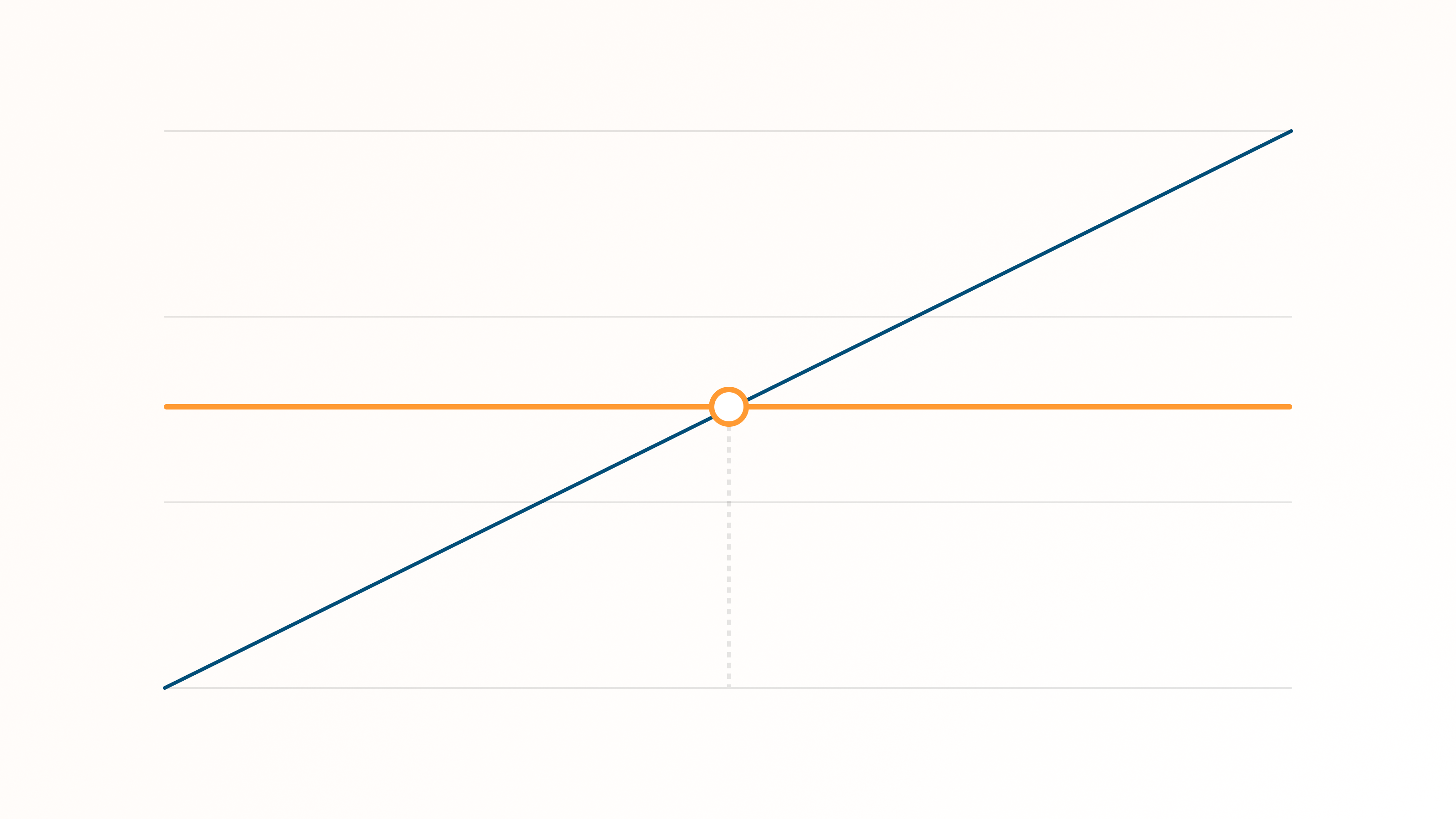
At around 1.57 billion tokens, it reaches approximately the monthly cost of a Hivenet medium endpoint running continuously at the published starting rate.
Past that point, the economics move in the other direction, assuming one dedicated replica can support the workload.
At 2 billion tokens, the OVHcloud example reaches €1,950.
At 3 billion, it reaches €2,925.
The Hivenet replica does not become more expensive simply because more tokens pass through it. Hivenet's dedicated endpoints use per-replica pricing rather than a token meter.
That is the commercial difference between the two models.
Per-token pricing makes idle capacity somebody else's problem. Dedicated pricing lets you use the capacity you are already paying for.
.png)
The crossover is useful, but it is not a capacity promise
There is an important condition attached to that 1.57-billion-token figure.
One Hivenet replica has to be able to handle the workload.
Token volume by itself does not tell you that.
Three billion tokens spread evenly across a month create a different serving problem from three billion tokens arriving in large bursts during business hours. Long prompts behave differently from short prompts. Output-heavy workloads place different demands on the model. Latency targets and concurrency matter too.
That is why this is an economic crossover, not a promise that one endpoint can handle any workload below or above a particular token count.
Hivenet's dedicated pricing depends on model family, endpoint tier, replica setup, and deployment path. Its current public pricing lists medium endpoints for Qwen-class workloads from €2.10/hour, billed by the second.
The useful sales question is therefore not:
“How many tokens do you use?”
It is:
“How many tokens do you use, when do you use them, and what performance do you need while they are arriving?”
That is enough to turn a generic API bill into an infrastructure decision.
Output-heavy workloads reach the crossover sooner
Input and output tokens do not cost the same on OVHcloud's Qwen3.6-27B endpoint.
Its current published price is €0.40 per million input tokens and €2.70 per million output tokens.
That is why the token mix matters.
Our example uses a 3:1 input-to-output ratio. Change the workload and the economics change with it.
An application that reads long documents and produces short structured answers will lean more heavily toward the cheaper input side.
A conversational or generation-heavy application producing substantial responses will consume proportionally more output tokens and reach a higher blended cost sooner.
Dedicated capacity does not meter those two token types separately.
That can make its economics particularly interesting for workloads where output generation represents a large part of the bill.
You are also buying a different operating model
Price is only one difference between these two offers.
OVHcloud's AI Endpoints gives developers managed access to Qwen3.6-27B through an API and charges for the tokens consumed. Its current model page lists a 262K context window, multimodal support, function calling, and streaming.
Hivenet's managed inference product gives a customer dedicated endpoint capacity. Hivenet operates the router, gateway, runtime, observability, replica layer, and endpoint while exposing an OpenAI-compatible API. Endpoints can be deployed through regional paths including France, the UAE, and the US.
So the buying decision is not simply:
€0.975/M versus €2.10/hour.
It is also:
shared consumption versus dedicated capacity.
That distinction becomes more important as an AI workload moves from experimentation into something the business depends on every day.
Efficiency is what makes dedicated capacity interesting
Dedicated infrastructure has an obvious weakness.
If the model sits idle, you are still paying for the replica while it is running.
The economics improve when the capacity is used.
That is where Hivenet's work on inference efficiency matters.
Our Qwen3.6-27B serving configuration uses half the hardware required by full precision, with capability retained between 95.5% and 100% across the reported accuracy benchmarks.
We cover the hardware side in why half the hardware changes AI inference economics, and the quality side in our Qwen3.6-27B NVFP4 benchmark comparison.
The commercial point is straightforward.
Dedicated capacity becomes much easier to price competitively when the model itself can be served efficiently.
And because different Qwen3.6-27B providers make different serving choices, the model name alone does not tell you how efficiently the infrastructure underneath it is being used.
Europe gives us an unusually clean comparison
Cloud comparisons often get muddied by currencies.
One provider prices in dollars, another in euros, and a small exchange-rate movement changes whichever company happens to look cheaper that week.
Here, we can avoid that.
OVHcloud publishes euro pricing for Qwen3.6-27B on its European site: €0.40/M input and €2.70/M output.
Hivenet publishes its managed inference pricing in euros as well, with dedicated medium endpoints starting at €2.10/hour.
No currency conversion is needed.
The only thing that needs to change is the unit.
Once both models are expressed against an actual monthly workload, the trade-off becomes much easier to see.
The right price model follows the workload
There is no reason to force every AI application into the same billing model.
If your workload is small, unpredictable, or highly intermittent, a token meter can be exactly what you want.
If your model is running steadily and production volume keeps growing, paying for every additional token can eventually become the expensive way to buy infrastructure.
That is the point where dedicated capacity deserves a look.
The threshold will not be identical for every team. It changes with token mix, concurrency, latency, runtime, model configuration, and the number of replicas required.
But the principle is stable:
At low utilization, pay for consumption. At sustained utilization, start asking what the underlying capacity costs.
For Qwen3.6-27B in Europe, current public pricing makes that question concrete.
At a 3:1 input-to-output mix, OVHcloud's token meter works out to €0.975 per million tokens.
Hivenet's medium dedicated endpoint tier starts at €2.10 an hour.
For a continuously running endpoint, those two economic curves meet at roughly 1.57 billion tokens per month, if one Hivenet replica can carry the workload.
Below that point, the token meter has the lower cost in this simplified comparison.
Above it, dedicated capacity starts to change the conversation.
And once a production AI bill reaches that scale, the conversation is worth having.
Explore Hivenet Inference API or talk to our team about your token volume, traffic pattern, latency target, region, and model requirements.
Your next workload belongs on Hivenet.
Pick one AI, compute, or storage workload and see the difference for yourself. Spin it up in minutes, or let our team map your fastest path to production.