
Sign in to Hivenet
Access your files and manage your storage account.
Store
Access your files and manage your storage account.
Compute
Launch instances and manage your compute resources.
Store and Compute still use separate accounts today. We’re working on a unified sign-in.
Just need to send a file?
Use Send directlyNew to Hivenet? Get Started
Get started with Hivenet
Choose what you want to use first.
Store
Back up photos and files across your devices.
Compute
Launch self-serve GPU compute for demanding work.
Store and Compute still use separate accounts today. We’re working on a unified account experience.
Need Hivenet for business?
Talk to salesNeed to send a file?
Open SendAlready have an account? Sign in
The Qwen3.6-27B inference detail most providers still don't show
You can buy access to Qwen3.6-27B from several inference providers.
That does not mean you are buying the same thing.
The model name tells you which base model sits underneath the API. It does not necessarily tell you what precision the provider serves, what optimizations have been applied, how much context is exposed, or whether those changes affected model quality.
For a production buyer, those details matter.
They influence the hardware needed to run the model, the economics of serving it, the performance you can expect, and potentially the answers the model produces.
Yet provider pages vary considerably in how much of that serving layer they expose.
Hivenet takes a simple position: if an optimization is important enough to improve the economics of the model, its quality cost is important enough to measure.
The same base model can become a different inference product
Qwen3.6-27B is an open-weight 27B model. That gives inference providers considerably more control over how they deploy it than they would have with a closed API.
That flexibility is useful.
A provider can choose hardware, serving software, numerical precision, context limits, batching behavior, cache configuration, and other optimizations around the same base model.
Those choices are part of how providers compete.
They are also why comparing model names alone is not enough.
Look at the current public Qwen3.6-27B offerings.
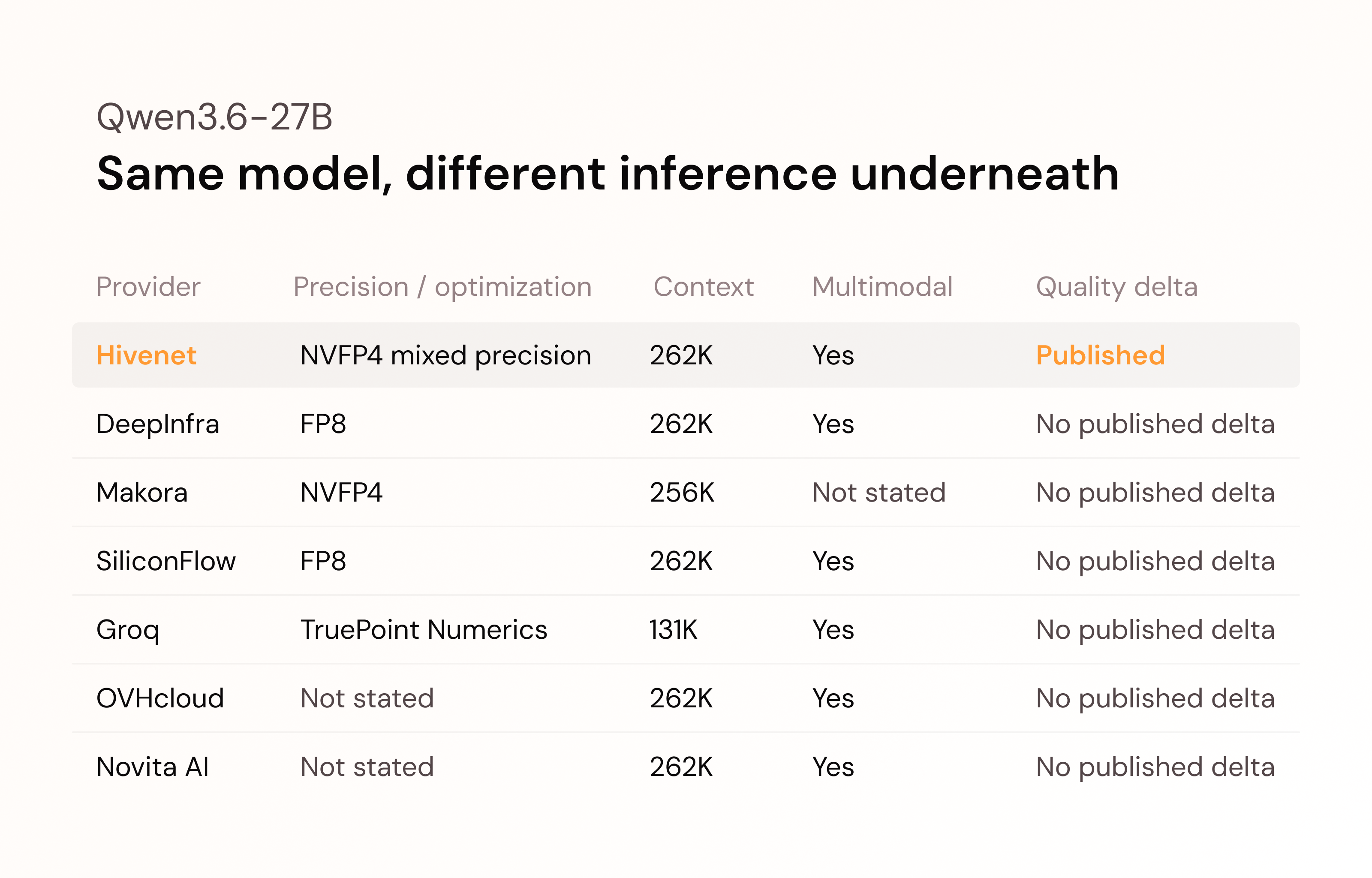
DeepInfra states that it serves the model at FP8 with a 262,144-token context window.
SiliconFlow also lists FP8 and 262K context.
Makora explicitly names its version Qwen3.6-27B-NVFP4 and lists 256K context.
Groq takes a different route, describing its proprietary TruePoint Numerics system rather than giving a conventional bit-precision label. Its Qwen3.6-27B endpoint exposes a 131K context window.
OVHcloud lists a 262K context window and multimodal support but does not state serving precision on its public model page.
Novita AI lists a 262,144-token context window and text, image, and video input, but its public Qwen3.6-27B material does not identify serving precision.
These can all be perfectly valid ways to serve the model.
They are not the same configuration.
Knowing the precision is only half the answer
Inference providers increasingly talk about quantization and numerical precision because the benefits are significant.
FP8 can reduce memory requirements relative to higher precision. 4-bit formats can reduce them further. Proprietary numerical systems can make their own trade-offs between precision and performance.
That tells a buyer what the provider changed.
It does not tell them what the change did to the model.
That second question is the more important one.
If an optimized configuration costs less to serve but also reduces accuracy on the tasks you depend on, you need both sides of the trade-off before you can judge whether it is efficient.
This is where Hivenet's approach differs.
We serve Qwen3.6-27B using NVFP4 W4A4 mixed precision, with more accuracy-sensitive parts of the model protected at higher precision.
Then we benchmark that configuration against full precision.
The result is not a generic claim that quantization is “near-lossless.” It is a set of measured deltas across different kinds of work.
Across the ten reported accuracy benchmarks, capability retained ranges from 100% to 95.5%.
The weakest result is visible.
So are the stronger ones.
Transparency turns “optimized” into something you can evaluate
“Optimized” is an easy word to put on an inference product.
The difficult part is showing what was optimized and what changed as a result.
For our Qwen3.6-27B configuration, the trade is concrete.
The model requires half the hardware of full precision at our serving precision.
On the quality side, the weakest benchmark result retains 95.5% of full-precision capability, with other reported evaluations landing between 97.3% and 100%.
That gives a buyer two numbers they can actually use:
What did the optimization save?
Half the hardware requirement.
What did the optimization cost?
Between no measured loss and a 4.5% relative capability loss across the accuracy benchmarks we ran.
The answer will not make the configuration right for every workload.
It makes the trade-off visible enough to decide.
Our NVFP4 explainer covers the underlying precision format and mixed-precision approach in more detail. The broader LLM quantization guide explains why reducing precision can change both hardware requirements and model behavior.
For an infrastructure buyer, the principle is simpler: optimization claims become much more useful when the quality bill is attached.
Context is another reason the model name is not enough
Precision is not the only serving choice hidden behind a model name.
Context is another.
The base Qwen3.6-27B model has a native context length of 262,144 tokens.
Most providers in the comparison expose roughly that window.
Groq currently exposes 131,072 tokens.
Makora writes its limit as 256K.
That does not make one endpoint universally better than another. A 131K window is already far beyond what many production workloads need, and Groq competes aggressively on inference speed.
But it does make the buying decision workload-dependent.
A coding agent that needs to keep a large repository, tools, and history in context has different requirements from a classification service processing short records.
“Supports Qwen3.6-27B” does not answer that question.
The actual endpoint specification does.
A good comparison separates “not stated” from “not supported”
There is an important discipline when comparing providers.
If a provider does not publish something, that does not mean the feature is absent.
OVHcloud may use a particular serving precision internally. Novita may use one too.
Their public Qwen3.6-27B pages simply do not state it today.
That distinction matters because competitive comparisons become untrustworthy quickly when missing information is presented as a missing capability.
The useful question is not whether every cell in a comparison can be turned into a win.
It is whether the information a buyer needs to understand the product is available.
For precision, the market is getting better. DeepInfra, SiliconFlow, and Makora all now expose useful information about how they serve Qwen3.6-27B. Groq explains its own numerical optimization system.
The next step is exposing the effect.
What does FP8 cost in model capability on that provider's configuration?
What does NVFP4 cost?
What did a proprietary numerical format change?
Those are harder numbers to produce.
They are also more useful.
This matters most when efficiency is part of the pitch
Lower precision is one of the main ways inference providers improve efficiency.
That is a legitimate advantage.
But once efficiency becomes part of the buying argument, quality needs to remain inside the same conversation.
A configuration that uses fewer resources but drops below your production quality threshold is not efficient for your workload.
A configuration that preserves capability you never need while doubling the hardware requirement may not be efficient either.
The right point sits somewhere between those extremes.
That is why Hivenet Inference API is built around testing the model against the workload rather than treating a model name as a guarantee of fit.
For a production deployment, that means looking at prompts, context, latency, throughput, region, model quality, and cost together.
The serving precision is one part of that system.
Knowing what it did to the model makes it a useful part.
Ask one more question when comparing Qwen APIs
Price is easy to compare.
Context length is usually easy to find.
Tokens per second gets plenty of attention.
When you compare Qwen3.6-27B providers, add another question:
What version of the model am I actually being served, and what did the serving optimization cost in quality?
A provider should be able to tell you how the model is being run.
Better still, it should be able to show you what those choices changed.
Hivenet publishes its Qwen3.6-27B serving precision, the quantization approach behind it, and the measured benchmark delta against full precision.
The HivenetQuant Qwen3.6-27B NVFP4 model makes the model itself inspectable as well.
That gives teams something more useful than another “optimized inference” claim.
It gives them enough information to decide whether the optimization belongs in production.
Explore Hivenet Inference API, or talk to our team about the model quality, context, region, throughput, and cost requirements behind your workload.
Your next workload belongs on Hivenet.
Pick one AI, compute, or storage workload and see the difference for yourself. Spin it up in minutes, or let our team map your fastest path to production.