
Sign in to Hivenet
Access your files and manage your storage account.
Store
Access your files and manage your storage account.
Compute
Launch instances and manage your compute resources.
Store and Compute still use separate accounts today. We’re working on a unified sign-in.
Just need to send a file?
Use Send directlyNew to Hivenet? Get Started
Get started with Hivenet
Choose what you want to use first.
Store
Back up photos and files across your devices.
Compute
Launch self-serve GPU compute for demanding work.
Store and Compute still use separate accounts today. We’re working on a unified account experience.
Need Hivenet for business?
Talk to salesNeed to send a file?
Open SendAlready have an account? Sign in
The neocloud business model explained
AI changed what cloud infrastructure has to do. The old cloud was built for web apps, storage, databases, and general compute. AI workloads need something more specific: available GPUs, predictable performance, fast provisioning, and pricing that does not punish long training runs or frequent experiments.
That is why the neocloud exists.
A neocloud is an AI-first cloud provider built around GPU compute rather than general-purpose CPU infrastructure. It gives developers, researchers, startups, schools, and enterprises access to GPUs for training, inference, rendering, simulation, and other compute-heavy workloads. If you want the broader definition first, read our guide to what a neocloud is.
The business model matters because not every neocloud works the same way. Some providers own large GPU fleets. Some lease space in colocation data centers. Some act as marketplaces. Others, like Hivenet, use a distributed GPU cloud model that connects available compute capacity through a more flexible infrastructure layer.
That difference affects price, availability, sovereignty, sustainability, and control.
Direct answer: what is a neocloud business model?
A neocloud business model is the way an AI-first cloud provider delivers GPU compute, prices access, manages capacity, and handles infrastructure risk.
Most neoclouds make money by renting GPU capacity to users on an hourly, per-second, reserved, or contract basis. The provider’s margin depends on how it sources GPUs, how much utilization it can maintain, how much power and infrastructure cost it carries, and how efficiently it matches available compute with demand.
In plain English: a neocloud turns expensive AI hardware into usable cloud access.

For Hivenet, the distributed GPU cloud model is the important one: it keeps the neocloud focus on GPU access, but adds a wider argument about cost control, regional placement, sovereignty, and better use of available infrastructure.
Why neoclouds appeared
AI exposed a gap in the cloud market. Traditional hyperscalers can provide GPUs, but they were not originally designed around GPU-first workloads. Their catalogs are broad, their billing can be layered, and GPU access can involve quota limits, wait times, long commitments, or complicated total-cost calculations.
Uptime Institute reported that at the start of 2024, hyperscalers struggled to meet GPU demand, with some GPU-backed instances exceeding $100 per hour when available. The same analysis found that renting four Nvidia H100-powered instances for a month could cost nearly $300,000.
That pressure created room for specialized providers. ABI Research forecasts GPUaaS revenue from neocloud providers to rise from US$42 billion in 2025 to more than US$250 billion by 2030.
The basic demand is simple: teams need GPU compute without buying and operating their own clusters.
The hard part is delivering that access in a way that is affordable, available, and trustworthy.
The four main neocloud business models
Most discussions stop at three models: owned infrastructure, colocation, and marketplace. That misses an important fourth model: distributed GPU cloud. This is where Hivenet’s position becomes clearer.
The difference is not cosmetic. It shapes the user experience.
A provider that owns everything may offer tighter control, but it carries heavy capital risk. A marketplace can offer low prices, but users may need to evaluate host quality carefully. A distributed GPU cloud tries to keep the flexibility of a marketplace while adding a more deliberate infrastructure and governance layer.
That is the model Hivenet is building around.
Model 1: owned infrastructure
The owned-infrastructure model is the most capital-intensive version of neocloud. The provider buys GPUs, builds or controls facilities, manages networking, hires operations teams, and sells access to the resulting capacity.
The advantage is control. Providers can tune the full stack, offer enterprise-grade deployments, and build around specific hardware generations.
The tradeoff is financial exposure. GPUs are expensive, age quickly, and must be kept busy. If utilization drops, the provider still carries depreciation, power, cooling, financing, and maintenance costs. If a newer GPU generation changes customer demand, older capacity becomes harder to price.
This model can work well for large providers with deep financing and large committed customers. It is less forgiving for smaller players or for providers trying to serve unpredictable demand.
Model 2: colocation
The colocation model reduces some facility risk. Instead of building new data centers from scratch, a neocloud provider leases space, power, cooling, and network access from established data center operators.
This can speed up expansion. It lets a provider scale GPU capacity faster than a full data center build would allow. It can also place infrastructure closer to certain regions or customers.
But colocation does not remove the core economics. The provider still needs access to GPUs, favorable power terms, strong utilization, and reliable operations. It may avoid building the building, but it does not avoid the cost of running serious AI infrastructure.
For many neoclouds, colocation is a practical middle path: less capital-heavy than owning everything, more controlled than a loose marketplace.
Model 3: marketplace
The marketplace model aggregates GPU capacity from third-party suppliers. Instead of owning the fleet, the platform acts as the coordination layer between people who have GPUs and people who need GPUs.
This is attractive because it can scale supply without the provider buying every card. It can also create lower headline prices because the platform does not carry the same hardware balance-sheet risk.
The tradeoff is consistency. GPU marketplaces need to solve trust, uptime, host quality, performance variation, security, and support. For experimental jobs, that tradeoff may be acceptable. For production inference, sensitive workloads, or long training runs, buyers need to understand exactly what kind of capacity they are renting.
A marketplace can be useful. But it is not automatically the same thing as reliable production infrastructure.
Model 4: distributed GPU cloud
The distributed GPU cloud model starts from a different assumption: useful compute capacity already exists in many places. The job is to coordinate it, verify it, price it clearly, and make it usable for real workloads.
That model fits Hivenet’s broader approach. Compute with Hivenet is built around GPU-first access, transparent pricing, and distributed design. For more detail, read how Compute with Hivenet matches the neocloud model.
The business logic is straightforward. Instead of depending only on centralized data centers or speculative marketplace capacity, distributed GPU cloud uses available infrastructure more efficiently. That can improve cost control, reduce waste, and support regional compute access.
This matters because the AI cloud problem is not only about raw performance. It is also about where compute happens, how predictable the bill is, and whether teams can keep control of their data and workloads.
How neoclouds make money
Neoclouds usually make money through one or more of these pricing models:
- Usage-based GPU rental: users pay by the second, minute, or hour for GPU instances.
- Reserved capacity: teams commit to a block of GPU access over a period of time.
- Enterprise contracts: larger customers negotiate capacity, support, compliance, or deployment terms.
- Managed services: providers add support, orchestration, inference services, storage, or private AI environments.
- Marketplace fees: the platform takes a percentage of transactions between GPU suppliers and customers.
The best model depends on the buyer. A student fine-tuning a model does not need the same contract as an enterprise running production inference. A research lab may need predictable access during a project window. A startup may need to scale up and down without buying hardware.
That is why transparent pricing matters. See our article on the economics of the neocloud for a deeper look at cost predictability and why complex billing makes AI experimentation harder.
Neocloud vs hyperscaler: what changes?
A hyperscaler sells a large cloud platform with hundreds of services. Compute, storage, databases, analytics, identity, networking, AI tools, and enterprise integrations all live inside the same platform. That can be useful for general IT.
A neocloud is narrower. It focuses on AI infrastructure, especially GPU compute.
That focus changes the buying decision. You are not choosing a whole corporate cloud estate. You are choosing where to run the workloads that need GPUs.
For AI teams, the practical differences usually show up in five areas:
- GPU availability.
- Provisioning speed.
- Pricing clarity.
- Control over hardware.
- Fit for training, inference, rendering, and simulation.
For a fuller comparison, read neocloud vs hyperscalers.
The short version: hyperscalers still make sense for many general-purpose workloads. Neoclouds make more sense when the workload is GPU-bound and the team needs more control over cost and performance.
When should you use a neocloud?
Use a neocloud when your workload depends on GPU performance and your team needs clearer economics than a traditional cloud bill usually provides.
Good fits include AI training, model fine-tuning, inference, rendering, simulation, data analysis, and GPU-heavy research. For larger workloads, our GPU cluster guide explains how multi-GPU infrastructure changes performance and cost planning.
A neocloud is not always the right answer. If you are running a small website, a basic database, or light automation, a traditional cloud provider may be simpler and cheaper. The point is not to move everything. The point is to move the workloads that benefit from GPU-first infrastructure.
For a more practical decision path, read when to use a neocloud.
The pricing problem: headline cost is not real cost
GPU pricing can be misleading. A low hourly rate is not useful if the job is interrupted, if the GPU is shared, if storage and egress fees change the real cost, or if support is unavailable when a run fails.
A useful GPU pricing comparison should separate:
- On-demand from spot pricing.
- Dedicated access from shared access.
- Headline rates from total cost.
- Transparent billing from layered billing.
- Production reliability from experimental capacity.
Our GPU pricing chart explains how to compare GPU costs without mixing incompatible service tiers.
For AI teams, this distinction matters. A failed or interrupted training run does not only waste GPU hours. It wastes human time, deadlines, and momentum.
Why sovereignty belongs in the business model
Cloud infrastructure is not neutral plumbing. It shapes who controls data, who captures value, and which regions depend on which providers.
For European teams, this is becoming more important. AI workloads may involve sensitive data, regulated sectors, research partnerships, or public institutions. In those cases, the location and governance of infrastructure matter as much as raw speed.
The European Commission has emphasized the need for more energy-efficient and sustainable data centers, and it has introduced reporting obligations and further work on rating schemes and minimum performance standards for data centers in Europe.
A distributed neocloud model can support sovereignty by making compute more region-aware and less dependent on a few centralized platforms. For more on this angle, read why the neocloud matters for Europe.
Why sustainability is part of neocloud economics
AI compute has a material footprint. Data centers used about 415 TWh of electricity in 2024, according to the IEA, and global data center electricity consumption is projected to reach around 945 TWh by 2030 in its base case.
That does not mean AI infrastructure should stop growing. It means growth needs better design.
The sustainability question is not only “which data center uses renewable energy?” It is also “how much new infrastructure do we need to build, and how much existing capacity can we use better?”
That is where distributed GPU cloud has a different argument. By coordinating existing or underused compute capacity, the model can reduce pressure to build everything from scratch. This is central to Hivenet’s approach. Read more in sustainability in the neocloud era.
What Hivenet adds to the neocloud category
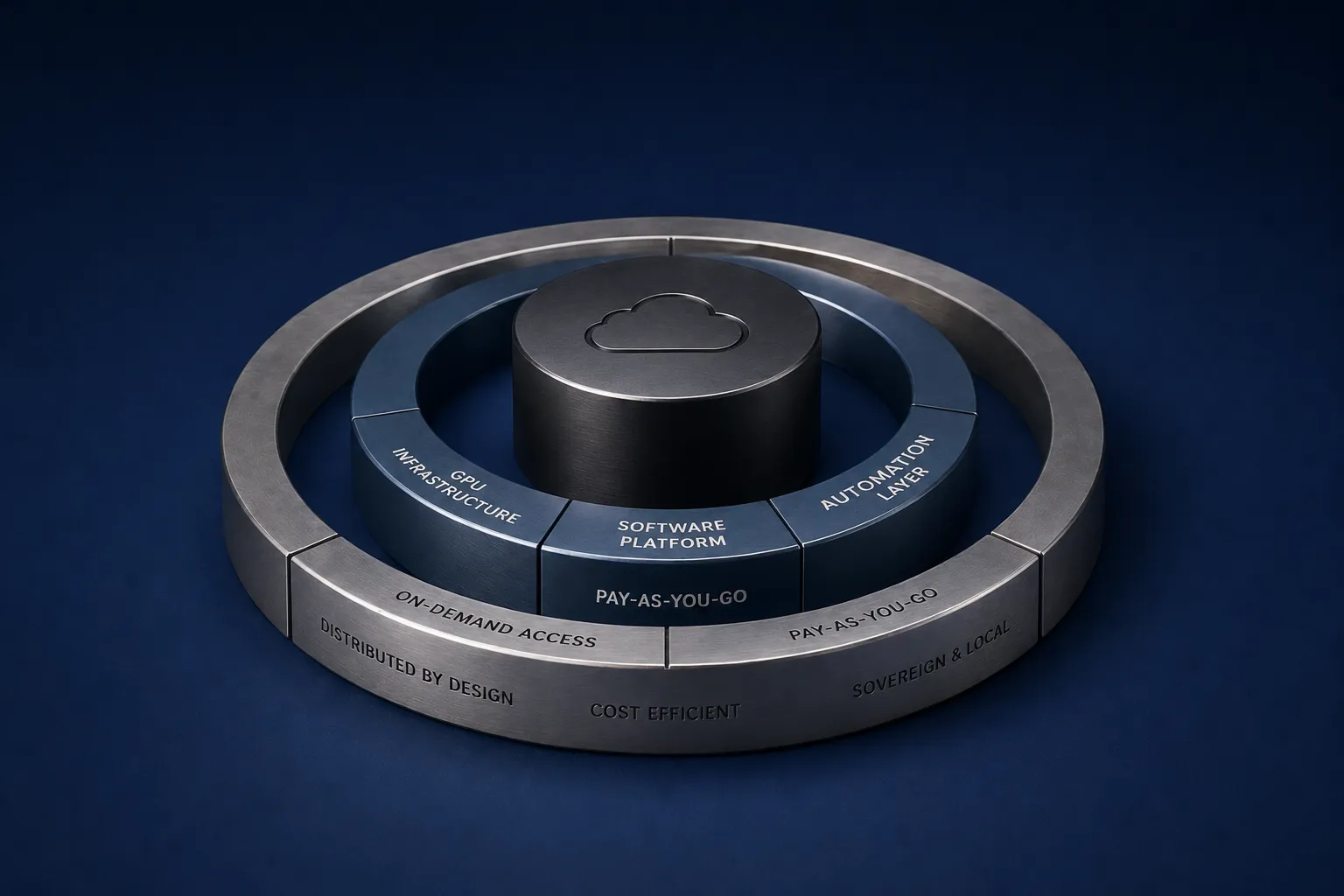
Hivenet’s neocloud model combines four ideas:
- GPU-first access for AI and high-performance workloads.
- Transparent pricing that helps teams plan real costs.
- Distributed infrastructure that avoids overdependence on centralized cloud models.
- A sovereignty and sustainability argument that matters in Europe and beyond.
This is not just a technical difference. It is a different view of what cloud infrastructure should become.
The cloud does not have to mean a handful of giant platforms selling abstracted compute from distant centralized facilities. It can be more distributed, more accountable, and closer to the people and organizations using it.
That matters for schools as much as startups. In DSTI’s GPU access story, the problem was not theoretical. Students needed reliable GPU access to move beyond small sandbox experiments and work on real AI projects.
That is the practical value of the neocloud: it turns AI infrastructure from a procurement problem into something builders can actually use.
The bottom line
The neocloud business model exists because AI workloads broke the assumptions of general-purpose cloud. Teams need GPUs, predictable costs, fast access, and infrastructure that fits training, inference, simulation, and rendering.
There are four main models: owned infrastructure, colocation, marketplace aggregation, and distributed GPU cloud.
Each model has strengths. Owned infrastructure gives control. Colocation helps scale. Marketplaces widen access. Distributed GPU cloud offers a different balance: flexible capacity, clearer pricing, regional control, and better use of existing infrastructure.
For Hivenet, that is the real opportunity. The neocloud is not only a cheaper GPU rental category. It is a chance to build AI infrastructure that is faster, clearer, more sovereign, and less wasteful.
Frequently asked questions
What is a neocloud?
A neocloud is an AI-first cloud provider built around GPU compute. It is designed for workloads such as machine learning, inference, rendering, simulation, and other tasks that need high-performance parallel processing.
What is a neocloud business model?
A neocloud business model is how a provider sources GPU capacity, sells access to users, prices compute, and manages infrastructure risk. The main models are owned infrastructure, colocation, marketplace aggregation, and distributed GPU cloud.
How do neoclouds make money?
Neoclouds usually make money by renting GPU capacity by the second, hour, reserved term, or enterprise contract. Some also earn revenue from managed services, support, storage, inference tooling, or marketplace fees.
How is a neocloud different from a hyperscaler?
A hyperscaler is a broad general-purpose cloud platform. A neocloud is narrower and more specialized. It focuses on GPU-first infrastructure for AI and high-performance workloads.
Is a neocloud cheaper than a traditional cloud?
It can be, especially for GPU-heavy workloads. But the real answer depends on total cost: GPU rate, storage, egress, access quality, interruptions, support, and utilization. Always compare the real cost of completed work, not only the headline hourly rate.
When should I use a neocloud?
Use a neocloud when your workload depends on GPU performance, when predictable pricing matters, or when you need more control over AI infrastructure. Training, fine-tuning, inference, rendering, simulation, and research workloads are common fits.
Is Hivenet a neocloud?
Yes. Hivenet fits the neocloud model through GPU-first infrastructure, transparent pricing, and distributed cloud design. Its specific contribution is a distributed approach that connects AI compute with cost control, sustainability, and sovereignty.
Your next workload belongs on Hivenet.
Pick one AI, compute, or storage workload and see the difference for yourself. Spin it up in minutes, or let our team map your fastest path to production.