

Connectez-vous à Hivenet
Accédez à vos fichiers et gérez votre compte de stockage.
Boutique
Accédez à vos fichiers et gérez votre compte de stockage.
Calculer
Lancez des instances et gérez vos ressources de calcul.
Store et Compute utilisent toujours des comptes distincts aujourd'hui. Nous travaillons sur une connexion unifiée.
Vous avez juste besoin d'envoyer un fichier ?
Utilisez Envoyer directementVous êtes nouveau sur Hivenet ? Commencez
Commencez avec Hivenet
Choisissez ce que vous voulez utiliser en premier.
Boutique
Sauvegardez des photos et des fichiers sur tous vos appareils.
Calculer
Lancez le calcul GPU en libre-service pour les tâches exigeantes.
Store et Compute utilisent toujours des comptes distincts aujourd'hui. Nous travaillons sur une expérience de compte unifiée.
Vous avez besoin de Hivenet pour votre entreprise ?
Parlez au service des ventesVous avez besoin d'envoyer un fichier ?
Ouvrir EnvoyerVous avez déjà un compte ? Connectez-vous

What €2.10 an hour buys you with a dedicated Qwen3.6-27B endpoint
Two AI infrastructure prices can both say “per hour” and still be buying completely different things.
Rent a GPU and you get compute capacity.
Buy a dedicated inference endpoint and you get a model that is already there for your application to call.
That distinction matters when comparing Hivenet's current pricing.
GPU/CPU rental with Hivenet gives you raw infrastructure and full control over the stack. RTX 5090 capacity currently starts at €0.75 per GPU-hour.
Hivenet Inference API starts medium dedicated endpoints for Qwen-class workloads at €2.10 per hour, billed by the second.
The second number is higher because it is buying a different product.
Your team is no longer renting a GPU and then turning it into an inference service.
You are buying the inference service.
A GPU is infrastructure. An endpoint is something your application can use.
Suppose your team wants to run Qwen3.6-27B in production.
One route is to rent GPU capacity.
That gives you the freedom to build exactly the environment you want. You can choose the model checkpoint, serving engine, container, quantization, context settings, networking, monitoring, and everything else around it.
For technical teams that want that control, it is a good option.
It also means the work belongs to you.
You need to deploy the model.
You need a serving runtime. vLLM, for example, can expose models through an OpenAI-compatible server, but somebody still has to install it, configure it, update it, and keep it healthy.
Then you need to think about the rest of the production path: routing, authentication, replicas, monitoring, failures, metrics, and the endpoint your application actually calls.
A dedicated managed endpoint moves that boundary.
Hivenet operates the serving layer. Your application talks to the API.
That is what the hourly price needs to be compared against.
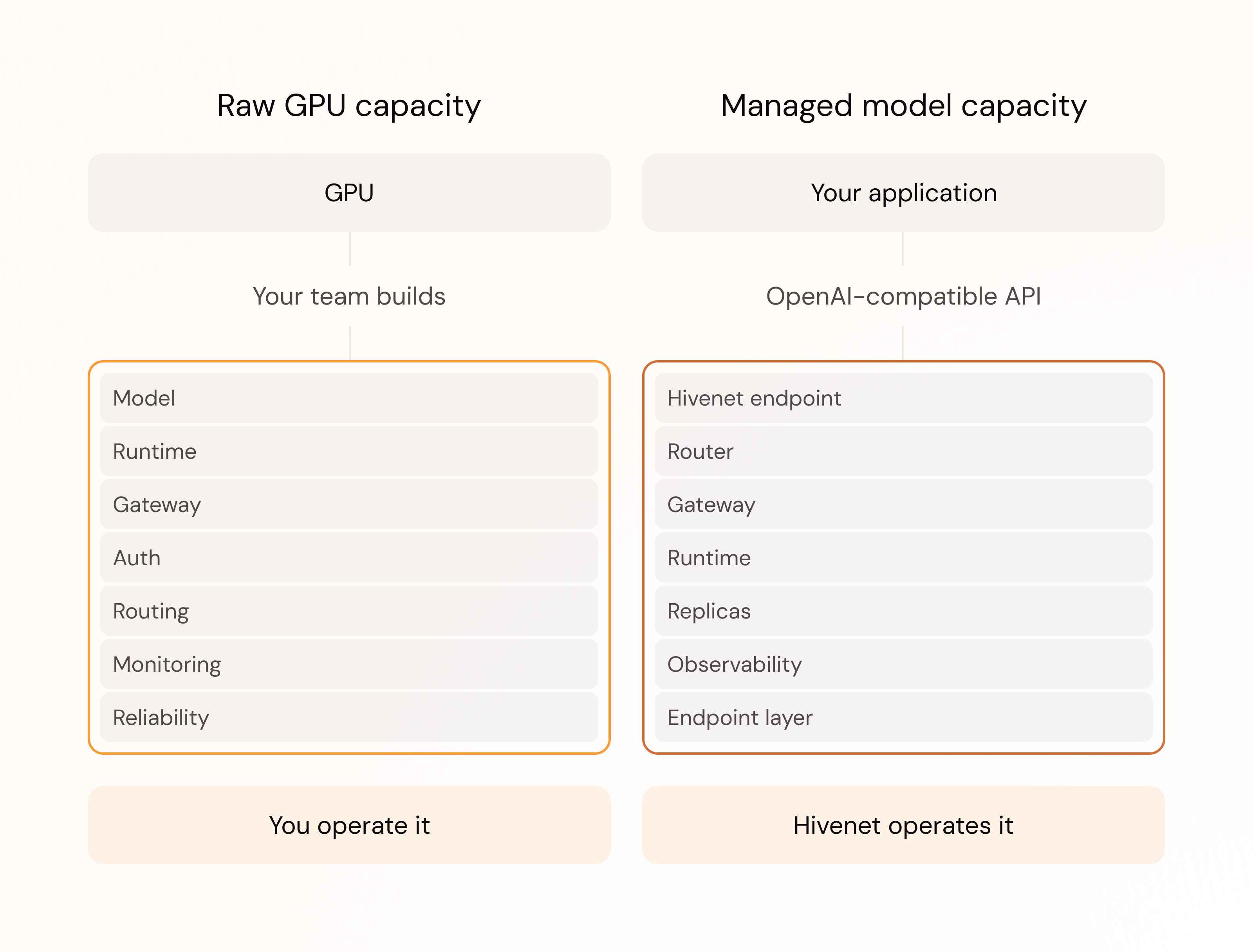
What Hivenet operates for you
A Hivenet dedicated endpoint is built around a managed serving path rather than a bare machine.
Hivenet operates the:
- model serving runtime
- router
- gateway
- replica layer
- observability
- endpoint layer
The API surface is OpenAI-compatible, so applications using familiar OpenAI client patterns can switch the base URL rather than build a completely new integration.
You choose the model class, endpoint tier, and available deployment region.
Hivenet runs the infrastructure between your application and the model.
For teams that already know how to operate an inference stack, none of these individual pieces is mysterious.
That does not make them free.
Every component has to be deployed, configured, monitored, updated, and debugged when something goes wrong.
Managed inference turns that operational work into part of the product.
€2.10/hour is a capacity price, not a token price
Hivenet also prices the endpoint differently from most general-purpose model APIs.
Dedicated endpoints use per-replica pricing billed by the second.
There is no token meter on the dedicated path.
A medium endpoint for Qwen-class workloads currently starts at €2.10/hour.
Run one continuously for a 730-hour month and the starting cost is about €1,533.
That does not mean every Qwen3.6-27B workload costs €1,533 a month. The right tier and replica count depend on the model, traffic pattern, context, throughput, and latency target.
What it does mean is that the unit you are buying is clear.
You pay for dedicated model capacity while it is running.
For production teams with steady traffic, that can be easier to reason about than a bill that increases with every input and output token.
It is also why our AI pricing page separates GPU rental from managed inference. One is infrastructure you operate. The other is infrastructure Hivenet operates for you.
The endpoint still has to perform
Management would not matter much if the endpoint itself could not deliver useful throughput.
So performance belongs in the comparison too.
On our Qwen3.6-27B serving configuration, Hivenet measured:
WorkloadInput tokensConcurrencyOutput tokens/sMedium request1,0001100.4Long request10,000199.1Parallel requests1,0001067.7
These are first-party measurements from the production serving stack, not competitor benchmarks.
The single-request figures show roughly 100 output tokens per second across both the 1,000-token and 10,000-token prompt tests.
The concurrency result matters for a different reason: production inference is rarely one user waiting politely for the previous user to finish.
Traffic shape changes performance.
That is why Hivenet's benchmark library reports the model, serving configuration, prompt shape, concurrency, and other conditions behind a result rather than publishing a token-per-second number without context.
Our guide to LLM inference metrics explains the same principle: throughput, time to first token, queue behavior, context, and concurrency need to be read together.
A dedicated endpoint gives you capacity.
The benchmark tells you what that capacity can do under a defined workload.
Your own traffic tells you whether it is enough.
The price difference starts making sense when you list the work
A raw GPU can look dramatically cheaper on a pricing page.
That is because the price stops at the GPU.
Imagine the stack above it:
GPU → model → serving runtime → gateway → authentication → routing → replicas → monitoring → production endpoint
With GPU rental, your team owns most of that chain.
With Hivenet Inference API, the managed service owns the serving chain.
That difference is particularly important for smaller AI teams.
A company may have developers who can deploy vLLM perfectly well. The question is whether running inference infrastructure is where those developers should keep spending their time once the application is in production.
For a research team, custom ML platform, or company with unusual serving requirements, the answer may be yes.
For a business using Qwen to extract data from documents, answer customer questions, power RAG, classify content, or automate internal workflows, operating the serving stack may be work that exists only because the model needs somewhere to run.
That is exactly the work managed inference is designed to remove.
You still keep the familiar API layer
Managed does not need to mean proprietary integration.
Hivenet endpoints use an OpenAI-compatible API surface.
That matters because OpenAI-compatible interfaces have become a common integration layer across open-model serving tools as well. vLLM itself provides an OpenAI-compatible server for self-managed deployments.
So moving between a self-managed stack and a managed endpoint does not necessarily require rebuilding the application around a completely different request model.
Your application can keep familiar client patterns.
The infrastructure responsibility changes underneath.
That makes the choice between Compute and Inference API less about developer lock-in and more about a straightforward operational question:
Who do you want running the serving stack?
Region becomes part of the endpoint
Production inference is also a data-placement decision.
Hivenet dedicated endpoints can be pinned to an available deployment path in France, the UAE, or the US.
The endpoint stays tied to the selected region.
For a company with customers, contracts, or internal policies that care where AI processing happens, that is useful information to have at deployment time rather than something to infer from a global API.
It does not make every workload a sovereignty problem.
It gives teams that do have regional requirements a clear infrastructure choice.
Hivenet's broader AI workload options use the same principle: start with what the workload needs, then choose managed inference, raw Compute, RAG, storage, or a more private deployment path accordingly.
Dedicated capacity is strongest when you use it
There is still one thing a managed endpoint cannot solve for you.
Utilization.
If you reserve capacity and barely use it, per-token pricing may be cheaper.
If traffic is highly unpredictable, a shared API can transfer more of that utilization risk to the provider.
Dedicated inference becomes attractive when the workload is stable enough to make use of the capacity.
That is why Hivenet positions the product around production workloads rather than occasional experiments.
Document automation.
Extraction.
RAG.
Support workflows.
Internal tools.
Applications where the model is no longer a demo and is starting to behave like infrastructure.
Once that happens, predictable capacity and predictable operating responsibility become much more valuable.
Efficient inference improves the value of the endpoint
There is another reason Qwen3.6-27B is useful here.
Hivenet does not serve the model at full precision and simply pass the hardware cost through.
Our mixed-precision NVFP4 configuration reduces the hardware requirement while preserving the model within a measured quality range.
Across the accuracy benchmarks in our evaluation, capability retained runs from 95.5% to 100% versus the full-precision baseline.
The point of that optimization is commercial as much as technical.
If the model can meet the quality bar with less infrastructure underneath it, dedicated capacity becomes easier to price efficiently.
That is what “performance per euro” means in practice.
You are not paying for the largest possible hardware footprint.
You are paying for enough model capacity to do the work.
Raw Compute is still the better choice when you need raw Compute
Managed inference is not an upgrade path that makes GPU rental obsolete.
They solve different problems.
Use GPU/CPU rental when you want:
- full control over the operating environment
- your own vLLM, TGI, SGLang, llama.cpp, or PyTorch configuration
- custom model pipelines
- fine-tuning or experimentation
- direct access to the instance
- unusual serving architectures
- control over every optimization yourself
Use a managed endpoint when the output you need from the infrastructure is much simpler:
an API that reliably serves the model.
That distinction can save a surprising amount of engineering time.
Compare what the hour buys, not just what the hour costs
A GPU-hour is easy to price.
A production inference service is harder because the GPU is only one layer of it.
So when €0.75/hour for a raw RTX 5090 sits beside €2.10/hour for a medium managed endpoint, the right conclusion is not that one costs 2.8 times as much.
The units are different.
One buys GPU capacity.
The other starts buying model capacity plus an operated serving layer.
For teams that want to build and run that layer themselves, raw Compute gives them the control to do it.
For teams that want Qwen behind an API and would rather spend their engineering time on the product using it, dedicated inference changes what the hour buys.
That is the comparison worth making.
Explore Hivenet Inference API for dedicated model endpoints, or compare it with GPU/CPU rental if your team wants to run the serving stack itself.
Your next workload belongs on Hivenet.
Pick one AI, compute, or storage workload and see the difference for yourself. Spin it up in minutes, or let our team map your fastest path to production.