

Connectez-vous à Hivenet
Accédez à vos fichiers et gérez votre compte de stockage.
Boutique
Accédez à vos fichiers et gérez votre compte de stockage.
Calculer
Lancez des instances et gérez vos ressources de calcul.
Store et Compute utilisent toujours des comptes distincts aujourd'hui. Nous travaillons sur une connexion unifiée.
Vous avez juste besoin d'envoyer un fichier ?
Utilisez Envoyer directementVous êtes nouveau sur Hivenet ? Commencez
Commencez avec Hivenet
Choisissez ce que vous voulez utiliser en premier.
Boutique
Sauvegardez des photos et des fichiers sur tous vos appareils.
Calculer
Lancez le calcul GPU en libre-service pour les tâches exigeantes.
Store et Compute utilisent toujours des comptes distincts aujourd'hui. Nous travaillons sur une expérience de compte unifiée.
Vous avez besoin de Hivenet pour votre entreprise ?
Parlez au service des ventesVous avez besoin d'envoyer un fichier ?
Ouvrir EnvoyerVous avez déjà un compte ? Connectez-vous
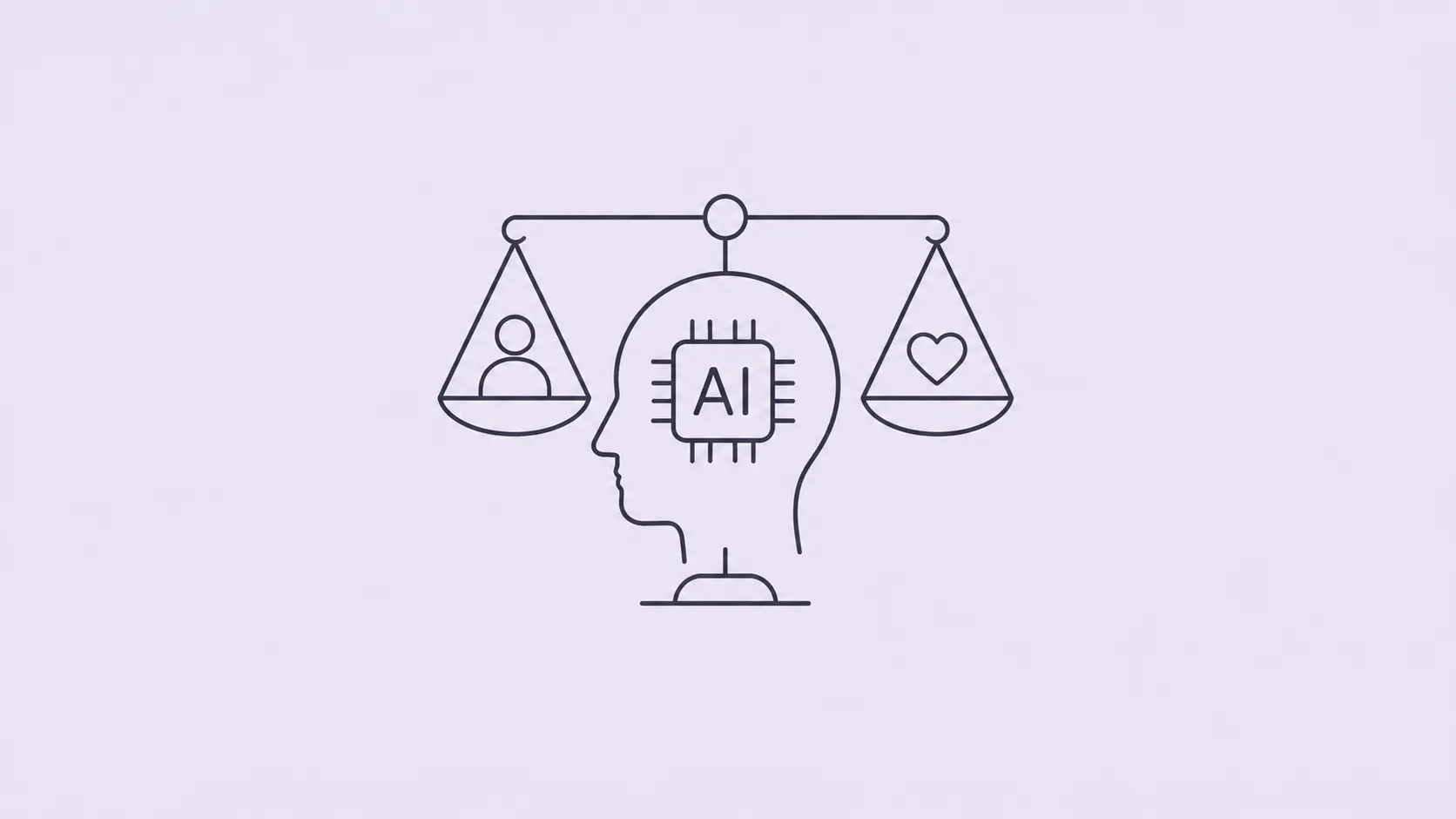
Éthique de l'intelligence artificielle : guide pour une prise de décision éthique en IA
What is artificial intelligence ethics and why it matters
Artificial intelligence ethics is the practice of deciding what AI systems should do, what should not be automated, who remains accountable, and who bears the cost when AI systems scale. It is not just a technical discipline or a compliance checklist. The ethics of artificial intelligence asks who gets to decide what artificial intelligence is for, whose data is used, who benefits, who is exposed to risk, and who can challenge the outcome.
AI ethics matters because AI tools now influence hiring, credit, healthcare, education, public services, creative work, surveillance, and access to information. These systems can affect millions of people at once. When an AI model reflects historical biases, weak data governance, or incentives that reward speed over safety, the harm is not just a software bug. It becomes a social decision embedded in AI code.
Many organizations and governments are developing AI ethics frameworks that include principles such as fairness, accountability, and transparency to guide the responsible use of AI technologies. Those ethical principles are useful, but they are only meaningful when they shape real decisions across the AI lifecycle: data collection, model design, deployment, monitoring, appeals, and rollback.
Ethics is broader than law. Legal compliance asks, “Are we allowed to do this?” AI ethics asks, “Should we do this, who decides, and who carries the consequences?” The difference matters because government regulation often arrives after AI adoption has already reshaped business outcomes, labor markets, and human decision making.
Effective AI governance requires continuous processes for assessing risk, documenting design decisions, monitoring deployed systems, and responding to unexpected behaviors or harms. Many organizations are establishing AI ethics boards to provide centralized governance, review, and decision-making processes for AI ethics policies and practices, drawing on broader governance frameworks and modern governance principles. But an ethics board only matters if it has authority, access to evidence, and the power to stop or change AI applications.
The core ethical questions every AI system should answer
A practical ethical framework starts with questions that expose power, risk, and accountability. These questions should be asked before development, during testing, and after deployment, because ethical challenges can emerge at every stage of the AI lifecycle.
- What is the AI actually doing?
Define the real function, not the marketing description. Is the AI system recommending content, screening job applicants, diagnosing illness, predicting credit risk, generating text, identifying faces, or monitoring workers? Ethical considerations depend on the actual decision, the level of automation, the error rate, and the harm caused when the AI algorithms fail. - Who is affected?
Include users, non-users, workers, creators, customers, patients, students, citizens, and people who cannot opt out. A hiring tool affects applicants who never see the model. A predictive policing system affects neighborhoods. A generative AI system trained on creative work affects artists whose work may have been used without meaningful consent. - Who benefits?
Identify whether the main benefit goes to the user, the organization, a platform provider, or a third party. AI solutions often promise efficiency, but efficiency for one group can create risk for another. A company may save money through automation while workers face monitoring, deskilling, or job displacement. - Who carries the risk?
Ethical dilemmas often appear when benefits and risks are separated. A bank may benefit from automated credit scoring, while rejected applicants carry the burden of errors. A hospital may gain workflow efficiency, while patients carry the risk of misdiagnosis. The question is not only whether the AI model performs well on average, but who is harmed when it performs poorly. - What data was used?
AI models rely on data, making data privacy, data protection, and data security core concerns of AI ethics, prompting policymakers to advance significant pieces of data protection legislation. Ask whether training data was collected with consent, whether it represents affected groups, whether it contains historical biases, and whether proxy variables can recreate protected characteristics. Bias can be introduced through historical data used to train AI systems, leading to discriminatory outcomes in areas such as hiring and facial recognition. - Can people understand or challenge the outcome?
Transparency means people know when AI is being used. Explainability means they can understand enough about the decision to question it. Appeals matter most when the stakes are high: jobs, loans, benefits, education, healthcare, policing, and housing. Ethical use requires correction paths, not just model confidence scores. - Who is accountable after deployment?
Someone must be ultimately responsible for ongoing monitoring, incident response, correction, suspension, and rollback. Organizations should not hide behind “the algorithm.” Accountability mechanisms need named owners, audit logs, reporting channels, and authority to intervene when deployed systems drift or cause harm. - What should not be automated?
Ethical AI requires refusal boundaries. Some decisions require human intelligence, human values, and moral context that should not be delegated to AI technology. These may include certain uses in lethal weapons, intrusive surveillance, human rights decisions, highly sensitive healthcare decisions, and legal or medical advice without qualified professional responsibility.
Ranking the biggest ethical concerns in AI by impact and urgency
The most urgent ethical concerns in AI are not identical in every organization, but some risks consistently deserve priority because they can harm people at scale and are difficult to correct after deployment.
- Bias and fairness
AI bias is often the most immediate ethical issue because it can affect access to work, credit, housing, education, healthcare, and public services. Algorithmic bias may come from historical data, design choices, labels, measurement gaps, or deployment context. Facial recognition algorithms have been shown to perform significantly worse on darker-skinned individuals, highlighting the biases present in AI systems. This ranks first because discriminatory outcomes can damage human dignity, violate human rights, and become embedded before anyone notices. - Privacy and consent
AI data is not limited to what people knowingly provide. AI systems can infer traits, combine datasets, expose sensitive information, and reuse personal data in ways people did not expect. The EU’s General Data Protection Regulation (GDPR) gives individuals in the European Union and European Economic Area more control over their personal data, which applies to AI tools as well as traditional software. Privacy ranks high because consent is often weak, especially when data collection happens through platforms, workplaces, schools, or public infrastructure. - Transparency and explainability
People should know when AI applications affect them, especially in high-stakes settings. A person denied a loan, rejected for a job, flagged by a fraud system, or scored by an education platform needs more than “the model said so.” Explainability does not require exposing every line of AI code, but it does require meaningful reasons, documentation, and challenge mechanisms appropriate to the risk. - Accountability and oversight
AI ethics frameworks often emphasize the importance of human oversight, with a significant majority of professionals believing that AI systems should be held to higher standards than humans. But human oversight is only meaningful when humans have time, authority, information, and protection to intervene. Weak oversight creates algorithmic deflection: the organization benefits from automation while blaming the system for harm. - Labor displacement and economic inequality
AI is likely to shift job demand to other areas rather than shrink the workforce, as individuals will be needed to manage AI systems and address complex problems that arise in their industries. Still, the introduction of AI technologies can lead to the disappearance of certain job roles, similar to how personal computers eliminated roles like typist and file clerk, while simultaneously creating new job categories such as IT support and software development. As AI technologies become more prevalent, the market demand for specific job roles is expected to shift, necessitating a focus on helping individuals transition to new areas of market demand. - Environmental cost
The largest generative AI models require significant computing resources to train and use, leading to increased greenhouse gas emissions, water consumption, and electronic waste. Understanding how GPU cloud platforms manage billing, storage, and resource allocation is part of assessing this impact. A 2023 study suggests that the amount of energy required to train large AI models was equivalent to 626,000 pounds of carbon dioxide, comparable to 300 round-trip flights between New York and San Francisco. Data centers, which are essential for AI operations, require around two liters of water per kilowatt hour of energy used, leading to potential water scarcity in regions where they are located. - Concentration of power
The AI industry depends on data, chips, cloud platforms, model architectures, and distribution channels. Many technology companies in the private sector now control critical layers of AI development. When a small number of technology companies shape the infrastructure and rules of AI adoption, ethical standards can become dependent on their incentives. Insights from AI and cloud governance case studies in specialized industry blogs show that this is not only a market issue; it affects who can build AI programs, who can audit them, and whose values are embedded in future AI tools.
Examples of AI ethics failures and what they teach us
Ethical failures show why technical performance is not enough. Most failures come from a mix of flawed training data, weak governance, poor transparency, misaligned incentives, and insufficient accountability.
- Amazon’s biased hiring tool
In 2018, Amazon scrapped an AI recruiting tool after discovering it systematically favored male candidates due to being trained on a dataset predominantly composed of male resumes. The system reflected historical hiring patterns rather than fair hiring standards. What went wrong was not only biased data; it was the decision to automate screening without strong fairness testing, affected-user input, or clear refusal boundaries. Prevention would have required representative training data, bias audits, human resources accountability, candidate transparency, and authority to halt deployment. - Facial recognition discrimination
Facial recognition systems have repeatedly shown higher error rates for darker-skinned people and women. Facial recognition algorithms have been shown to perform significantly worse on darker-skinned individuals, highlighting the biases present in AI systems. In law enforcement or border control, this kind of error can produce wrongful suspicion, detention, or arrest. Prevention requires diverse evaluation datasets, strict limits on use, public transparency, independent audits, and legal accountability when systems fail. - Generative AI copyright and attribution disputes
Generative AI systems raise ethical implications around training data, consent, attribution, and value extraction. Artists, writers, musicians, and publishers have objected to models trained on creative work without permission or compensation. The ethical challenge is not just whether the output copies a specific work. It is whether creators lose control over labor, style, and market value while model developers capture the benefit. - Healthcare AI trained on underrepresentative data
In healthcare ethics, safety and reliability are central because human life may be affected. An AI model trained on one population can underperform on another, creating unequal diagnosis or treatment quality. Healthcare AI also raises data privacy, consent, explainability, and professional responsibility concerns. Prevention requires clinical validation across populations, human judgment, patient communication, and clear accountability for misdiagnosis or harmful recommendations. - Workplace monitoring and automated evaluation
AI tools used to score productivity, analyze video interviews, infer emotion, or rank employees can create ethical concerns around surveillance, privacy, bias, and coercion. Workers may not have meaningful consent when their employment depends on acceptance. Prevention requires limits on data collection, transparency, worker input, appeal processes, and a refusal to automate judgments that require context, empathy, or nuanced human decision making.
How different industries should prioritize AI ethics
AI ethics is not one-size-fits-all. The ethical framework should match the domain, the stakes, the affected groups, and the type of decision being automated.
Generative AI can affect artists, publishers, designers, musicians, and writers by using creative training data and generating competing content without clear compensation.
For business leaders, the key is to avoid treating AI ethics as a universal template. A chatbot for internal knowledge search does not carry the same ethical concerns as a healthcare triage system or a criminal risk tool. Risk classification should determine testing, documentation, human oversight, and whether automation should be allowed at all.
Why most AI ethics efforts fail and how to avoid common mistakes
AI ethics often fails because organizations turn ethical principles into branding rather than authority. Clear ethical principles matter, but they must change how decisions are made.
- Principle-washing
Failure: The organization publishes ethical guidelines but does not connect them to procurement, product review, model evaluation, or executive decision-making.
Better approach: Build ethics into the AI lifecycle. Require risk assessment, documentation, fairness testing, privacy review, and approval gates before deployment. - Weak human oversight
Failure: A human reviewer exists, but the reviewer lacks time, context, authority, or protection to override the AI system.
Better approach: Give reviewers evidence, logs, escalation channels, and the power to pause or reject AI applications. Human oversight must be operational, not symbolic. - Misaligned business incentives
Failure: Teams are rewarded for speed, automation, cost reduction, or engagement, while ethical risks are treated as blockers.
Better approach: Tie business outcomes to responsible AI use. Leadership should own ethical risks, not delegate them entirely to data scientists or legal teams. - Lack of affected-user input
Failure: AI researchers, AI developers, and executives decide what is acceptable without involving the people most affected.
Better approach: Include workers, customers, patients, students, communities, creators, and marginalized groups in evaluation. Ethical literacy improves when real-world harms are heard early. - Focus only on technical fixes
Failure: The organization assumes fairness metrics, explainability tools, or model cards solve the problem.
Better approach: Treat AI as sociotechnical. Audit the model, the data, the deployment context, the incentives, the infrastructure, and the accountability mechanisms. - Treating compliance as ethics
Failure: The organization does only what AI regulation currently requires, even when legal rules lag behind potential risks.
Better approach: Use compliance as the floor, not the ceiling. Ethical practices should preserve human dignity, well being, and human rights even where laws are incomplete.
The infrastructure layer of AI ethics most organizations ignore
Artificial intelligence ethics should include the infrastructure layer. AI systems depend on compute, storage, energy, water, chips, cloud providers, and data location. Organizations can also explore sustainable cloud solutions for generative AI workloads that prioritize efficiency and reduced environmental impact. An organization can claim to support trustworthy AI while relying on opaque infrastructure, excessive energy use, unclear data handling, or a small number of dominant Big Tech platforms.
The environmental impact is no longer a side issue. The largest generative AI models require significant computing resources to train and use, leading to increased greenhouse gas emissions, water consumption, and electronic waste. Data centers’ growing water consumption illustrates the scale of the problem: a 2023 study suggests that the amount of energy required to train large AI models was equivalent to 626,000 pounds of carbon dioxide, comparable to 300 round-trip flights between New York and San Francisco. Data centers, which are essential for AI operations, require around two liters of water per kilowatt hour of energy used, leading to potential water scarcity in regions where they are located.
Infrastructure also shapes power. If AI development depends on a small group of chip manufacturers, cloud providers, and foundation model companies, then ethical choices become constrained by vendor terms, pricing, audit access, and platform rules. Comparing traditional hyperscale clouds with GPU-first neocloud alternatives shows how concentration can make it harder for smaller organizations, researchers, and public-interest groups to build or evaluate AI solutions independently.
This is where alternatives matter. Secure, distributed GPU cloud platforms for AI and HPC and privacy-first storage can reduce dependence on dominant platforms and make infrastructure choices part of responsible AI. For example, neocloud-style services such as Compute with Hivenet can be understood as one type of distributed GPU compute approach, while Store with Hivenet reflète une orientation de stockage cloud axée sur la confidentialité. Il ne s'agit pas de dire que l'infrastructure seule résout les questions d'éthique de l'IA. Il s'agit plutôt de considérer que le calcul, le stockage, le traitement des données, la durabilité et la dépendance à la plateforme sont des considérations éthiques, et non de simples décisions d'achat techniques.
Élaborer un cadre d'évaluation éthique de l'IA pour votre organisation
Un cadre éthique pour l'IA doit produire des décisions, pas de la paperasse. Utilisez la liste de contrôle ci-dessous pour transformer les principes moraux en une gouvernance reproductible.
- Identifier les parties prenantes
Livrable : Une cartographie des parties prenantes couvrant les utilisateurs, les non-utilisateurs, les travailleurs, les clients, les régulateurs, les communautés, les créateurs et les groupes qui pourraient être affectés de manière disproportionnée. Incluez les personnes qui ne peuvent pas facilement se désengager. - Définir les valeurs et les limites de refus
Livrable : Des principes éthiques clairs et une liste d'utilisations interdites ou restreintes. Les limites de refus doivent indiquer ce que l'organisation n'automatisera pas, même si le cas d'usage est rentable. - Inventorier et classer les systèmes d'IA
Livrable : Un registre des projets d'IA et des systèmes d'IA déployés, classés par niveau de risque, domaine, sensibilité des données, autonomie et préjudice potentiel. - Évaluer les risques liés aux données et aux modèles
Livrable : Documentation des sources de données d'entraînement, du consentement, de la représentativité, des contrôles de confidentialité des données, des risques de sécurité, des tests de biais, des tests de robustesse et des limitations connues. - Cartographier l'autorité de décision
Livrable : Un modèle de gouvernance indiquant qui approuve, audite, surveille, suspend ou rejette les applications d'IA. De nombreuses organisations mettent en place des comités d'éthique de l'IA pour assurer une gouvernance centralisée, un examen et des processus décisionnels pour les politiques et pratiques d'éthique de l'IA. - Définir les exigences de transparence et de documentation
Livrable : Avis aux utilisateurs, documentation du modèle, journaux d'audit, évaluations d'impact, divulgations des fournisseurs et explications adaptées au niveau de risque. - Mettre en place des processus de recours et de correction
Livrable : Un processus permettant aux personnes de contester les résultats, de demander un examen humain, de corriger les données, de signaler les préjudices et de recevoir des réponses significatives. - Surveiller après le déploiement
Livrable : Surveillance continue de la dérive, des erreurs, des biais, des utilisations abusives, des risques de sécurité et des comportements inattendus. Une gouvernance efficace de l'IA exige des processus continus pour évaluer les risques, documenter les décisions de conception, surveiller les systèmes déployés et réagir aux comportements ou préjudices inattendus. - Examiner l'infrastructure et les fournisseurs
Livrable : Évaluation de la puissance de calcul, du stockage, de la consommation d'énergie, de l'impact sur l'eau, de la résidence des données, du verrouillage propriétaire, de l'accès à l'audit et des rapports environnementaux. - Former le personnel et mettre à jour le cadre
Livrable : Programmes de sensibilisation à l'éthique pour les équipes produit, les dirigeants, les data scientists, les équipes d'approvisionnement et le personnel en contact avec la clientèle. Le cadre devrait évoluer à mesure que la recherche en IA, la réglementation de l'IA et les cas d'utilisation organisationnels changent.
L'avenir de l'éthique de l'IA : des principes à l'application
L'éthique de l'IA passe de lignes directrices éthiques volontaires à des règles exécutoires. La loi sur l'intelligence artificielle de l'Union européenne, entrée en vigueur en 2024, établit des obligations contraignantes pour certaines pratiques d'IA, y compris des exigences de transparence et des règles de gouvernance du cycle de vie pour les modèles d'IA à haut risque. La loi sur l'intelligence artificielle de l'Union européenne, entrée en vigueur en 2024, établit des obligations contraignantes pour certaines pratiques d'IA, y compris des exigences de transparence et des règles de gouvernance du cycle de vie pour les modèles d'IA à haut risque.
Ce changement est significatif car il fait de la documentation, de la gestion des risques, de la transparence et de la supervision humaine des obligations légales dans certains contextes. Les organisations ne peuvent plus considérer l'IA éthique comme une déclaration publique détachée de la conception des produits. La réglementation de l'IA exige de plus en plus des preuves : ce que fait le système, quelles données il utilise, comment il est gouverné, comment les personnes sont informées et comment les préjudices sont gérés.
L'avenir de l'IA responsable ne se limitera pas à de meilleurs modèles. Il s'agira de mécanismes de responsabilisation exécutoires, d'une gouvernance des données plus solide, d'une supervision humaine significative, de rapports environnementaux et de limites plus claires sur ce qui ne devrait pas être automatisé.
Pour les organisations, la prochaine étape pratique est simple : construire le cadre éthique avant que la pression du déploiement ne le rende facultatif. Inventoriez les outils d'IA, évaluez les risques, documentez les décisions, impliquez les personnes concernées, surveillez les systèmes après le lancement et créez une réelle autorité pour arrêter les utilisations nuisibles. L'intelligence artificielle peut aider les technologies à bénéficier à la société, mais seulement lorsque les personnes qui la construisent et la déploient acceptent la responsabilité du pouvoir qu'elle génère.
Your next workload belongs on Hivenet.
Pick one AI, compute, or storage workload and see the difference for yourself. Spin it up in minutes, or let our team map your fastest path to production.