
Sign in to Hivenet
Access your files and manage your storage account.
Store
Access your files and manage your storage account.
Compute
Launch instances and manage your compute resources.
Store and Compute still use separate accounts today. We’re working on a unified sign-in.
Just need to send a file?
Use Send directlyNew to Hivenet? Get Started
Get started with Hivenet
Choose what you want to use first.
Store
Back up photos and files across your devices.
Compute
Launch self-serve GPU compute for demanding work.
Store and Compute still use separate accounts today. We’re working on a unified account experience.
Need Hivenet for business?
Talk to salesNeed to send a file?
Open SendAlready have an account? Sign in
A closer look at Hivenet and Inria’s distributed cloud project
In December 2022, Hivenet and Inria (the French Institute for Research in Computer Science and Automation) announced a four-year partnership to create a peer-to-peer cloud that is sustainable and accessible to all. This represented a significant investment from Hivenet, covering the recruitment of 8 PhD students, post-doctoral fellows, and engineers across 4 Inria project teams. This article was first published in February 2025. It recaps the work completed at that point and records the research questions the teams planned to explore next.
Alvearium: it’s Latin for ‘hive’!
It’s important not to overthink things when choosing a name, and with that in mind, the “Challenge” motivating our partnership with Inria was named Alvearium, Latin for beehive. When announcing the Challenge in early 2023, Inria defined it in terms of four problem spaces (see Table 1 below) and set the overall objectives as “to offer … a sovereign, high-performance Cloud capable of meeting users' storage needs as effectively as existing providers, while respecting the confidentiality and security of their data”. If you’ve been following Hivenet and what we do, you’ll see this aligns with our company mission.
| Viable data placement and repair | Peer-to-peer storage needs a data placement strategy to select the most appropriate storage nodes, constrained by compliance with regulatory policies and user security and privacy needs. In addition, the system should include data repair mechanisms to respond to possible failures. |
|---|---|
| The management of mutable data | Data that is mutable can be modified after its creation. In a distributed model, this represents a challenge: data is spread across many nodes; any data sharing should be end-to-end encrypted, and only authorized peers should be able to decrypt the data. Any parallel changes need to be merged only once they have been received and decrypted by the authorized peers. |
| Investigating new techniques for handling "Sybil attacks" and "Byzantine failures" | Sybil attacks and Byzantine failures are threat scenarios that arise in a distributed environment and are non-trivial to mitigate. The intent of the Challenge is to offer stronger guarantees in terms of fault tolerance, data integrity, and security. |
| The development of a data security mechanism | The objective will be to propose a security mechanism adapted to distributed systems without a central authority that manages users' access rights to shared documents from end to end (i.e., that only the end user can decrypt), which is not the case today with the major Cloud providers. |
Table 1: the four problem spaces underpinning Inria and Hivenet’s Challenge
Much has happened in the last two years since the themes in Table 1 were defined. In May 2024, the team attended Per3S in Paris to update on work to quantify the performance of Erasure Codes in peer-to-peer storage systems. More recently, in December 2024, Hivenet’s R&D team presented at the PEPR Cloud Forum in Grenoble, showcasing the amazing work done to realize our distributed storage and compute services. Later in December, the team shared findings on a new secure messaging protocol for distributed environments: “DiSCreet: Distributed Delivery Service with Context-Aware Cooperation.” The paper: 1) demonstrated a new, efficient approach to encrypted communications in a highly scalable, dynamic environment like Hivenet’s; 2) summarised follow-up research to evaluate the performance and security of the proposed mechanism in depth and formalize the proposals.
On Erasure Codes: we won’t go into detail in this article, but just know that Erasure Codes are a data protection technique that breaks data into pieces and encodes the pieces in such a way that they can be reassembled into their original form without all the pieces being available. Specifically, Hivenet uses Reed-Solomon Encoding.
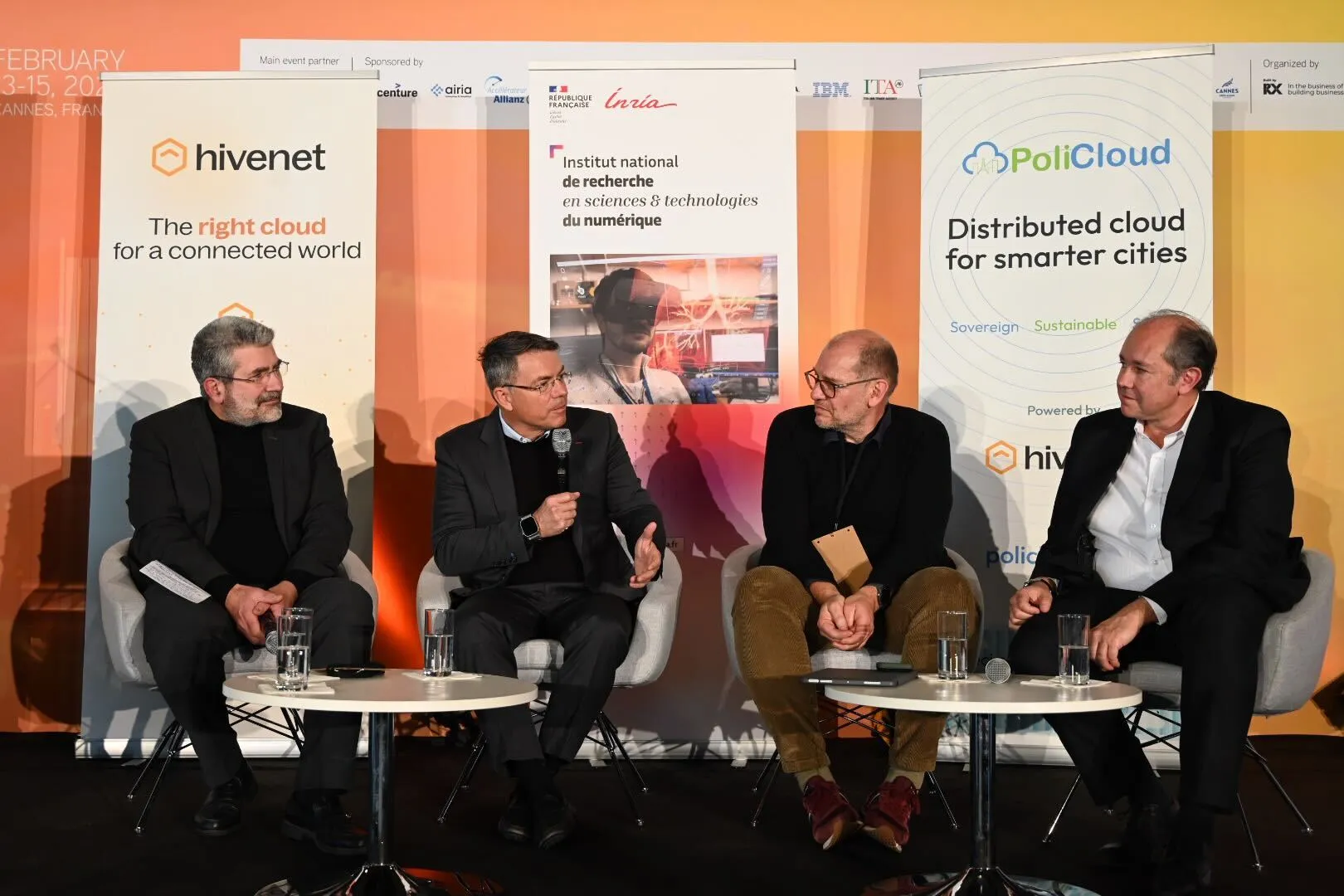
In 2025, work on Alvearium continued, and on February 14 at the World Artificial Intelligence Cannes Festival (WAICF), Hivenet and Inria formally launched a new Challenge, Cupseli. The name Cupseli derives from Κυψέλη (Ancient Greek for beehive) and is also an acronym for Collaborative Unified Platform for a Scalable and Efficient Learning Infrastructure.
Cupseli is now active. The four-year program runs from September 2025 to August 2029 and brings together Hivenet and 11 Inria research teams. It studies how demanding AI and Big Data applications can run efficiently and securely across heterogeneous, distributed, and volatile resources while preserving accuracy and confidentiality and reducing environmental impact. Hivenet’s own research continued alongside the partnership. The next section describes Chat with Hivenet as it stood when this article was first published.

Figure 1: front row seats at WAICF for the Cupseli signing ceremony [source: Inria]
Chat with Hivenet: a distributed approach to AI chat
You’re probably already well aware of ChatGPT and similar tools' impact in shaping customer service, support, marketing, and other key business interactions. Well, Hivenet being Hivenet, although we recognize AI’s vast potential, we maintain a healthy skepticism towards such technology being centralized under the control of large monopolies, who are ever more aligned to state-level objectives. Unsurprisingly, we took a different approach: we built an in-house AI chat, a Retrieval-Augmented Generation (RAG) system, to power Hivenet’s internal knowledge management. RAG in Generative AI is a way to ensure that responses from LLMs are contextually grounded in up-to-date, relevant information, reducing inappropriate or hallucinated results. We ingest our documents, knowledge, chats, and so on in the system and combine these with the output of LLMs (e.g., Llama 3.3-70B, Qwen2-VL-7B, and Mistral) running on Hivenet’s distributed compute service. Please refer to Figure 1 below for a high-level overview of HiveGPT’s architecture.
On model naming conventions: when you see (e.g.) “70B” or “7B” in a model name, this describes the number of parameters (or weights) that the model possesses, with “B” representing “billion.”
In simple terms, parameters are numbers in a model that can be used to tune its accuracy. For example, the Llama 3.3-70B model contains 70 billion parameters. It’s important to note that more parameters don’t always mean “better.” Instead, the number of parameters can be read as a measure of model “complexity,” which must be balanced against the computational cost of training. A smaller model trained on high-quality data may perform more effectively than a larger one.

Figure 2: high-level architecture for Chat with Hivenet
Now, running AI inference in a distributed environment is not new. For example, frameworks such as Petals and vLLM exist to achieve this, and Chat with Hivenet leverages vLLM - a choice made because of its high throughput and its support for OpenAI APIs. However, we want to be clear that it was not built “off the shelf,” and our Research team is addressing some tough technical challenges. Firstly, Hivenet is a distributed platform where resources can come in various shapes and sizes; for example, GPUs come with different amounts of RAM. Meanwhile, vLLM requires the same memory for all cards, which our solution must work around. Secondly, not all distributed systems are equally distributed: unlike some scenarios, Hivenet’s resources can exist in geographical locations spanning multiple continents. In practice, this challenges network performance and latency, which is critical for many inference use cases.
When this article was first published, the system offered acceptable performance for Hivenet’s internal needs, while network distribution and latency remained open research problems. Cupseli now studies these broader distributed-computing constraints, including communication overhead, fault tolerance, and performance across heterogeneous and volatile resources.
At the time, deploying a 405-billion-parameter model such as Llama 3.1 405B was the team’s next planned experiment. That sentence records a 2025 R&D goal; it is not a current product commitment.
When this article was first published, Chat with Hivenet remained an internal R&D prototype running on Hivenet’s distributed computing platform. The architecture described here is retained as historical context and should not be read as a current product commitment.
We hope you enjoyed this overview of Hivenet and Inria’s research. For current information about Cupseli, see Inria’s project material. You can also get in touch with any questions.
Your next workload belongs on Hivenet.
Pick one AI, compute, or storage workload and see the difference for yourself. Spin it up in minutes, or let our team map your fastest path to production.