

Connectez-vous à Hivenet
Accédez à vos fichiers et gérez votre compte de stockage.
Store
Accédez à vos fichiers et gérez votre compte de stockage.
Compute
Lancez des instances et gérez vos ressources de calcul.
Store et Compute utilisent toujours des comptes distincts aujourd'hui. Nous travaillons sur une connexion unifiée.
Vous avez juste besoin d'envoyer un fichier ?
Utilisez Send directementVous êtes nouveau sur Hivenet ? Commencez
Commencez avec Hivenet
Choisissez ce que vous voulez utiliser en premier.
Store
Sauvegardez des photos et des fichiers sur tous vos appareils.
Compute
Lancez le calcul GPU en libre-service pour les tâches exigeantes.
Store et Compute utilisent toujours des comptes distincts aujourd'hui. Nous travaillons sur une expérience de compte unifiée.
Vous avez besoin de Hivenet pour votre entreprise ?
Parlez au service des ventesVous avez besoin d'envoyer un fichier ?
Ouvrir SendVous avez déjà un compte ? Connectez-vous
Que signifie HPC ? (L'informatique haute performance expliquée)
HPC stands for high performance computing. It means using more computing power than a normal laptop, desktop, or single server can provide, often through supercomputers, computer clusters, GPUs, or cloud resources.
What does HPC stand for?
High performance computing (HPC) is the practice of aggregating computing resources to achieve performance greater than that of a single workstation or server, often involving custom-built supercomputers or clusters of individual computers. In plain terms, hpc generally refers to using powerful computers together to finish hard computing tasks in a timely manner.
HPC systems can perform quadrillions of calculations per second, far beyond standard desktop computers, which typically operate at around 3 billion calculations per second. That difference matters when you need to process data, run simulations, or train models at serious scale.
- HPC: high performance computing for large amounts of data and complex algorithms.
- High performance: faster processing speed, more memory, more parallel work, and optimal performance across the system.
- Computing: CPUs, GPUs, data storage, network storage, and tools working together.
- Everyday computing: browsing, documents, and spreadsheets. HPC: weather forecasting, drug discovery, engineering applications, and AI.
What HPC means in plain English
HPC means lots of computers working together so your job finishes in hours instead of weeks. It may be a high performance computer, a single powerful server, an hpc cluster with many compute nodes, or cloud hpc rented on demand.
Examples include:
- Computing millions of possible drug molecules for healthcare research.
- Simulating airflow over a car or aircraft wing.
- Processing terabytes of telescope input data.
- Running data analytics for fraud detection, risk, or business intelligence.
Most hpc work uses parallel computing: many tasks run at the same time across multiple cores, GPUs, or multiple computers.
Why is HPC important today?
HPC is essential for processing massive datasets and performing complex calculations quickly, which is crucial for applications in fields such as scientific research, simulation, and business intelligence. The phrase hpc important keeps showing up because modern work produces more data than ordinary computers can handle.
Since around 2010, IoT devices, 3D imaging, genomics, and AI models have created massive amounts of data. Demand is also driven by real-time insights and AI-driven workloads; IBM reports that the market for scalable computing infrastructure for HPC and AI reached USD 85.7 billion in 2023.
Key reasons include:
- Faster storm tracking, stock analysis, live video, fraud detection, and systems that stream live events.
- Shorter R&D cycles for chip design, automotive crash simulations, pandemic modeling from 2020–2022, and energy research.
- New insights from large models, including large language models and generative AI.
- high performance computing hpc has become central to modern AI workloads, not just national labs.
How does HPC work? (From nodes to HPC clusters)
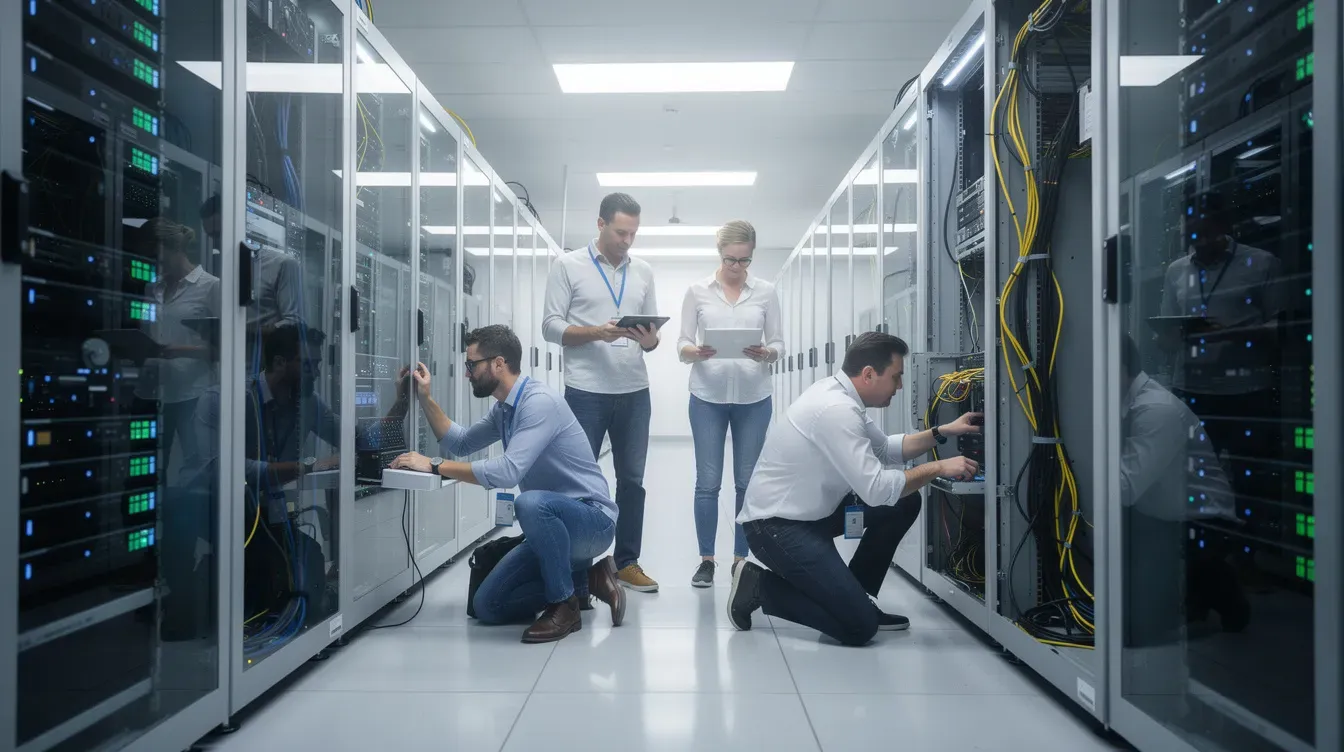
HPC work typically runs on HPC clusters, which are groups of networked computers acting like one big machine. An HPC cluster consists of multiple high-speed computer servers, known as nodes, that are networked together to manage parallel computing workloads.
The main components look like this:
- Computer clusters / HPC clusters: many servers called nodes.
- Compute nodes: the machines that run calculations.
- Login nodes: where users connect, edit files, and submit jobs.
- High-speed network: moves data between nodes with low delay.
- Shared storage: lets all nodes read and write files.
- job scheduler: software such as Slurm or PBS that queues work and assigns resources.
The performance of an HPC cluster relies on the speed and efficiency of its components, including compute nodes, storage systems, and networking capabilities, which must all operate in harmony. Think of compute network storage as one connected stack.
Inside an HPC cluster: nodes and roles
Not all nodes in a cluster are identical. HPC clusters can be designed as homogeneous, where all nodes have similar performance, or heterogeneous, where nodes have different characteristics and capabilities.
Each node in an HPC cluster can be a compute node, login node, or storage node, with compute nodes executing the computations and login nodes serving as the user interface.
- Login nodes support interactive access.
- Compute nodes run batch jobs.
- Large memory nodes support memory-heavy workloads.
- GPU nodes handle accelerated hpc workloads.
- Storage and controller nodes manage data storage, scheduling, and system health.
Login nodes
Login nodes are the entry point to an hpc cluster, usually through SSH.
- Use them to browse directories, edit scripts, compile code, and submit jobs.
- Don’t run heavy computation there; it can slow access for other users.
- Some modules may differ from compute nodes.
- Treat login nodes as a control area, not the place where hpc work runs.
Compute nodes
Compute nodes are the workhorses of high performance computing. Users usually don’t SSH directly into them; the scheduler launches jobs there.
- They mount shared filesystems so code and data are available from any node.
- Large hpc systems may have hundreds or thousands of compute nodes.
- Each node may have many CPU cores, so total core count can reach tens of thousands.
- These nodes supply the main computing resources for cluster computing.
Large memory nodes
Large memory nodes are specialized compute nodes with far more RAM, often 1–4 TB.
They are useful for:
- Genomics assembly.
- In-memory analytics.
- Large graph algorithms.
- Finite element models with huge meshes.
Schedulers often route high-memory jobs to these nodes. They can also support shared-memory models such as OpenMP.
GPU nodes
GPU nodes are compute nodes equipped with powerful processors for parallel computation, not just graphics.
Common uses include:
- AI training and inference.
- Rendering and visual effects.
- Scientific simulations using CUDA or OpenCL.
- Computer vision and benchmarking.
Modern high performance computing HPC increasingly depends on GPU nodes because many workloads run better on GPUs than CPUs.

Classic HPC vs modern GPU-driven HPC
Classic HPC grew around CPU-based supercomputers, message passing interface software, and tightly linked simulations. Modern GPU-driven HPC now includes AI, deep learning, rendering, and data science.
- Classic HPC: physics, climate, CFD, structural analysis, national supercomputers, and Top500-style systems.
- Modern GPU HPC: growth since about 2012 with CUDA and deep learning.
- Hybrid systems: CPUs, GPUs, high-bandwidth memory, and fast network links.
- Why GPUs help: thousands of cores, strong parallel performance, and good performance per watt.
HPC vs cloud computing vs GPU compute
HPC is about the workload pattern: large-scale, parallel, high performance computing. Cloud is one way to access the infrastructure.
- On premises HPC: institutions own and run computer clusters.
- Cloud HPC: providers such as google cloud rent high performance instances or clusters.
- GPU compute: renting or owning GPU machines for parallel workloads, often via GPU rental services tailored for AI and deep learning projects.
HPC in the cloud, also known as HPC as a service (HPCaaS), provides a faster, more scalable, and more affordable way for organizations to use high-performance computing resources without on-premises infrastructure, closely mirroring modern AI compute rental models for cloud-based GPUs and TPUs. Cloud-based HPC allows organizations to scale their computing resources up or down based on demand, enabling cost savings and flexibility in managing workloads. HPC in the cloud can reduce the time required to process large datasets, with tasks that might take weeks on traditional systems being completed in hours.
How HPC jobs are structured (tightly vs loosely coupled)
Not all hpc applications need the same infrastructure. Job structure affects cost, performance, security, and scalability.
- Tightly coupled jobs: tasks depend on each other and need fast, low-latency networks. Examples include MPI-based weather models, CFD, and large climate simulations.
- Loosely coupled jobs: many independent tasks share storage but run separately. Examples include rendering frames, Ray or Dask jobs, job arrays, Monte Carlo simulations, and hyperparameter tests.
Tightly coupled jobs often fit classic supercomputers. Loosely coupled or single-node GPU workloads can run well on flexible cloud or GPU platforms.
Common use cases for high performance computing
HPC now supports national labs, researchers, startups, and most organizations that need serious computing.
- Scientific research: astronomy, particle physics, climate modeling, seismology, and energy research.
- Engineering and design: car crash simulations, airflow over wings, chip design, and structural models.
- Santé : Le HPC est utilisé dans le domaine de la santé pour la découverte de médicaments, la gestion des dossiers médicaux et le diagnostic rapide du cancer, accélérant des processus qui prenaient autrefois des années.
- Automobile : Le HPC est utilisé pour simuler et optimiser la conception de produits, y compris la dynamique des fluides numérique (CFD) pour l'aérodynamisme et la performance des batteries.
- Météo : Le HPC joue un rôle crucial dans la prévision météorologique et la modélisation climatique en traitant de vastes quantités de données météorologiques pour prédire les phénomènes météorologiques et les changements climatiques.
- Finance : Les institutions financières utilisent le HPC pour l'analyse de données en temps réel, la détection de fraudes par carte de crédit, l'analyse des risques et les simulations de Monte Carlo.
- Médias : Rendu CGI, animation et effets visuels pour les événements en direct et le cinéma.
Le véritable problème de coût dans le HPC moderne
Posséder du matériel et utiliser le HPC cloud des hyperscalers comportent tous deux des compromis.
- Les clusters sur site nécessitent du matériel, de l'énergie, du refroidissement, du personnel, des mises à niveau et de l'espace physique.
- Le HPC cloud peut entraîner des prix de GPU élevés, des frais de stockage, des coûts de sortie de données, des quotas et un verrouillage fournisseur (lock-in).
- Les instances Spot et préemptibles sont moins chères, mais les interruptions peuvent gâcher de longues exécutions d'entraînement d'IA ou des simulations.
Pendant le boom de l'IA de 2023-2025, la rareté des GPU a fait de l'accès aux GPU haute performance un goulot d'étranglement plus important que les cœurs de CPU, poussant de nombreuses équipes à comparer les meilleurs fournisseurs de GPU cloud pour les charges de travail d'IA. Le défi pratique est souvent d'obtenir le bon accélérateur au bon prix aussi longtemps que vous en avez besoin, et non pas simplement d'acquérir un superordinateur.
La place des plateformes modernes comme Compute with Hivenet dans le HPC
Il existe un fossé entre les grands supercalculateurs institutionnels et le HPC complexe des hyperscalers. Le cloud GPU sécurisé et distribué de Compute with Hivenet se situe au juste milieu pratique pour les charges de travail gourmandes en GPU, à nœud unique ou faiblement parallèles.
Il peut prendre en charge :
- L'entraînement et le réglage fin de l'IA sur des GPU cloud NVIDIA RTX 4090.
- Inférence d'IA sur GPU NVIDIA RTX 5090 optimisés pour les LLM à faible latence.
- Science des données et analyse de données qui bénéficient de calcul distribué sur de nombreux appareils.
- Rendu.
- Simulation et évaluation comparative.
- Expériences de recherche et traitement par lots.
Le calcul avec Hivenet offre un accès à la demande aux GPU NVIDIA modernes sans contrats à long terme, avec des FAQ claires sur la facturation, le stockage et la location d'instances, y compris les RTX 4090 à 0,40 €/heure et les RTX 5090 à 0,75 €/heure. L'objectif est un calcul GPU de haute qualité et à faible coût, avec des GPU dédiés, une VRAM complète, une exécution non-spot par défaut, une tarification publique, une facturation simple et un support en cas de problème.
Son modèle d'infrastructure distribuée peut également réduire la pression pour continuer à construire de nouveaux centres de données, s'alignant sur l'infrastructure neocloud conçue pour les charges de travail axées sur l'IA, ce qui est important car l'énergie renouvelable, les déchets matériels et les coûts de refroidissement font partie de la planification HPC.

Comment savoir si vous avez besoin de HPC (et de quel type)
Beaucoup de gens découvrent le terme HPC lorsqu'un ordinateur portable ou une VM normale devient trop lent.
Vous pourriez avoir besoin de HPC si :
- Les simulations ou les analyses prennent des jours ou des semaines sur une seule machine.
- Votre charge de travail nécessite des centaines de Go ou de To de mémoire.
- Vous avez besoin de milliers de tâches similaires, telles que le rendu par lots ou les balayages de paramètres.
- Vous entraînez ou affinez des modèles d'apprentissage profond sur des GPU modernes et avez besoin de conseils pour choisir les meilleurs GPU IA pour 2026.
- Vous avez besoin de réponses quasi en temps réel de modèles lourds ou d'analyses de flux, et vous comparez les hyperscalers avec des plateformes néo-cloud axées sur le GPU comme Compute avec Hivenet.
Si vous exécutez des codes MPI fortement couplés, vous pourriez avoir besoin d'un cluster classique ou d'un HPC cloud spécialisé. Si votre charge de travail est intensive en GPU et tient sur un ou quelques nœuds, une plateforme axée sur le GPU comme Compute avec Hivenet, conçue pour être un cloud IA plus abordable et plus simple, peut être plus simple et plus rentable.
Commencez modestement : testez un GPU, mesurez les performances, puis adaptez l'échelle. Le HPC ne consiste pas tant à posséder la plus grande machine du monde qu'à choisir les bonnes ressources haute performance pour votre charge de travail.
Votre prochaine charge de travail sur Hivenet.
Choisissez une charge de travail d’IA, de calcul ou de stockage à tester sur Hivenet, ou échangez avec notre équipe sur sa mise en production.