

Sign in to Hivenet
Access your files and manage your storage account.
Store
Access your files and manage your storage account.
Compute
Launch instances and manage your compute resources.
Store and Compute still use separate accounts today. We’re working on a unified sign-in.
Just need to send a file?
Use Send directlyNew to Hivenet? Get Started
Get started with Hivenet
Choose what you want to use first.
Store
Back up photos and files across your devices.
Compute
Launch self-serve GPU compute for demanding work.
Store and Compute still use separate accounts today. We’re working on a unified account experience.
Need Hivenet for business?
Talk to salesNeed to send a file?
Open SendAlready have an account? Sign in
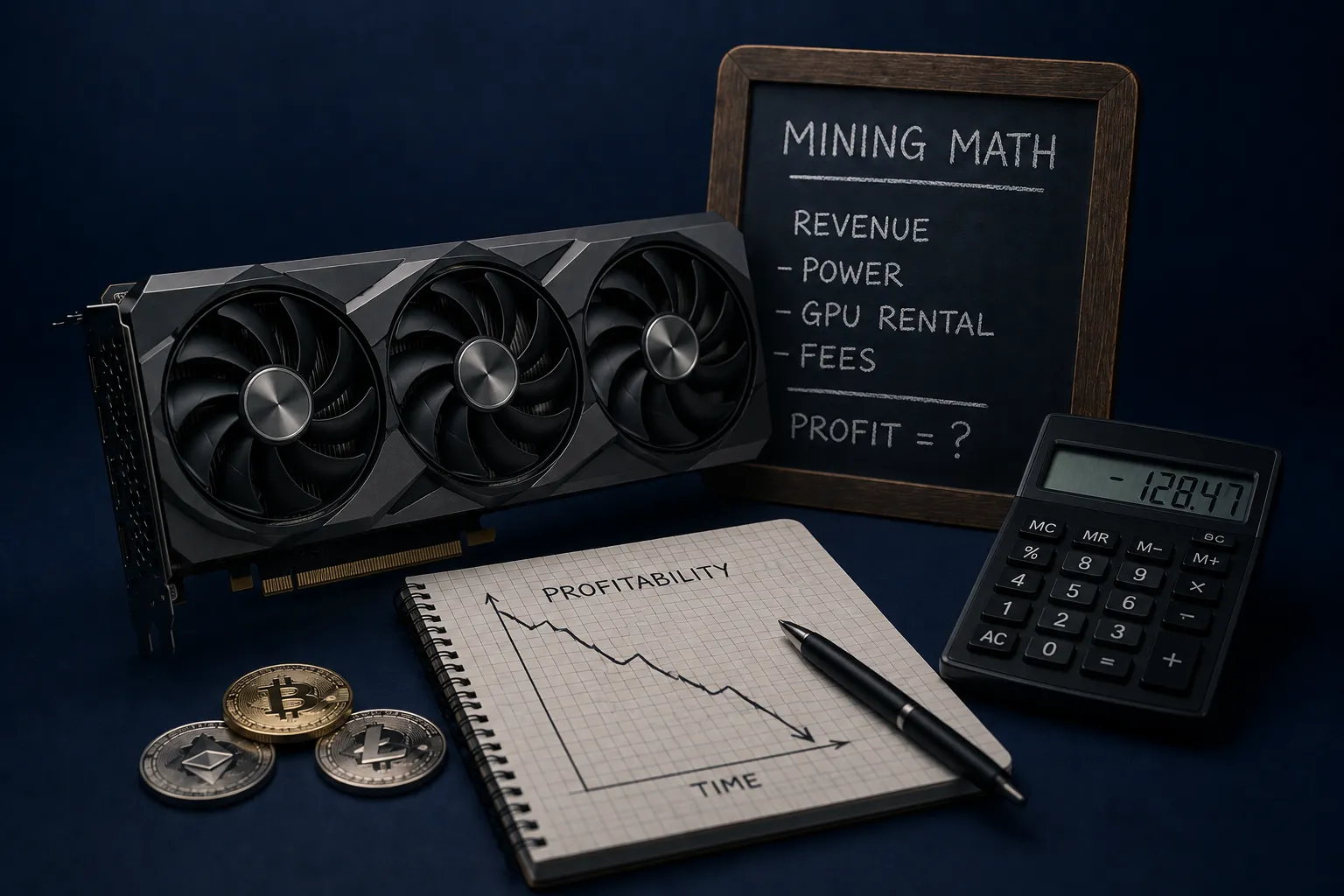
Renting GPU for mining: why the math usually does not work
Renting GPUs for mining is usually not worth it in 2026 unless you have a low all-in rental cost, a provider that explicitly allows mining, stable access, and a live profitability model that still works after fees. Check whether power is included in the rental rate before adding a separate electricity cost. The better question is not “Which GPU rental platform is cheapest?” but “Should rented GPU power be used for mining at all?”
For most users, the answer is no. The same compute time is often better spent on AI training, LLM inference, rendering, simulation, data science, benchmarking, or other gpu workloads that create direct output instead of speculative coin rewards.
The real decision: is GPU mining still worth renting for?
Most people searching for renting gpus for mining want to avoid buying expensive hardware, but in 2026 the short answer is that renting GPUs for crypto mining usually does not make financial sense unless you have a low all-in rental cost, a provider that permits mining, stable access, and a profitability model that still works after fees. The appeal is real: a mining rig with several high-performance gpus can cost thousands or tens of thousands before power supplies, cooling, ram, cpu, networking, storage, and maintenance are included.
GPU rental for cryptocurrency mining means leasing graphics processing units to mine a compatible proof-of-work cryptocurrency instead of owning the hardware. In theory, that gives miners on-demand access to gpu capacity and lets them scale up or down without a capital purchase. In practice, the decision is harder than most comparisons suggest, because rentable compute has to stay profitable after rental cost, any separately charged power, platform policies, interruptions, and network difficulty are accounted for.
This guide is for miners, individual users, and anyone comparing GPU rental options for crypto, while also weighing whether the same rented hardware is better used for AI, rendering, or other productive workloads, similar to broader guides on renting GPUs for AI and deep learning workloads. It breaks down the economics and risks of renting GPUs for mining, compares the main types of GPU rental and cloud mining platforms, looks at how renting stacks up against owning mining hardware, and shows when alternatives like AI training, inference, or other compute jobs produce better returns.
That matters because many miners turn to rentals to skip the upfront spend, but “no hardware purchase” is not the same as “profitable.” The old GPU mining case was stronger when major proof-of-work networks could be mined profitably on consumer hardware. That world changed: Ethereum moved away from proof-of-work, ASICs dominate many profitable markets, and smaller GPU-mineable coins can be volatile, thinly traded, or hard to model. Even a powerful gpu like an RTX 4090 does not fix weak coin economics or expensive rental pricing.
Mining optimization tools do not remove the core constraint: rented compute must produce more value than it costs to rent and run. That is why the real question is not just where to rent a gpu for mining, but whether mining is the right use case at all. For AI training, LLM inference, rendering, or high-performance computing, judge the rental against the output your project needs; those workloads do not guarantee a financial return either.
What most GPU rental comparisons get wrong
Most gpu rental comparisons focus on headline prices: the cheapest gpu cloud, the lowest hourly rate, or the fastest nvidia card available. That is the wrong starting point. A low price per hour only matters if the workload is allowed, stable, and profitable after all costs.
GPU rental prices vary by GPU, location, resource allocation, availability, and provider terms. Use the active quote for the exact configuration you would rent rather than a generic price range. Check billing increments, minimum commitments, and any additional fees. Mining revenue also depends on the time the workload actually runs, so include interruptions in the calculation.
Comparisons also ignore that mining profitability changes quickly. Coin prices move. Difficulty adjusts. Hashrate shifts. A setup that looks profitable at 9 a.m. can fail by the end of the week. Hashrate marketplaces allow users to mine cryptocurrency without owning hardware, but buying hashrate or compute capacity does not remove price volatility, pool risk, or payout uncertainty.
Another mistake is treating every platform as if it allows every workload. Provider policies differ. For example, Google Cloud’s terms require prior written approval for cryptocurrency mining. Check the terms for the exact service and account before running mining software, and obtain any required permission. If the policy is unclear, ask the provider; technical access alone is not permission.
Marketplace access also varies. An offer may provide a container, a virtual machine, or another access model; root access and permission to run mining software are separate questions. Check the listed permissions, allocated resources, security responsibilities, and service terms rather than assuming that a lower price includes unrestricted access.
Marketplace prices on platforms like Vast.ai are influenced by the demand from AI developers willing to pay for GPU resources. That matters because miners are not only competing with other miners. They are competing with developers running ai models, training jobs, inference services, computer vision, and production workloads that may justify a higher pay rate per hour than mining can support.
The biggest omission is opportunity cost. The same gpu access could process data, train neural networks, render images, run simulations, test an api integration, or support a machine learning project, and many users now look at AI rent models for on-demand compute instead of speculative mining alone. When productive compute can create a useful model, dataset, benchmark, or customer-facing service, mining has to clear a much higher bar.
Real evaluation criteria for GPU rental mining rentals
A serious decision about gpu rental for mining should start with all-in economics, not a list of cards. The key question is simple: after every cost and rule, does the rented gpu create more value than it consumes?
Use these criteria before you rent:
- Actual profitability after all costs
Include the rental fee, platform commission, pool fees, rejected shares, setup time, downtime, interruptions, bandwidth, storage, and any data transfer charges. If you own the hardware and rent it out, include power, cooling, hardware wear, internet, maintenance, and depreciation. - Transparent pricing and contract terms
Public prices are easier to model than bidding systems or opaque contracts. Look at whether the platform can change prices, add fees, reduce payouts, or terminate usage. Cost efficiency depends on the real cost per successful hour, not the advertised price. - Whether mining is explicitly allowed
Do not assume mining is permitted because you have root access. Read the provider’s current terms for your service and obtain any required written approval before running mining workloads. - Stability of access
Mining prefers continuous compute. Spot, preemptible, shared, or interruptible instances can break mining economics. Stable on demand access or persistent gpu instances matter more than a small discount if the workload needs uninterrupted usage. - Hidden costs and setup requirements
Mining can require configuration, monitoring, wallet setup, pool tuning, security controls, and data movement. If the platform charges for bandwidth, storage, or extra services, those costs belong in the model. - Environmental impact and energy efficiency
Mining runs hardware hard for long periods. Power use, cooling, heat, and local energy sources matter. Energy is not a side issue; it is central to mining cost and risk. - Risk-to-reward ratio versus alternative gpu uses
Compare mining against AI training, inference, rendering, simulation, research, and high performance computing. If a gpu can create a model, video, dataset, benchmark, or customer-facing output, that may be a better use of compute time than speculative mining, especially given how modern GPUs power AI, research, and high-performance workloads.
This is also where the difference between gpu types matters. A card with more memory and better throughput may be valuable for ai workloads even if its mining return is weak. High memory capacity, full VRAM access, stable servers, low network latency, and reliable support often matter more for productive compute than raw mining hashrate.
Cloud mining services: high caution recommended
Cloud mining contracts are different from renting a GPU instance. A contract may sell a share of mining output or hashrate without giving you direct access to the hardware. Check the operator’s identity, current terms, fees, payout rules, and evidence that the promised capacity exists. As a historical warning, the US Department of Justice reported the sentencing of HashFlare’s operators in August 2025 for a mining-fraud scheme. HashFlare should not be treated as a current provider recommendation.
That structure creates several problems. Customers may not know exactly which hardware is being used, where the mining farms are located, how power is priced, what cooling systems are used, or how maintenance fees are calculated. The provider controls the system, the reporting, and often the payout process.
Long-term contracts are especially risky. Mining difficulty can rise while rewards fall. A contract that appears profitable at purchase can become unattractive if coin prices drop, network difficulty increases, or the service adds maintenance fees. Because mining rewards are variable, a fixed contract can lock users into declining returns.
Hashrate marketplaces allow users to mine cryptocurrency without owning hardware, and they can be useful for advanced miners testing short-term strategies. But they still require careful modeling. Paying for hashrate is not the same as owning profitable mining capacity. You are buying exposure to a process whose economics can change quickly.
Many cloud mining offers have historically underperformed or shut down unexpectedly. Some providers pause payouts, alter terms, or disappear during market stress. That is why cloud mining should be treated as high risk, not as a passive income shortcut. If a service cannot clearly explain hardware, fees, contract duration, payout logic, and risk, it deserves caution.
GPU rental marketplaces: flexible but risky
GPU rental marketplaces may provide direct access to GPU instances, while mining-rig or hashrate rental services can offer a different product. Check what is actually being rented, how access works, and whether mining is permitted. For AI and HPC use cases, Compute by Hivenet is an option to evaluate; that is not confirmation that it permits mining.
The advantage of GPU rental is flexibility: users can select resources for a project without owning hardware. Compare the actual resource allocation, permissions, rental terms, and total price of each offer. Do not assume a marketplace listing provides root access or is cheaper than every managed alternative.
The trade-off is the amount of setup and reliability risk you accept. Check whether an offer is interruptible, which resources are shared, and who maintains the operating system and GPU drivers. Your responsibilities for software, security, monitoring, and recovery depend on the access model. A container user may not be able to change the host driver.
Policy risk is just as important. Even where mining software can technically run, that does not mean the workload is allowed. Check the provider’s terms and obtain any required permission before spending money. For Hivenet, review its terms of service and FAQs, and ask Support to confirm the intended use if the policy is unclear.
Performance can also be variable, throttled, or unstable compared to dedicated hardware. A gpu that looks good on paper may share system resources, suffer from poor cooling, have weak network latency, or deliver inconsistent output under sustained load. For AI developers, that may only slow training. For miners, it can damage the whole profitability model.
Marketplace economics are also changing because ai workloads compete for the same supply. AI developers may pay more for high performance cloud gpus because they need capacity for training, inference, rendering, and production workloads. That demand can push prices above what mining can justify.
Owning mining hardware: higher control, higher risk
Buying GPUs gives miners full control. You choose the gpu model, mining software, power limits, pool, wallet, cooling, system configuration, and location. You are not dependent on a rental platform’s terms, spot availability, or instance interruptions.
That control comes with high upfront cost. A serious mining setup requires GPUs, motherboards, risers, power supplies, ram, cpu, storage, frames, cooling systems, internet, monitoring, and physical space. Large scale operations can spend tens of thousands before generating a single payout.
Ongoing costs are where many ROI calculations fail. Power is usually the biggest expense. Cooling is next, especially when hardware runs continuously. Maintenance, failed fans, dust, heat, noise, safety, replacement parts, downtime, and resale value all matter. Mining is not just “plug in a gpu and print money.”
Hardware depreciation is also severe. New nvidia and AMD cards launch. Network difficulty changes. ASICs take over profitable algorithms. Older cards lose cost efficiency, and newer gpu types with better memory, throughput, and power efficiency can reduce the value of existing rigs.
Owning hardware may still make sense for a narrow group: miners with very cheap electricity, strong cooling, technical skill, stable infrastructure, and high tolerance for market risk. For everyone else, buying hardware for mining can be a way to turn flexible money into depreciating equipment.
The key difference is that owned hardware can be redirected. If mining does not pay, the same high performance gpus might be used for ai training, rendering, data processing time, research, or rented out for compute, as covered in many AI and cloud GPU computing guides. That fallback is often more valuable than the mining plan itself.
Using rented GPUs for machine learning, AI, and productive work instead
The strongest alternative to renting GPUs for mining is using rented GPUs for productive compute. AI training, rendering, simulation, and data science provide clearer value than speculative mining. Instead of hoping coin rewards exceed rental cost, users can create something directly: trained ai models, rendered images, processed data, simulations, benchmarks, or inference systems.
This is where modern gpu access shines. Machine learning teams need compute for neural networks. Researchers need high performance computing. Designers and studios need rendering. Developers need on demand access to test models, run inference, or support a production api. Businesses need throughput and reliability, not mining payouts.
There is no general profitability guarantee for renting GPUs for AI training, LLM inference, or mining. For an AI, rendering, or research project, compare the cost with a defined deliverable: a fine-tuned model, a completed render, a processed dataset, or a working integration. Its value depends on the project and does not establish a universal return advantage over mining.
AI workloads also explain why some gpu rental prices remain high. Developers and companies are willing to pay for memory, speed, stability, and capacity because those resources reduce training time and improve productivity. A gpu with strong VRAM and reliable servers may be worth more for ai training than for mining.
For many users, the practical question is no longer “Can this gpu mine?” It is “What can this gpu create?” If the answer is a model, benchmark, simulation, or production workflow, the compute time has a clearer purpose.
Where Compute with Hivenet fits: quality GPU compute for real work
Compute with Hivenet is best understood as a high-quality GPU compute option for real work, not as a mining-first platform. Unless mining is explicitly allowed and verified, users should not assume Compute with Hivenet supports or encourages crypto mining.
The better fit is productive gpu workloads: AI training and fine-tuning, AI inference, data science, computer vision, rendering, simulation, benchmarking, and research workloads. These are use cases where gpu access creates direct output and where reliability, memory, support, and transparent billing matter.
Check Hivenet’s current GPU rental offer and the active console price before launching. The RTX 4090 hardware guide remains useful as hardware context, but it is not a current rental offer:
- RTX 4090: retired from the Compute fleet and unavailable for new workloads.
- RTX 5090: advertised from €0.75/hr. Review RTX 5090 GPU rental details and confirm the available preset and active price in the console.
The advertised starting price is a planning reference, not a promise that every configuration is available at that rate. Check the selected location, GPU count, CPU, memory, storage, and active price before creating an instance.
Compute’s current fleet is documented in the GPU reference; the RTX 5090 launch announcement provides historical context. Running instances are billed per second, including idle time. Keep enough credits for the job and save important files outside the instance. A starting price or non-spot offer should not be read as a guarantee of uninterrupted execution.
This distinction matters. Mining is energy-consuming speculation. AI, rendering, simulation, and research can create assets, data, models, and productivity. Compute with Hivenet is better suited to that second category: GPU power used for work that produces something measurable.
For a user who came looking to rent GPUs for mining, the practical takeaway is simple: if you already need compute, choose a provider built for stable, productive workloads. If you are only chasing mining returns, model the risk carefully and check provider policies before spending money.
Making the smart choice: economics over hype
Choose cloud mining only if you understand the risk of poor returns. Contracts can be opaque, long-term, and difficult to verify. Check the operator’s current status, hardware transparency, payout rules, fees, and shutdown risk before paying; do not rely on an old provider list as evidence that a service is still available.
Consider GPU marketplaces for temporary experiments only after checking the specific listing, permissions, price, and reliability terms. They are not a default mining plan. Setup responsibilities, interruptions, policy restrictions, and changing revenue can make mining economics fragile.
Consider hardware ownership only with detailed ROI analysis and real risk tolerance. Full control is valuable, but power, cooling, maintenance, depreciation, heat, noise, and hardware obsolescence can overwhelm expected mining income.
Evaluate Compute with Hivenet for AI, rendering, simulation, research, or data-processing work with a defined output. The public RTX 5090 offer starts at €0.75/hr, subject to the selected preset and active console price. The retired RTX 4090 rate is not available for new workloads. Neither price establishes mining permission or profitability.
The smart decision is to focus on GPU rentals that create clear value. Mining may still appeal to some miners in specific conditions, but rented GPU time usually has a better advantage when it supports productivity, models, data, images, simulations, or production workloads. Economics matter more than hype. Use the gpu where the output is real.
Your next workload belongs on Hivenet.
Pick one AI, compute, or storage workload and see the difference for yourself. Spin it up in minutes, or let our team map your fastest path to production.