
Sign in to Hivenet
Access your files and manage your storage account.
Store
Access your files and manage your storage account.
Compute
Launch instances and manage your compute resources.
Store and Compute still use separate accounts today. We’re working on a unified sign-in.
Just need to send a file?
Use Send directlyNew to Hivenet? Get Started
Get started with Hivenet
Choose what you want to use first.
Store
Back up photos and files across your devices.
Compute
Launch self-serve GPU compute for demanding work.
Store and Compute still use separate accounts today. We’re working on a unified account experience.
Need Hivenet for business?
Talk to salesNeed to send a file?
Open SendAlready have an account? Sign in
Cloud computing vs distributed computing: key differences
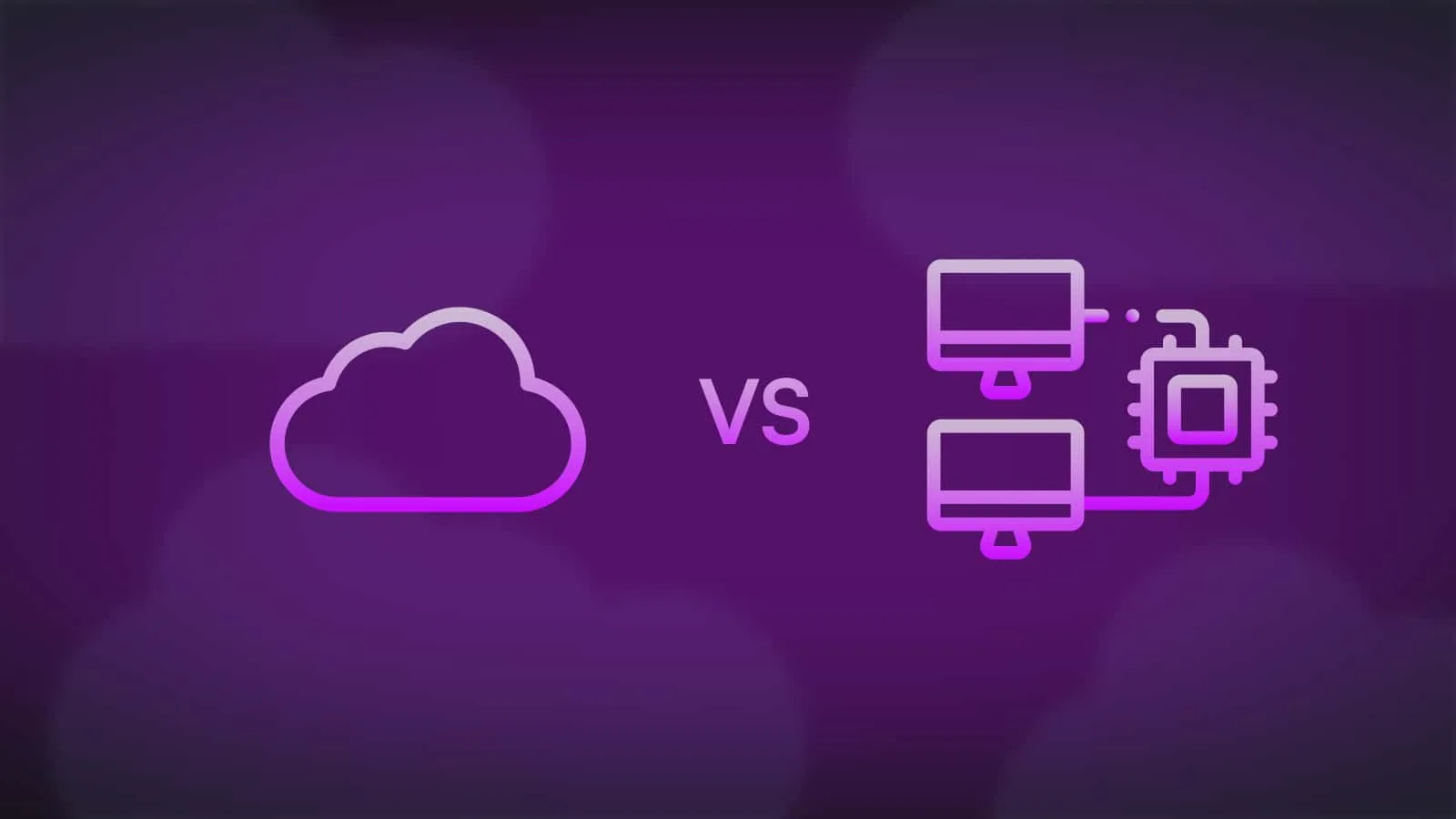
Cloud computing and distributed computing describe different decisions. Cloud computing is a way to provision and consume computing services. Distributed computing is a way to design a system so multiple networked computers coordinate on one workload or service.
They often overlap. A cloud provider may use distributed systems underneath its services, and a team may deploy a distributed application on cloud instances. But a cloud resource can be a single virtual machine, while a distributed system can run on owned servers, edge devices, research clusters, or volunteer computers without being offered as a cloud service.
The practical question is therefore rarely “cloud or distributed?” Start by deciding how you want to obtain and operate infrastructure, then decide whether the workload needs distribution for scale, resilience, parallel work, or locality.
Cloud vs distributed computing: the short answer
| Dimension | Cloud computing | Distributed computing |
|---|---|---|
| Primary question | How are computing capabilities provisioned, delivered, managed, and measured? | How do multiple computers coordinate work and state? |
| Defining property | On-demand access to pooled resources through a service model | Components on separate computers communicate through a network |
| Typical interface | Console, API, managed endpoint, or hosted application | Messages, remote calls, queues, shared protocols, or distributed data stores |
| Infrastructure ownership | Provider, customer, or a combination, depending on the deployment model | One organization, several organizations, or individual participants |
| Scaling | Provision or release service capacity | Partition work, replicate state, or add cooperating nodes |
| Main operating risk | Misconfiguration, provider dependency, cost drift, service limits, and unclear responsibility | Partial failure, coordination errors, partitions, stale state, and operational complexity |
| Example | A managed database, object-storage service, or rented VM | A database cluster, parallel compute job, or replicated application |
The categories are not opposites. “Cloud” describes a service and operating model. “Distributed” describes system structure and behavior.
What cloud computing means
The NIST definition of cloud computing identifies five essential characteristics: on-demand self-service, broad network access, resource pooling, rapid elasticity, and measured service. These properties distinguish a cloud service from ordinary remote hosting or a server reached over the internet.
Cloud computing changes the boundary between provider and customer. Instead of buying and operating every physical component, the customer consumes a defined capability and manages the layers that remain under its control.
Service models change what the customer operates
- Infrastructure as a Service (IaaS): The provider supplies compute, storage, and networking resources. The customer still manages operating systems, applications, identities, data, and much of the configuration.
- Platform as a Service (PaaS): The provider also operates more of the runtime and deployment platform. The customer focuses on applications and data.
- Software as a Service (SaaS): The customer uses the provider's application and controls a narrower set of user, data, and configuration choices.
Modern product labels do not always fit neatly into three boxes, but the operating question remains useful: which layer is the provider promising to run, and which layer is still yours?
Deployment models describe access and ownership
Public, private, community, and hybrid cloud describe how cloud infrastructure is made available and governed. They do not tell you whether an application uses one process or hundreds of cooperating services. A private cloud can host a distributed application, and a public cloud account can run one standalone VM.
What distributed computing means
A distributed computing system has components on more than one computer that communicate and coordinate to deliver a result. The computers may divide a large calculation, serve different parts of an application, hold replicas of data, or take over when another component fails.
Distribution creates capabilities that one machine may not provide, but it also introduces network delay and partial failure. One node may be healthy while another is unreachable. A message may be delayed, duplicated, or lost. Two components may temporarily disagree about membership or state. Google's SRE guidance on distributed consensus explains why leader election, locks, queues, membership, and critical shared state need tested coordination rather than informal assumptions.
Kubernetes is a familiar example, although it is not the definition of distributed computing. Its node architecture places workloads on physical or virtual machines managed by a control plane, tracks capacity, uses heartbeats, and reacts when nodes become unhealthy. A cluster can run in a public cloud, a private cloud, or an on-premises environment.
For deeper application design, see the distributed systems in cloud computing guide. For nodes, links, routing, overlays, and failure domains, use the distributed network architecture guide. Distribution also does not imply shared ownership; the distributed versus decentralized systems guide separates those concepts.
How cloud and distributed computing overlap
Cloud platforms rely on distributed infrastructure to pool capacity, place workloads, store data, and maintain service availability. Customers may not see those internal systems because the provider exposes a simpler service interface.
Customers also build their own distributed systems on cloud resources. A team might run an application across several instances and zones, use a managed queue, replicate a database, and store objects through an API. In that design, responsibility is layered: the provider operates the cloud service boundary, while the customer still owns application behavior, data choices, identities, configuration, and recovery decisions.
Distributed cloud is one point of overlap. It extends cloud services across more locations while retaining cloud-style provisioning and management. It is still a cloud operating model; it is not a synonym for every cluster, peer-to-peer system, or geographically distributed application.
Compare the models by the decision that matters
Provisioning and operational control
Cloud services reduce the time and capital needed to obtain capacity. The tradeoff is a provider-defined interface, service catalog, quota model, and responsibility boundary. Distributed computing gives the application designer control over placement, partitioning, replication, and coordination, but someone must build and operate that behavior.
Using IaaS does not remove distributed-systems work. It moves physical infrastructure tasks to the provider while leaving the customer responsible for the architecture running above it.
Scale and workload shape
Cloud elasticity is useful when demand changes and capacity can be provisioned or released through an API. Distribution is useful when work can be divided or when one machine cannot meet the required throughput, memory, locality, or availability target.
Adding nodes is not automatically useful. Communication, data movement, coordination, and scheduling can cost more than the parallel work saves. Measure the real workload before turning a single-node application into a distributed one.
Reliability and failure handling
A provider may offer durable services and several locations, but the customer's deployment still needs an explicit failure design. One instance in one zone remains one instance. A distributed system can continue through selected failures only when replicas cross real failure domains, health signals are meaningful, capacity exists on the surviving path, and failover has been tested.
Judge availability from successful user operations, not from the number of nodes or regions on a diagram. Define recovery objectives, decide which state must be replicated, and test degraded operation and restoration.
Performance and data placement
Cloud services can put capacity near users or data, but distance still affects latency and transfer cost. Distributed computing can process work closer to its source or across several nodes, yet synchronization and cross-location traffic add overhead.
Keep tightly coupled work close enough to communicate efficiently. Distribute when locality, parallelism, independent failure domains, or regional placement produces a measurable benefit.
Cost and portability
Cloud replaces much upfront infrastructure spending with metered service consumption, but the bill depends on runtime, storage, requests, data movement, support, and idle capacity. A self-operated distributed system adds hardware, facilities, staffing, maintenance, and recovery costs even when no provider invoice shows them.
Compare complete workload cost at the required service level. Include migration and exit work, data transfer, managed-service dependencies, and the engineering time needed to operate alternatives. Sustainability comparisons need the same discipline; the green cloud comparison explains why workload and measurement boundaries matter.
Security, responsibility, and compliance
Cloud security follows a shared-responsibility boundary that changes by service. AWS's shared responsibility guidance, for example, separates provider-operated infrastructure from customer responsibilities such as applications, identities, data, and configuration. A managed service can reduce operational work without transferring every security or compliance duty.
Distributed systems widen the set of nodes, communications paths, credentials, and failure states to protect. Use strong workload identity, least privilege, encryption, segmentation, patching, monitored administrative changes, and tested recovery.
Server location alone does not prove compliance. The ICO's current cloud and international-transfer guidance requires organizations to examine the legal entities, roles, contracts, processing, transfers, and safeguards involved.
Which approach should you choose?
| Need | Likely starting point | What to verify |
|---|---|---|
| Rapid access to compute, storage, software, or managed services | Cloud service | Service boundary, region, quota, cost, recovery, and exit path |
| One workload exceeds a single machine | Distributed or parallel design | Work partitioning, communication overhead, scheduler, and failure recovery |
| Application must tolerate selected node or site failures | Distributed deployment, often on cloud infrastructure | Failure-domain independence, replication, capacity, consistency, and tested failover |
| Data or processing must stay near a location | Regional cloud, edge, or distributed deployment | Actual data flows, contracts, latency, transfer rules, and operations |
| Small stable workload with simple recovery needs | One well-operated system may be enough | Whether distribution would solve a measured problem |
| Managed interface over distributed infrastructure | Use both models | Which complexity the provider absorbs and which remains with the customer |
How Hivenet fits
Hivenet is an example of the two models working together. Its current architecture overview describes cloud services built on distributed infrastructure for compute, managed inference, S3-compatible storage, personal file storage, and file transfer.
The products do not all use one architecture. Compute gives teams instance-level access, Inference provides managed OpenAI-compatible endpoints, S3 storage uses familiar object-storage tools, Store supports everyday files, and Send handles link-based transfer. The cloud layer provides usable service interfaces; the infrastructure and software below use product-specific distribution.
For storage products using Hivenet's distributed storage model, files are encrypted, split into fragments, and distributed across nodes inside the selected region. Compute, Inference, and other products have different operating models. The Hivenet trust page documents the current infrastructure, research, interface, and placement boundaries.
A practical decision sequence
- Define the workload. Record latency, throughput, capacity, availability, recovery, security, and location requirements.
- Choose the service boundary. Decide whether you need SaaS, a managed platform, infrastructure control, or owned hardware.
- Test whether distribution is necessary. Identify the measured limit that another node or location would solve.
- Map responsibility. Name who owns identities, patching, data, networking, replicas, recovery, monitoring, and provider configuration.
- Model failures and cost. Include partial failure, dependency loss, transfer, idle capacity, staffing, and exit work.
- Prototype the smallest useful design. Measure it under realistic load and failure before adding regions or coordination layers.
Frequently asked questions
Is cloud computing a type of distributed computing?
Cloud platforms commonly use distributed systems, but the terms describe different properties. Cloud computing is defined by service delivery characteristics such as on-demand provisioning, pooling, elasticity, and measurement. Distributed computing is defined by coordinated work across networked computers.
Can distributed computing run without the cloud?
Yes. A distributed system can run on owned servers, university or research clusters, edge devices, peer machines, or hardware operated by several organizations.
Can a cloud workload be non-distributed?
Yes. A single rented VM or a small hosted application may use cloud provisioning without distributing the customer's workload across several computers.
Does distributed computing always improve reliability?
No. It improves tolerance only for failures the design anticipates and tests. Shared dependencies, insufficient failover capacity, unsafe coordination, or correlated locations can make a multi-node system less reliable.
Which model is cheaper?
Neither is universally cheaper. Compare provider consumption and transfer charges with hardware, facilities, engineering, maintenance, recovery, and migration costs at the same performance and availability target.
Choose the operating model, then the architecture
Cloud computing decides how a capability is delivered and who operates each layer. Distributed computing decides how several computers cooperate and what happens when communication or components fail.
Choose the service boundary first. Add distribution only for a concrete requirement, then verify it with workload measurements, failure tests, security evidence, and a complete cost model. In many production systems, the right answer is a cloud service carrying a deliberately designed distributed workload.
Your next workload belongs on Hivenet.
Pick one AI, compute, or storage workload and see the difference for yourself. Spin it up in minutes, or let our team map your fastest path to production.