
Sign in to Hivenet
Access your files and manage your storage account.
Store
Access your files and manage your storage account.
Compute
Launch instances and manage your compute resources.
Store and Compute still use separate accounts today. We’re working on a unified sign-in.
Just need to send a file?
Use Send directlyNew to Hivenet? Get Started
Get started with Hivenet
Choose what you want to use first.
Store
Back up photos and files across your devices.
Compute
Launch self-serve GPU compute for demanding work.
Store and Compute still use separate accounts today. We’re working on a unified account experience.
Need Hivenet for business?
Talk to salesNeed to send a file?
Open SendAlready have an account? Sign in
What are data centers? How they work and why cloud computing still needs them
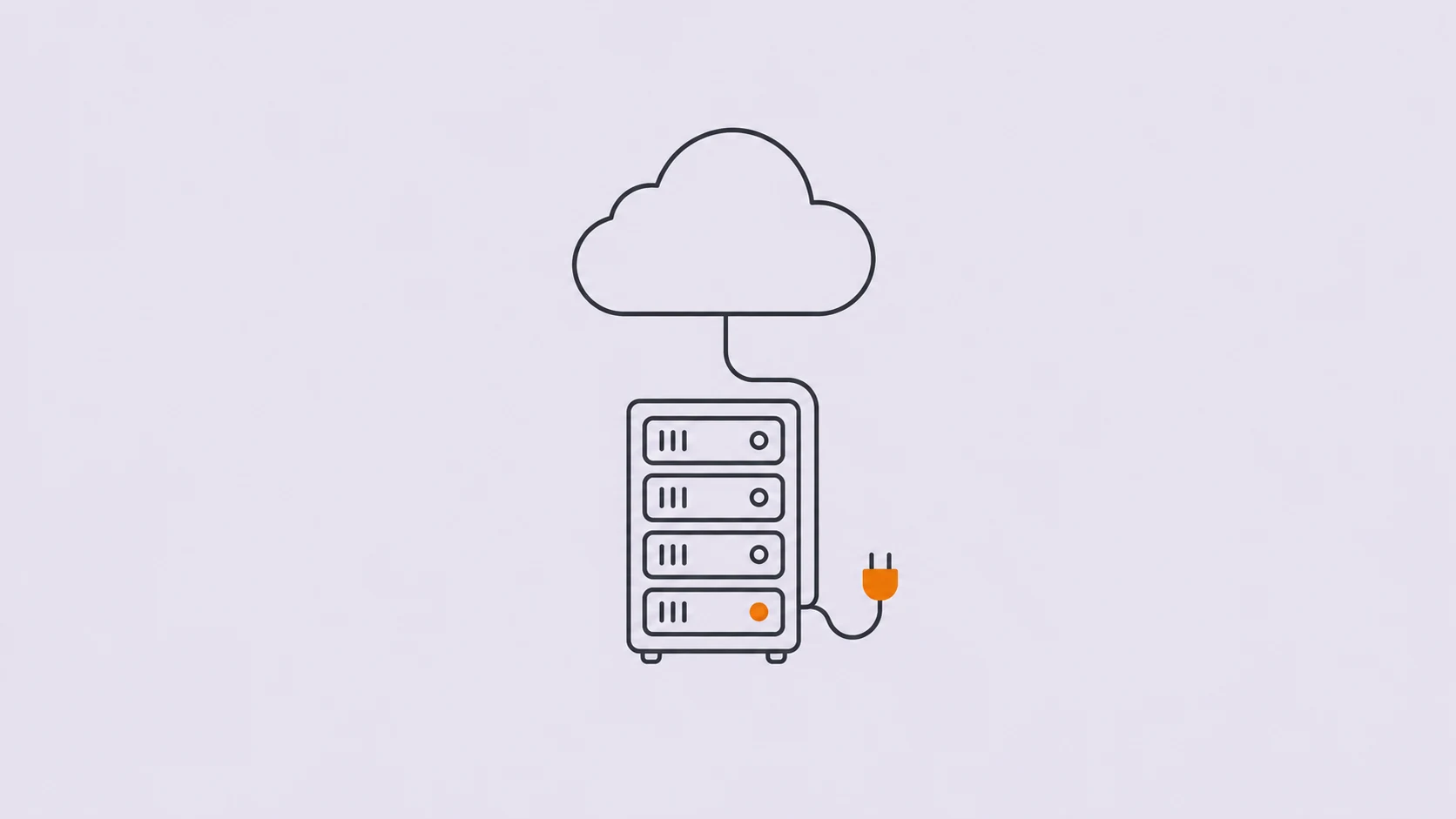
A data center is a physical site that houses servers, storage, and network equipment, together with the power, cooling, security, and operational systems that keep them working. It can occupy a room, a dedicated building, or a campus of buildings.
Cloud computing depends on this equipment. A cloud platform adds the software and service interfaces that let customers request resources without managing every underlying machine. An organization can operate a data center without offering cloud services, or use a cloud service without owning a facility.
This guide is for readers evaluating infrastructure or trying to understand what sits behind digital services. It explains the components, operating models, reliability questions, and local effects of data centers, including the demands of AI workloads.
What is inside a data center?
The equipment that processes information and the systems that support it must be designed together. A room with space for more servers may still lack the electrical capacity, cooling, or network connections to use them.
Compute, storage, and networking
Servers contain processors, memory, and often local drives. CPUs handle general application work; GPUs and other accelerators suit particular parallel workloads. Racks organize equipment and its connections. A rack is a mounting structure, not a fixed amount of computing capacity.
Storage may include server drives, shared storage arrays, backup systems, and software that presents file, block, or object storage. Data can be replicated or divided across several devices and sites. Its placement depends on the service design, so an uploaded file does not necessarily exist as one complete copy on one disk.
Switches, routers, fiber, and copper cabling connect servers to storage, other servers, and external networks. Internal traffic between machines has different requirements from traffic entering through an internet connection. A private facility can also support applications that are never publicly accessible.
Cisco's data center overview describes these computing, storage, and network components and the supporting facility systems.
Power and backup systems
Electrical infrastructure takes power from the supply connection through distribution equipment to the racks. Uninterruptible power supplies (UPS) can bridge short interruptions while another source becomes available. Batteries, generators, switchgear, and distribution paths must be sized and maintained for the intended load.
Backup equipment has limits. Battery runtime, generator starting reliability, fuel availability, and maintenance affect how long a facility can continue operating. Two power connections also need scrutiny: they may share an upstream dependency.
Cooling and environmental control
Computing equipment releases heat that must leave both the equipment and the facility. Designs may use air cooling, chilled-water systems, direct-to-chip liquid cooling, or immersion cooling. Temperature, humidity, airflow, and leak monitoring help operators keep hardware within its supported conditions.
A liquid circuit at the chip does not reveal how the facility ultimately rejects heat. That circuit may connect to equipment that uses outdoor air, a chiller, or an evaporative cooling tower. Water consumption therefore depends on the whole system and the local climate. The US Department of Energy's cooling guide explains these separate stages.
Physical security and operations
Controlled entrances, equipment cages, visitor records, surveillance, and fire detection protect the site and its occupants. Monitoring systems track hardware health, electricity use, temperature, and network conditions. Data center infrastructure management tools can bring readings and capacity information together for operators.
The operational work continues after installation: replacing failed components, testing alarms, managing cabling, checking backup systems, and planning maintenance. A security control or spare component is useful only if people know how and when to use it.
What do data centers do, and how do they work?
Data centers host websites, databases, email, business applications, video services, backups, AI training and inference, and scientific computing. They support public services and private organizational networks. The work performed depends on the software and equipment installed.
Consider a business application retrieving a customer record:
- A request reaches the service through a network connection and the relevant access controls.
- A server executes application code and requests the required data.
- A storage or database system returns the data, and the application sends a response.
- Power delivery and cooling support the equipment throughout the operation.
- Monitoring records conditions and faults so operators or automated systems can respond.
These steps overlap in practice. A single request may involve several applications or facilities. Cloud software can automate provisioning, allocation, monitoring, and billing above this physical infrastructure.
Types of data centers
Data center labels describe different things: who operates the equipment, how customers use it, where it sits, or how it is built. They can overlap. A cloud provider might run equipment in a colocation facility, while an edge site might use modular construction.
- Enterprise data center: serves primarily one organization, which retains substantial responsibility for the infrastructure and its operation.
- Colocation data center: rents customers space and supporting services such as power, cooling, physical security, and connectivity options. Customers usually supply or lease their own IT equipment; extra management services depend on the contract.
- Managed data center: a provider operates agreed equipment or services for a customer. The division of responsibility matters more than the label.
- Cloud data center: supports a cloud platform whose customers consume computing services. It does not describe one universal facility architecture.
- Hyperscale data center: supports computing and storage at very large scale. Definitions vary, so a single server count or floor-area threshold is a poor comparison on its own.
- Edge data center: places infrastructure nearer relevant users, devices, or data sources. Potential benefits include shorter network paths and less long-distance traffic; actual latency still needs measurement.
- Modular or micro data center: packages infrastructure into prefabricated or compact units. The format does not by itself establish capacity, deployment speed, efficiency, or reliability.
IBM's overview of data center models provides further context on enterprise, cloud, managed, and colocation arrangements.
Data center, cloud, server room: what is the difference?
A data center is the physical environment. Cloud computing is a way of delivering configurable resources as services. A server room is usually a smaller space within another building, though there is no universal size boundary separating it from a data center.
Colocation describes an operating arrangement within a data center. It does not automatically provide a cloud platform, managed applications, or backups. Those services must be specified separately.
NIST's definition of cloud infrastructure distinguishes the physical resources from the abstraction software above them. That distinction explains why moving to the cloud changes operational responsibility while leaving a dependence on real equipment. A private cloud can run inside an organization's own facility; public cloud services use infrastructure operated for customers by a provider.
Reliability depends on the facility and the application
Redundant power, cooling, and networking can protect against selected failures. They do not make every failure harmless. Equipment may share a distribution path, software may fail across replicas, or a maintenance error may affect several supposedly independent systems.
Ask which components can be taken offline for maintenance, which failures the design tolerates, and how those behaviors are tested. Facility certification, service-level commitments, and application recovery procedures answer different questions. A contractual uptime commitment also needs a defined measurement period, exclusions, and remedies.
For an application, distinguish replication from backup. Replication can keep a service available after a device fails, but it can also copy an accidental deletion. Backups require separate retention and a tested restore process. Establish how much data loss is acceptable and how long recovery can take.
Physical security is one part of protection. Identity management, access permissions, patching, encryption, network segmentation, and application configuration still matter. Moving equipment into a secure building does not correct an exposed database or an overprivileged account.
Why data center location matters
Location affects access to electricity, connectivity, staff, spare parts, and expansion space. Climate and exposure to floods, fires, or other hazards influence facility design and recovery planning.
For customer-facing applications, test network performance from actual user locations. Geographic distance is only one factor; routing, congestion, interconnection, and the application's dependencies can change the result. Moving an application nearer its users may accomplish little if it repeatedly contacts a database far away.
Data-location requirements also need a service-level answer. Ask where primary data, replicas, backups, logs, and support access are located. Choosing a country does not, by itself, establish compliance, security, or control over every part of a service.
Power, water, and the local impact of data centers
Electricity supplies the IT equipment and the systems that keep it operating. The IEA's 2026 Energy and AI update estimates global data center electricity consumption at 485 TWh in 2025 and projects about 950 TWh in 2030. The latter is a central projection, not a measured outcome or a claim about AI alone.
A global figure cannot describe an individual site's impact. Relevant questions include when electricity is needed, which generation serves it, whether grid upgrades are required, and how their costs are allocated. A facility's contracted capacity and its actual energy consumption are different measurements. Our separate article collects 10 data center facts about energy, water, and waste, with dates and source boundaries.
Water assessment should separate direct facility use from water associated with electricity generation. It should identify the cooling design, source of water, local availability, and seasonal demand. A closed loop inside the building does not prove that the entire cooling system consumes no water.
Power usage effectiveness (PUE) compares total facility energy with IT equipment energy. It helps describe facility overhead, but does not measure how much useful work the servers perform or their total carbon footprint. Hardware manufacture, construction, electricity sources, equipment utilization, and end-of-life handling need separate consideration.
Why residents raise concerns about new facilities
Community concerns can involve continuous equipment noise, construction traffic, land use, water demand, backup-generator emissions, and new grid infrastructure. Projects can also generate tax revenue and employment, but construction jobs and permanent operating jobs are different benefits.
Virginia's 2024 JLARC study documents both economic benefits and local impacts, including noise issues at some sites near homes. Its findings are specific to Virginia; they are a useful set of questions for other locations, not a universal prediction.
A credible assessment should explain the proposed site's design and operating conditions, publish relevant evidence, and identify who responds if conditions differ from the plan. Neither “green data center” nor “distributed infrastructure” supplies that evidence by itself. Hivenet's sustainability methodology explains the scope and assumptions behind its own environmental claims.
How AI changes infrastructure requirements
Large AI workloads can place many accelerators in a small space. Facility planning must account for the resulting power and heat, while system design must supply data and connect the accelerators efficiently. Existing space alone is not proof that a facility can support a dense GPU deployment.
- Electrical capacity: check supported rack loads and how power changes during the workload.
- Cooling: match the equipment's thermal requirements to the facility's complete heat-removal path.
- Networking: measure communication between machines when a job spans multiple nodes.
- Storage: check whether data loading and checkpoint writing keep pace with the compute workload.
These requirements vary by model, hardware, and workload. A small inference service does not have the same needs as a large training cluster. Our GPU cluster guide explains the related compute, network, and storage decisions.
Centralized and distributed infrastructure
Large regional facilities concentrate capacity and operations. Distributed architectures place resources across multiple sites and coordinate them through software. A system can combine large facilities with smaller regional or edge sites.
Several sites can create options for workload placement and recovery, but the outcome depends on data replication, spare capacity, network links, and failure handling. Distribution also adds coordination work. A workload that exchanges data frequently between sites may pay for that distance in time, bandwidth, or complexity.
Distribution describes placement and coordination; decentralization concerns how control is shared. The two need not coincide. See our explanation of distributed and decentralized systems.
Where Hivenet fits
Hivenet's distributed cloud architecture connects Policloud-backed physical infrastructure with cloud software and customer interfaces. Its services include Compute with Hivenet, Inference API, S3-compatible storage, Store, and Send. Their architectures and customer responsibilities differ by product.
This is an example of the facility and service layers working together. It does not remove the need for power, cooling, network capacity, or hardware maintenance, and it does not establish one environmental or performance result for every service.
Questions to ask before choosing infrastructure
Start with a representative workload and its operating requirements. Then compare what each option actually provides:
- Performance: which CPU, GPU, memory, storage, and network resources are required, and can the provider demonstrate them under your workload?
- Responsibility: who maintains hardware, operating systems, applications, access controls, and backups?
- Recovery: what happens after a machine, network connection, or whole site fails?
- Placement: where will data, replicas, logs, and backups reside?
- Capacity: is the required power and equipment available now, and how is expansion handled?
- Cost: what will connectivity, data transfer, backup, support, idle capacity, and staff time add to the headline price?
- Environmental evidence: what is measured, over which period, and for which facility or service?
Record these answers before comparing proposals. A test deployment and a documented restore exercise often reveal more about suitability than a facility label or an advertised maximum.
Frequently asked questions
Does using the cloud mean using someone else's data center?
For a public cloud service, the provider operates or arranges the underlying infrastructure. An organization can also build a private cloud on its own equipment. In either case, the cloud service depends on physical resources.
Does every data center use water for cooling?
No. Cooling designs differ. Some consume water through evaporation; others use different heat-rejection methods. Ask about the entire facility system and distinguish onsite water use from water associated with electricity production.
Can a data center keep running through any power outage?
No facility design covers every possible event. Backup duration and successful transfer depend on equipment, maintenance, fuel or stored energy, and the failure involved. Applications also need a recovery plan if a site becomes unavailable.
Is a smaller or distributed data center automatically more sustainable?
No. Compare the actual workload, utilization, electricity supply, cooling, hardware lifetime, redundancy, and network requirements. Size and distribution alone cannot establish the result.
Your next workload belongs on Hivenet.
Pick one AI, compute, or storage workload and see the difference for yourself. Spin it up in minutes, or let our team map your fastest path to production.