

Connectez-vous à Hivenet
Accédez à vos fichiers et gérez votre compte de stockage.
Boutique
Accédez à vos fichiers et gérez votre compte de stockage.
Calculer
Lancez des instances et gérez vos ressources de calcul.
Store et Compute utilisent toujours des comptes distincts aujourd'hui. Nous travaillons sur une connexion unifiée.
Vous avez juste besoin d'envoyer un fichier ?
Utilisez Envoyer directementVous êtes nouveau sur Hivenet ? Commencez
Commencez avec Hivenet
Choisissez ce que vous voulez utiliser en premier.
Boutique
Sauvegardez des photos et des fichiers sur tous vos appareils.
Calculer
Lancez le calcul GPU en libre-service pour les tâches exigeantes.
Store et Compute utilisent toujours des comptes distincts aujourd'hui. Nous travaillons sur une expérience de compte unifiée.
Vous avez besoin de Hivenet pour votre entreprise ?
Parlez au service des ventesVous avez besoin d'envoyer un fichier ?
Ouvrir EnvoyerVous avez déjà un compte ? Connectez-vous
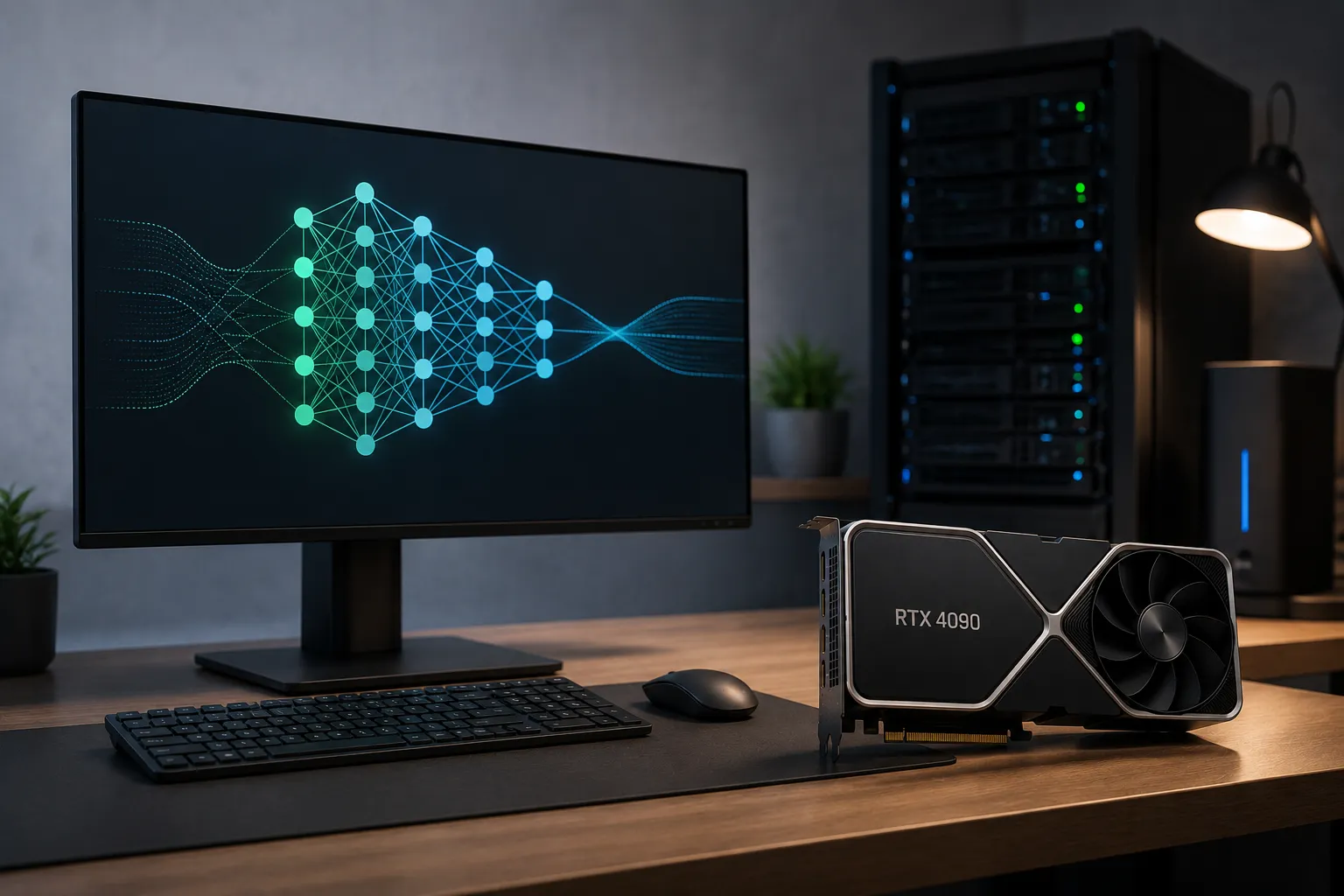
Inférence GPU : le guide complet pour l'exécution de modèles d'IA en production
GPU inference is the process of running a trained AI model on new data with GPU acceleration so the model can produce useful outputs quickly: text, images, embeddings, classifications, detections, recommendations, or predictions. It is where artificial intelligence moves from research into production, and it is often where AI workloads spend most of their time, hardware, and budget.
Training gets attention because it is technically demanding. Inference becomes the daily operational problem because a trained model may be used thousands, millions, or billions of times after training is complete. For teams building generative AI products, recommendation systems, computer vision tools, AI reasoning systems, or large language models, the important question is not only “Can this model run?” It is “Can this model run fast enough, reliably enough, and cheaply enough at scale?”
What is GPU inference?
GPU inference means using graphics processing units to run a trained AI model against new input data and return inference results. The trained model already has model weights; inference does not create those weights. Instead, the model applies what it learned during AI training to a specific task such as answering a prompt, classifying an image, detecting an object, generating an embedding, ranking recommendations, or producing a prediction.
That makes inference different from training and fine-tuning. Training builds model weights from data. Fine-tuning adapts an existing trained model to a narrower dataset, domain, or behavior. Inference runs the model as-is to produce outputs from new data. If training is how an AI system learns, inference is how an AI application does work for users.
Common inference tasks include:
- Text generation with large language models for chatbots, copilots, summaries, and AI reasoning.
- Image classification for identifying categories in images.
- Object detection for real-time video analysis, safety systems, autonomous vehicles, and self driving cars.
- Embeddings for semantic search, retrieval-augmented generation, recommendations, and similarity matching.
- Recommendation scoring for ranking products, content, ads, or next actions.
- Image generation and diffusion inference for creative and visual AI applications.
GPU inference is ideal for real-time data processing and large-scale data handling, making it suitable for applications like chatbots, real-time video analysis, and self-driving cars. GPUs are essential for AI inference as they can handle real-time processing requirements, making them ideal for applications like chatbots, real-time video analysis, and recommendation systems.
The reason inference matters so much is simple: this is where AI becomes useful. A model sitting in storage has no value until it processes input data and produces a result. For modern AI workloads, especially generative AI and LLM inference, the quality of the user experience depends on inference performance: low latency, high throughput, stable memory behavior, and predictable cost.
Training vs inference: where AI costs really live
Training builds a model once, or occasionally, while inference runs repeatedly. A company may spend a large amount on AI training or fine-tuning, but the trained AI model can then be queried every minute of every day. That repetition changes the economics. A model may cost $100k to train but $1M+ annually to serve if user volume, context length, token generation, and infrastructure overhead are high enough.
This is why inference is not “easy training.” Training usually requires massive compute bursts: many high performance GPUs working for days or weeks, often in a data center cluster with high-speed interconnects. Inference needs sustained reliability. It must keep serving users, keep latency within acceptable limits, and keep cost per useful output under control. High throughput and low latency are critical for GPU inference, as they enable efficient processing of large amounts of data in real-time applications.
The resource profile is different too. Training is dominated by large floating point operations, gradient calculations, optimizer states, and distributed compute. Inference often has lower compute per request, but it may run at enormous volume. It is also frequently constrained by gpu memory, kv cache growth, memory bandwidth, cold starts, batching behavior, and framework overhead. For large language models, the cost of AI inference is often measured in terms of the cost per token, as the computational resources required to process and generate tokens can be significant.
Inference receives less attention because it is less dramatic than training a frontier model. But operationally, inference is where most AI products succeed or fail. A slow chatbot feels broken. A real-time detection model that misses latency targets cannot be used in safety-sensitive environments. A recommendation system that is too expensive per request may not scale profitably. A generative ai feature that works in testing but becomes expensive in production needs a different infrastructure plan.
There is also a difficult balancing act. High performance in AI inference often requires overprovisioning GPUs, which can increase costs, making it challenging to balance latency, cost, and throughput. Teams may reserve more hardware than average demand requires so they can survive peak traffic. That improves reliability but raises cost. The goal is not simply maximum performance; it is better economics at the required service quality.
Why GPUs excel at AI inference
GPUs are effective for AI inference because neural network workloads are built around parallel math. Matrix multiplications, convolutions, attention operations, vector operations, and activation functions can be split across many cores. The architecture of GPUs, which includes thousands of cores, allows them to perform parallel processing, significantly speeding up the computations required for AI tasks compared to CPUs.
A CPU is excellent for general-purpose control flow, branching, system tasks, and fast single-thread performance. A GPU is built for throughput. Graphics processing units execute many operations at once, which is exactly what complex models need when processing tensors. AI inference involves using trained models to make predictions on new data, and GPUs are optimized for this task, providing the necessary computational power to handle complex models efficiently.
NVIDIA GPUs play a major role because much of the AI ecosystem has been built around CUDA, Tensor Cores, and mature model-serving tooling. Tensor Core performance matters for FP16, BF16, INT8, FP8, and other quantized formats because these units accelerate the dense math used in large models. This is one reason nvidia inference stacks, including TensorRT and TensorRT-LLM, are widely used for production inference performance.
Precision is central to inference economics. FP16 and BF16 are common because they reduce memory and increase speed compared with FP32 while maintaining accuracy for many models. INT8 and INT4 can reduce gpu memory requirements further. FP8 is increasingly important on newer high performance gpus, including advanced data center platforms. NVIDIA Blackwell Ultra hardware has pushed inference throughput for reasoning models forward, and future nvidia hardware roadmaps such as NVIDIA Vera Rubin point toward even more specialized hardware for modern ai workloads.
Memory bandwidth is often as important as raw floating point operations. Large models must move model weights, activations, and kv cache data through memory constantly. If memory bandwidth becomes the limiting factor, a GPU with impressive theoretical compute may still underperform. Strong memory bandwidth is especially important for LLM inference, long-context workloads, large batch sizes, and ai reasoning tasks where attention operations read large amounts of cached context.
That is the architectural advantage: GPUs combine parallel processing, high memory bandwidth, large gpu memory pools, and specialized units for lower-precision math. For many inference tasks, this combination can reduce processing time dramatically compared with cpu inference.
Key factors affecting GPU inference performance
Inference performance depends on more than the GPU model name. The choice of GPU directly impacts throughput, latency, memory limits, and overall cost for AI inference tasks. Different gpus can behave very differently depending on model size, precision, batch size, runtime, and the specific task.
The most important factors are:
- VRAM capacity. The model weights, activations, kv cache, runtime overhead, and concurrent requests must fit in gpu memory. If they do not fit, the system may fail, page to system memory, or slow down sharply. A single gpu with 24 GB of VRAM can be very cost effective for small models and many 7B to 13B LLM workflows, but larger models may need quantization, offloading, or multiple GPUs.
- Memory bandwidth. LLMs and large models often become memory-bound. The GPU needs to move weights and cache data quickly enough to keep compute units busy. Memory bandwidth is a common limiting factor in long-context inference.
- Batch size. Larger batches usually improve high throughput by keeping the GPU busier, but they can increase per-request latency. Real time inference, such as chat, needs low latency. Batch inference, such as embedding generation, can optimize for throughput and cost.
- Quantization. Quantization reduces the precision of model weights and activations to smaller data types, which can lead to faster inference times and lower memory usage. INT8, INT4, FP8, GPTQ, AWQ, and mixed-precision methods are common optimization techniques, but maintaining accuracy requires testing.
- Pruning. Pruning eliminates unnecessary parts of a model to reduce its size and complexity, which can enhance inference efficiency without significantly impacting accuracy.
- Speculative decoding. Speculative decoding uses a smaller or faster draft model to propose tokens that a larger model verifies, reducing processing time for some generative ai workloads.
- Knowledge distillation. Knowledge distillation transfers knowledge from a large teacher model to a smaller student model, optimizing performance while reducing resource requirements.
- Caching. Caching stores intermediate computations or inference results for faster data retrieval, significantly improving inference speed. In LLM systems, kv cache is a specialized form of caching that avoids recomputing attention over previous tokens.
- Framework and runtime choice. TensorRT, TensorRT-LLM, vLLM, llama.cpp, PyTorch, ONNX Runtime, Triton, and similar tools can change batching, memory management, quantization support, and serving stability.
- Production stability. Model serving needs uptime, predictable latency, dedicated resources, and recovery behavior under load. A benchmark result is not enough if the infrastructure is unreliable.
Techniques such as quantization, pruning, and speculative decoding are commonly used to optimize GPU inference performance while maintaining accuracy. Dynamic scaling also matters. Dynamic scaling adjusts GPU resources in real time to optimize costs and maintain high performance during peak loads, enhancing overall inference efficiency.
For production AI applications, the best gpu is rarely the most expensive GPU by default. It is the right hardware for the model, traffic pattern, latency target, memory requirement, and budget. That can mean a data center GPU for enterprise scale, an nvidia rtx card for cost effective open-source inference, or a workstation card when a professional needs strong compute on one machine.
CPU vs GPU inference: when to use each
CPU inference still has a place. CPUs are practical for small models, low-volume services, lightweight classifiers, traditional machine learning models, and some on device inference use cases. Modern CPUs with vector extensions can run quantized models reasonably well, and apple silicon can be effective for local development or on device AI workflows where power efficiency and integration matter.
CPU inference is suitable when:
- The model is small, often under a few billion parameters.
- Request volume is low.
- Latency requirements are moderate.
- The workload runs at the edge or on device.
- Simplicity is more important than high throughput.
- The model fits comfortably in system memory and does not require specialized hardware.
GPU inference is better when the workload involves large models, low latency requirements, high throughput, or many concurrent users. A 7B LLM running on an nvidia rtx GPU will usually provide a far better interactive experience than the same model running on a general CPU-only server. For larger models, long context windows, real-time image models, video analysis, and recommendation systems, GPUs become the practical choice.
The difference comes from architecture. CPU cores are fewer and optimized for flexible sequential work. GPUs offer thousands of cores for parallel processing and much higher memory bandwidth. That makes GPUs better for the repeated tensor calculations inside neural network inference. CPU systems may be cheaper per hour, but they can become more expensive per inference if they require more machines, deliver worse latency, or fail to meet throughput targets.
Consumer GPUs are often used for smaller open-source LLMs and experimentation, while workstation GPUs are suitable for professionals needing strong compute on a single machine. Consumer and workstation GPUs are generally more accessible and cheaper but often limited in VRAM, while data center GPUs provide the scale and reliability for enterprise AI deployments, though at a premium. Data center GPUs are typically the most practical choice for enterprises relying on large-scale AI inference and High-Performance Computing (HPC) workloads.
The deciding factor should be cost per inference, not only hourly hardware rate. A CPU instance that looks inexpensive can be a poor choice if processing time is long. A powerful GPU that is costly per hour can be efficient if it produces many tokens, embeddings, images, or classifications within that hour. The right comparison is cost per token, cost per image, cost per embedding, cost per completed batch, or cost per API call at the required latency.
LLM inference and GPU memory requirements
LLM inference is unusually sensitive to gpu memory because the model weights are large and the kv cache grows as context length and concurrent usage increase. A model that fits at a short context window may not fit at a long context window. A model that fits for one user may not fit for many simultaneous users. This is why VRAM planning is one of the first steps in deploying large language models.
As a rough guide:
- Small models, around 2B to 7B parameters, can often fit on consumer graphics cards, especially when quantized. In FP16, a 7B model may require several gigabytes for weights, plus additional memory for activations, kv cache, and framework overhead.
- Medium models, around 13B to 30B parameters, need more gpu memory and often benefit from INT8 or INT4 quantization. They may fit on a single gpu in some settings, but longer context windows and higher concurrency can push them beyond available VRAM.
- Large models, around 70B parameters and above, are difficult to run on one card without heavy quantization. FP16 weights alone can require far more memory than consumer GPUs provide, so sharding across multiple GPUs, offloading, or data center hardware is often required.
Quantization changes the equation. FP16 uses more memory but is a common baseline for maintaining accuracy. INT8 can reduce model memory significantly with modest accuracy impact when calibrated well. INT4 can make larger models fit on smaller hardware, but complex tasks such as code generation, long-context reasoning, or safety-sensitive AI reasoning may be more sensitive to quality loss. FP8 is increasingly relevant on newer nvidia gpus and specialized hardware.
KV cache is the hidden memory cost in many LLM systems. During text generation, the model stores key and value tensors from previous tokens so it does not recompute the full context on every new token. That cache grows with context length, number of layers, head dimensions, precision, batch size, and concurrent users. Long-context models are useful, but the memory cost can be steep.
For practical deployment:
- A 24 GB GPU can be a strong fit for many 7B and 13B open-source models, especially with quantization and controlled context length.
- A 32 GB GPU provides more headroom for larger batches, longer context, or somewhat larger models.
- 48 GB to 80 GB GPUs are more appropriate for larger models, more concurrency, and enterprise inference.
- Multi-GPU setups may be needed for 70B-class models, depending on precision, context, and runtime.
This is also where optimization techniques matter. Quantization reduces memory use. Caching avoids repeated work. Pruning reduces model complexity. Knowledge distillation can move an application from a large teacher model to a smaller student model. Speculative decoding can reduce generation time. The goal is not only to make a model fit, but to make it run with acceptable speed, high accuracy, and reliable cost.
Cloud GPU inference costs and hidden expenses
Cloud GPU pricing is easy to misunderstand because hourly rates are only part of the cost. For inference, the useful metric is output: cost per token, image, embedding, classification, request, or completed batch. A cheap instance with poor utilization, shared resources, cold starts, or interruptions can cost more in production than a higher-quality GPU with predictable performance.
Typical early-2026 market patterns look like this:
- RTX 4090 cloud instances often appear around the low tens of cents to under $1 per hour depending on provider, region, and reliability.
- A100 80GB instances often cost several times more, especially on hyperscalers.
- H100, Blackwell, and other premium data center GPUs can deliver exceptional performance, but at much higher hourly rates and with quota or availability constraints.
Those premium systems are important. A100 and H100 GPUs are often the right answer for large enterprise workloads, high concurrency, larger model serving, or workloads that need data center features. But they are not automatically the best economic answer for every AI inference task. Applied LLM serving, embedding generation, prototype-to-production testing, smaller open-source models, image inference, and evaluation pipelines can often run more cost effectively on high performance consumer-class or workstation-class hardware.
Hidden costs include (and you should understand billing and platform details up front, using resources like the Compute by Hivenet FAQ on billing and instance rental):
- Data transfer and egress fees. Moving prompts, images, logs, embeddings, or model outputs across cloud boundaries can become expensive.
- Storage. Model weights, datasets, container images, and generated outputs may require hot storage.
- Platform fees. Managed AI layers can simplify deployment but add cost and lock-in.
- Cold starts. Loading large models into memory takes time and may waste billable compute.
- Underutilization. Real-time inference often runs below maximum GPU utilization to preserve low latency.
- Overprovisioning. Keeping extra GPUs available for peak demand protects service quality but increases cost.
- KV cache growth. Long contexts increase memory use and memory bandwidth pressure.
- Spot risk. Spot or preemptible GPUs may be cheaper, but interruptions are a poor fit for user-facing inference.
For production inference, spot instance risk deserves special attention. A training experiment may survive interruption if checkpointing is good. A live inference service cannot randomly disappear without affecting users. Budget GPU marketplaces may advertise very low prices, but spot, preemptible, shared, bidding-based, or inconsistent infrastructure can make stable deployment difficult.
A better calculation starts with workload behavior. How many requests arrive per second? How many tokens are generated? What is the average and maximum context length? What latency target is acceptable? What batch size can the application tolerate? How much memory is required? What accuracy trade-offs are acceptable with quantization? Only then can a team calculate the real cost of inference.
Compute with Hivenet: stable GPU inference infrastructure
Compute with Hivenet is designed for teams that need low-cost, high-quality GPU inference without hyperscaler complexity or spot-market instability. It fits workloads where dedicated gpu memory, predictable access, transparent pricing, and reachable support matter as much as raw hardware specs, and is powered by a secure, distributed GPU cloud for AI and HPC like Compute by Hivenet.
Current approved Compute with Hivenet pricing is:
- RTX 4090: €0.40/hr — with RTX 4090 cloud GPUs tailored for AI training and inference
- RTX 5090: €0.75/hr — backed by RTX 5090 cloud GPUs optimized for LLM inference and high-resolution workloads
Those prices matter because inference is repeated. A small hourly difference compounds when a model runs every day. But the bigger point is cost per useful output. For LLM inference, that means cost per token. For image models, it may mean cost per image. For embedding workloads, it may mean cost per embedding or completed batch. For computer vision, it may mean cost per frame, video stream, or detection.
Compute with Hivenet is a strong fit for:
- LLM serving with open-source models.
- Embedding generation at scale.
- Computer vision inference.
- Image generation and diffusion inference.
- Batch inference pipelines.
- AI evaluation and benchmarking.
- Prototype-to-production testing.
- Latency and throughput experiments.
- Teams running their own models without buying hardware.
The positioning is not that RTX 4090 or RTX 5090 GPUs beat A100 or H100 systems in every workload. They do not. Data center GPUs can be better for very large models, large-scale enterprise deployments, high concurrency, multi-GPU clusters, HPC workloads, and specialized reliability requirements. Recent benchmarks, however, show that RTX 4090 and 5090 consumer GPUs can outperform A100 for many small to medium LLM inference workloads. The value of Compute with Hivenet is different: practical performance and better economics for many applied AI workloads.
High quality for inference means:
- On-demand or persistent usage for repeated tests and steady services.
- Not spot or interruptible by default, which matters for user-facing inference.
- Full, dedicated VRAM so memory behavior is predictable.
- Public, book-now pricing without opaque bidding.
- Transparent billing for easier planning.
- Reachable support when infrastructure problems affect workloads.
This is the stable value option: cheaper and simpler than many hyperscaler GPU inference paths, more reliable than spot-first marketplaces, and practical for teams that need to run real workloads rather than chase theoretical benchmark numbers.
The sustainability angle is also relevant, though not the lead. Inference can become the long-running physical cost center of AI: hardware, power, cooling, data center capacity, and thermal design power all matter when models serve users continuously. A distributed infrastructure model can help make better use of available hardware while giving teams cost effective access to high performance gpus, which is a recurring theme in Hivenet’s AI and cloud computing blog.
How to choose the right GPU for your inference workload
Choosing the right GPU for inference starts with the workload, not the brand. The best gpu is the one that meets your latency, throughput, memory, accuracy, and cost requirements with the least operational friction.
Use this decision process:
- Define the inference task. Text generation, embeddings, image generation, classification, object detection, recommendations, and ai reasoning workloads stress hardware differently.
- Measure model size. Check parameters, precision, activation memory, kv cache requirements, and framework overhead. Do not assume model weights alone define memory use.
- Set latency and throughput targets. Real-time chat, autonomous vehicles, and real-time video analysis require low latency. Batch embeddings or offline classification can prioritize high throughput.
- Choose a precision strategy. FP16 or BF16 may be safest. INT8, INT4, and FP8 can improve cost and speed, but quantization must be tested for high accuracy on your specific task.
- Evaluate runtime support. TensorRT, vLLM, llama.cpp, PyTorch, ONNX Runtime, Triton, and nvidia dynamo-style serving orchestration can affect batching, memory usage, and deployment complexity.
- Account for stability. Persistent access, dedicated VRAM, predictable billing, and support may matter more than the lowest advertised hourly rate.
- Calculate cost per useful output. Estimate cost per token, image, embedding, request, classification, or completed batch under realistic traffic.
A simple rule of thumb:
- Use CPU inference for small models, low-volume jobs, and edge or on device inference.
- Use consumer GPUs such as nvidia rtx cards for smaller open-source LLMs, development, experimentation, and cost-conscious inference.
- Use workstation GPUs when professionals need stronger compute, more memory, or reliable single-machine workflows.
- Use data center GPUs for enterprises relying on large-scale AI inference, HPC workloads, large models, or stricter reliability and scaling requirements, and refer to guidance on choosing the right GPU for LLM inference in 2026 when making that decision.
- Use Compute with Hivenet when you want dedicated RTX 4090 or RTX 5090 access at transparent pricing for practical inference workloads without hyperscaler pricing or spot instability, and you are evaluating GPU rental options for AI workloads.
Also consider power and infrastructure. Thermal design power, cooling, power availability, network performance, and storage can all affect production inference. For local deployments, these constraints are physical. For cloud GPU deployments, they are reflected in pricing, availability, and provider reliability, and in the specific terms of service that govern a GPU cloud like Compute by Hivenet.
The final choice should balance speed, cost, memory, and operational risk. A GPU that is technically faster but too expensive per output may be wrong. A GPU that is cheap but unstable may be wrong. A model that fits only with aggressive quantization may be wrong if the accuracy drop affects the product. Good inference infrastructure is the combination of right hardware, right runtime, right optimization techniques, and right economic model.
Foire aux questions
Quel GPU me faut-il pour exécuter un LLM 70B en local ?
Un LLM 70B est difficile à exécuter sur un seul GPU à moins qu'il ne soit fortement quantifié et que la longueur du contexte ne soit contrôlée. En FP16, les poids du modèle seuls nécessitent beaucoup plus de mémoire que ce que la plupart des cartes graphiques grand public offrent. En INT4, les poids peuvent tenir dans une empreinte mémoire beaucoup plus petite, mais le cache kv, les activations, la surcharge d'exécution et la longueur du contexte restent importants.
Pour une inférence 70B pratique, de nombreuses équipes utilisent plusieurs GPU, des GPU de station de travail à haute mémoire, ou des GPU de centre de données tels que les systèmes de classe A100 ou H100. Si vous expérimentez, des modèles 70B quantifiés peuvent être possibles sur du matériel accessible avec des compromis. Si vous servez des utilisateurs, testez la latence, le débit, le comportement de la mémoire et la précision avant de vous engager.
Quelle quantité de VRAM est requise pour différents niveaux de quantification ?
La VRAM dépend du nombre de paramètres, de la précision, de la longueur du contexte, de la taille du lot, du cache kv et de la surcharge d'exécution. Le FP16 utilise généralement environ 2 octets par paramètre de modèle pour les poids. L'INT8 peut réduire de moitié la mémoire des poids par rapport au FP16. L'INT4 peut réduire davantage la mémoire des poids, rendant souvent les modèles plus grands possibles sur des GPU plus petits.
Mais les poids ne sont pas tout. Les longues fenêtres de contexte et les utilisateurs concurrents augmentent la mémoire du cache kv. Un modèle qui tient avec un contexte de 4K pourrait ne pas tenir avec un contexte de 32K ou 128K. Estimez toujours la mémoire GPU totale, pas seulement la taille du modèle.
La RTX 4090 est-elle adaptée à l'inférence LLM en production ?
Oui, une RTX 4090 peut être adaptée à l'inférence LLM en production lorsque les exigences du modèle, de la longueur du contexte, de la concurrence et de la fiabilité respectent ses limites. Elle est particulièrement utile pour les modèles open-source 7B et 13B, les embeddings, les pipelines d'évaluation, l'inférence d'images et les charges de travail d'IA générative soucieuses des coûts, et l'ajout de NVIDIA RTX 5090 dans Compute en tant que GPU d'inférence le plus rapide de sa catégorie étend encore ces options.
Ce n'est pas la bonne solution pour toutes les charges de travail. Les modèles très volumineux, la concurrence élevée, les exigences strictes de fiabilité en entreprise ou le service multi-GPU intensif peuvent justifier l'utilisation de GPU de centre de données. Grâce à Compute avec Hivenet, l'accès à la RTX 4090 à 0,40 €/heure peut être une option très rentable lorsque la VRAM dédiée, l'accès prévisible et la tarification transparente sont importants.
Quelle est la différence entre les GPU grand public et les GPU d'entreprise pour l'inférence ?
Les GPU grand public sont généralement moins chers et plus accessibles. Ils peuvent offrir d'excellentes performances pour de nombreuses applications d'IA, en particulier les LLM plus petits, l'expérimentation et l'inférence appliquée. Leurs limites sont généralement la capacité VRAM, les fonctionnalités de fiabilité d'entreprise, l'interconnexion multi-GPU, les attentes en matière de support, et parfois la bande passante mémoire par rapport au matériel de centre de données haut de gamme.
Les GPU d'entreprise et de centre de données coûtent plus cher mais offrent des options de mémoire plus importantes, des caractéristiques de fiabilité plus robustes, une meilleure évolutivité et des fonctionnalités conçues pour les charges de travail de centre de données soutenues. Ils sont souvent le choix pratique pour l'inférence d'IA à grande échelle et le HPC, mais ils peuvent être excessifs pour les modèles plus petits ou les charges de travail de production initiales.
Comment estimer les coûts d'inférence avant le déploiement ?
Commencez par des chiffres de charge de travail réalistes :
- Requêtes moyennes et maximales par seconde.
- Jetons d'entrée et de sortie moyens pour les LLM.
- Longueur du contexte et exigences du cache KV.
- Taille du lot et objectif de latence.
- Taille du modèle et niveau de quantification.
- Coût horaire du GPU.
- Utilisation prévue.
- Coûts de stockage, de transfert de données, de journalisation, de surveillance et de support.
Calculez ensuite le coût par sortie utile : jeton, image, embedding, requête, classification ou lot complété. Pour les LLM, le coût par jeton est souvent la métrique la plus claire car la génération de jetons détermine l'utilisation du calcul et de la mémoire. Enfin, testez sur l'environnement d'exécution et le matériel réels. Les performances d'inférence dépendent des paramètres réels du modèle, et pas seulement des spécifications du GPU.
Your next workload belongs on Hivenet.
Pick one AI, compute, or storage workload and see the difference for yourself. Spin it up in minutes, or let our team map your fastest path to production.