
Sign in to Hivenet
Access your files and manage your storage account.
Store
Access your files and manage your storage account.
Compute
Launch instances and manage your compute resources.
Store and Compute still use separate accounts today. We’re working on a unified sign-in.
Just need to send a file?
Use Send directlyNew to Hivenet? Get Started
Get started with Hivenet
Choose what you want to use first.
Store
Back up photos and files across your devices.
Compute
Launch self-serve GPU compute for demanding work.
Store and Compute still use separate accounts today. We’re working on a unified account experience.
Need Hivenet for business?
Talk to salesNeed to send a file?
Open SendAlready have an account? Sign in
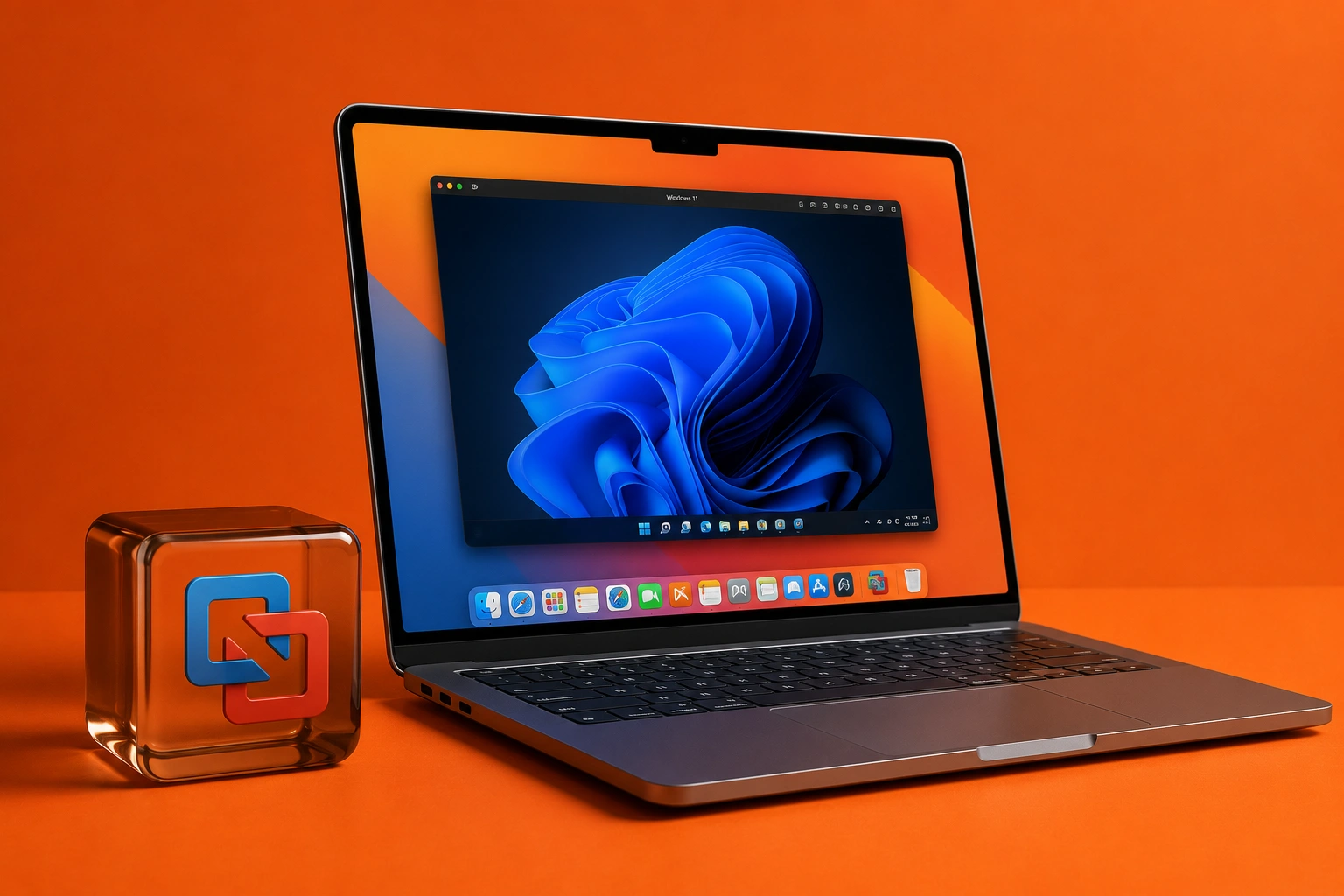
VMware Fusion on M1 Macs: Apple Silicon virtualization guide
VMware Fusion runs natively on Apple Silicon Macs, including M1 M2 M3 and M4 chips, but with fundamental architectural constraints that reshape what virtualization means on these machines. The shift from Intel to ARM architecture changes everything about which operating systems you can run and how well virtual machine performance translates to real-world workloads.
This guide covers what works well with VMware Fusion on Apple Silicon—primarily ARM Linux VMs and development workflows—and where you’ll hit walls, particularly with x86 compatibility and GPU-intensive tasks. The target audience is developers, engineers, and technical professionals who need virtualization on their Mac but want honest answers about limitations before investing time in setup.
Direct answer: VMware Fusion Pro is free for personal use on M1 and later Apple Silicon Macs, runs ARM64 guest operating systems at near-native speeds, but cannot virtualize x86 operating systems natively. Windows 11 ARM works with limitations, and GPU workloads requiring CUDA acceleration are not feasible locally.
By the end of this article, you’ll understand:
- The ARM vs x86 architecture difference and its practical implications
- Which use cases VMware Fusion handles well on Apple Silicon
- Performance expectations for different workload types
- When to use local virtualization versus cloud GPU solutions
- How to set up and optimize VMs for development workflows
Understanding VMware Fusion on Apple Silicon architecture
VMware Fusion serves as a Type-2 desktop hypervisor, running on top of macOS and enabling you to create virtual machines that execute alongside your regular applications. On Apple Silicon Macs, Fusion leverages the ARM-based architecture to run compatible guest operating systems without the performance penalties of cross-architecture emulation.
The main reason this matters: when Apple transitioned from Intel Mac hardware to its own silicon, the underlying instruction set changed from x86-64 to AArch64 (ARM64). This isn’t a minor version upgrade—it’s a fundamental shift in how processors execute code, which directly affects what you can virtualize.
ARM-based virtual machine virtualization capabilities
ARM virtualization on Apple Silicon means running guest operating systems compiled for the same ARM64 architecture as the host Mac. When you install an ARM Linux distribution like Ubuntu ARM or Fedora AArch64, the virtual machine executes instructions natively without translation.
Performance in this scenario is exceptional—community benchmarks show ARM Linux VMs running at 90-95% of host speeds for CPU-bound tasks like code compilation. The unified memory architecture on M1 chips, where CPU and GPU share the same high-bandwidth memory pool, allows VMs to allocate resources dynamically. Users with 16GB or more RAM report running multiple lightweight Linux VMs concurrently without significant slowdown.
For development and testing workflows, this native ARM performance makes Fusion genuinely useful. You can spin up new VMs for containerized applications, run Docker ARM images, or test Linux configurations without the overhead that plagued cross-architecture emulation in previous eras.
X86 translation limitations
Running x86 software on Apple Silicon requires translation layers, and here’s where things get complicated. Windows 11 ARM can run on VMware Fusion, but when that Windows VM needs to execute x86 applications, Microsoft provides the x86/x64 translation layer through Windows 11 ARM itself, basically similar to how Apple’s Rosetta 2 works for macOS apps, not through Fusion translating Intel operating systems into ARM.
The performance impact is measurable: expect 20-50% overhead, but performance varies depending on the application, and some workloads can feel slow. More critically, kernel-level x86 code and certain drivers simply fail, which is often the main issue. You cannot take a traditional x86 Windows or Linux VM from an Intel Mac and run it directly on Apple Silicon. The architecture mismatch means you’d need to recreate VMs from scratch using ARM ISOs, not just copy them over. Traditional Intel x86 Windows guest VMs or other x86 operating systems are not supported on Apple Silicon Fusion, and some enterprise apps still may not work correctly even when you run Windows 11 ARM under that compatibility layer.
This limitation creates the point of understanding which applications and use cases actually make sense on Fusion with Apple Silicon Macs.
Practical applications and use cases for Windows 11
With the architectural foundation clear, let’s examine where VMware Fusion delivers real value on M1 and later chips versus where you’ll encounter friction.
Development environment setup
ARM Linux distributions represent Fusion’s strongest use case on Apple Silicon. Ubuntu ARM, Debian arm64, and Fedora AArch64 all run exceptionally well, providing developers with isolated Linux environments for:
- Local development with full Linux toolchains
- Running containers via Docker ARM images
- Testing deployment configurations before pushing to production
- Maintaining separate environments for different projects
For an Intel or AMD host, the Debian VMware installation guide covers the Debian 13 guest and open-vm-tools steps. Apple Silicon requires the Debian arm64 image instead of amd64.
Development tools including IDEs, compilers, and scripting environments work as expected. The integration with macOS is smooth—you can drag and drop files between host and guest, connect USB-C and Thunderbolt peripherals to VMs, and use shared folders for project files. If you need to run Windows 11 ARM for app testing, you can choose Fusion’s built-in tool to download and install it, and Fusion 13.5 also supports direct Windows 11 ISO downloads. Windows guests also get accelerated DirectX 11 graphics for compatible scenarios when you develop and test apps. Fusion 13 is now a general release rather than a preview build.
Educational and learning applications
For users who want to go deeper into AI and cloud concepts alongside their VMware Fusion experiments, Hivenet’s AI and cloud computing insights blog offers broader context on how practitioners are applying these technologies.
Students and professionals learning Linux administration find VMware Fusion valuable for safe experimentation. You can create snapshots before testing system changes, break things without consequences, and restore to known-good states instantly.
The free personal use licensing for VMware Fusion Pro (introduced in 2024) removes cost barriers for educational purposes. You can install multiple Linux distributions to compare package management approaches, systemd versus init systems, or different desktop environments—all without affecting your primary macOS installation.
Light server workload testing
For web development, Fusion handles local testing scenarios competently. You can run NGINX, Apache, or application servers within ARM Linux VMs to stage deployments before pushing to production infrastructure.
Database testing works similarly well—PostgreSQL, MySQL, and MongoDB all have ARM64 builds that run at near-native speeds. The key note here is “testing and development.” When workloads scale toward production-level demands, or require software without ARM64 support, you’ll encounter the ceiling of local virtualization.
Advanced implementation and performance limitations
Building on these use cases, understanding the technical setup process and inherent constraints helps you make informed decisions about when Fusion fits your needs.
Installation and configuration process
VMware offers Fusion Pro as a free download for personal use on Apple Silicon Macs. The installation process is straightforward, but several configuration choices affect performance:
- Download VMware Fusion Pro from the official VMware website and install on macOS Monterey (12.x) or later
- Create new VMs by selecting ARM64 ISO images—convert Windows ISOs from a Windows PC if needed for Windows 11 ARM
- Allocate VM memory carefully, keeping total allocation below 50% of host RAM to maintain macOS stability
- Configure virtual disk storage on external drives for better I/O performance on machines with limited internal storage; in Fusion 13.5, you can run VMs from an external APFS-formatted drive
- Install VMware Tools within the guest OS to enable file sharing, clipboard integration, and display optimization
For Windows 11 ARM installation, YouTube videos and community guides often include an image for each step, and you can watch one from jan updates if you prefer viewing the process before setup. The tech preview history means some features remain less polished than ARM Linux support, and on M1 systems Fusion still does not support VBS or Nested VMs.
Local virtualization vs cloud GPU solutions comparison
When your workload requirements exceed what local virtualization can deliver, understanding the tradeoffs helps you select the right approach:
| Factor | VMware Fusion M1 | Compute with Hivenet |
|---|---|---|
| Performance | 90–95% host speed (ARM native) | Full dedicated GPU performance |
| GPU access | Apple Metal only, no CUDA | RTX 4090/5090, full NVIDIA CUDA |
| Resource usage | Shares host RAM and battery | Independent infrastructure |
| Scalability | Limited by Mac hardware | On-demand or persistent instances |
| Cost | Free for personal use | Pay for actual compute usage |
The synthesis here is practical: if you need a Linux environment on your Mac for development, Fusion works well. If you need to run GPU workloads—AI training, 3D rendering, data science pipelines—the honest answer is that local virtualization on Apple Silicon cannot deliver what NVIDIA RTX 4090 cloud GPUs on CUDA-equipped servers provide.
Hivenet's Compute offers on-demand Linux VMs with dedicated VRAM (not shared or sliced), public book-now pricing without auction mechanics, and transparent billing. You keep your Mac as the control surface for IDE, terminal, and local files while offloading compute-intensive work to infrastructure designed for it.
Common challenges and solutions
Users consistently encounter specific roadblocks when pushing VMware Fusion beyond its optimal use cases on Apple Silicon Macs.
GPU workload requirements
Apple Silicon integrates CPU, GPU, and Neural Engine on a unified chip, but this GPU lacks NVIDIA CUDA compatibility. Machine learning frameworks like TensorFlow and PyTorch with CUDA backends, 3D rendering applications expecting discrete NVIDIA GPUs, and professional data science workflows all hit hard stops.
Solution: For serious GPU workloads, GPUs in modern computing and how Compute with Hivenet can help provides context on dedicated GPU instances with full VRAM allocation. Rather than fighting the M1’s integrated graphics limitations (which result in 5-10x slowdowns for GPU compute), offload that work to purpose-built infrastructure while maintaining your Mac as the development interface.
X86 application compatibility issues
Professional software without ARM64 versions, legacy applications, and specialized tooling compiled for x86 create compatibility challenges. The translation layers add performance overhead and sometimes fail entirely for kernel-level operations.
Solution: For critical x86 dependencies, consider whether ARM-native alternatives exist. When they don’t, cloud-based x86 instances—including through services like Hivenet and its Compute FAQ covering billing and instance rental—provide full compatibility without the translation penalty. This approach separates the “development on Mac” workflow from “running production-equivalent software” requirements, and aligns well with renting GPUs for AI and deep learning when projects move beyond what your Mac can realistically handle.
Resource constraints and battery drain
Running virtual machines locally impacts Mac performance significantly. Battery life drops 30-50% under VM load on portable machines. Thermal throttling occurs under sustained workloads—M1 chips can reach 90°C under heavy VM usage. Users with less than 16GB RAM experience stalling when running VMs alongside other applications, which is where cost-effective GPU cloud computing for developers can act as a pressure valve for heavier tasks.
Solution: Use local VMs for lightweight tasks—terminal work, scripting, testing configurations—and offload sustained compute to cloud infrastructure. This hybrid approach preserves Mac battery and thermals for productivity work while accessing appropriate resources for heavy lifting.
Conclusion and next steps
VMware Fusion on M1 and later Apple Silicon Macs excels at running ARM Linux VMs for development, testing, and learning. The performance is excellent, the software is free for personal use, and the integration with macOS is smooth. These strengths make it genuinely valuable for developers who want Linux environments alongside their Mac workflows.
The limitations are equally clear: no native x86 virtualization, no CUDA GPU access, and resource constraints that prevent scaling beyond development-level workloads. Understanding these boundaries upfront saves you from hitting walls mid-project.
Immediate next steps:
- Evaluate whether your use case fits ARM Linux development and testing
- Download VMware Fusion Pro and experiment with an ARM Linux distribution
- For GPU workloads, explore Compute with Hivenet as a purpose-built alternative that complements your Mac workflow
Related topics worth exploring include cloud computing strategies for Apple Silicon users, optimizing distributed development workflows, and comparing virtualization options across the current landscape of ARM-compatible tools.
Additional resources
- VMware Fusion official documentation and Apple Silicon system requirements
- ARM Linux distribution compatibility guides for Ubuntu, Fedora, and Debian
- Hivenet's Compute GPU instance specifications with RTX 4090/5090 options and transparent pricing
- Performance benchmarking tools for comparing virtualization overhead across configuration
Your next workload belongs on Hivenet.
Pick one AI, compute, or storage workload and see the difference for yourself. Spin it up in minutes, or let our team map your fastest path to production.