

Sign in to Hivenet
Access your files and manage your storage account.
Store
Access your files and manage your storage account.
Compute
Launch instances and manage your compute resources.
Store and Compute still use separate accounts today. We’re working on a unified sign-in.
Just need to send a file?
Use Send directlyNew to Hivenet? Get Started
Get started with Hivenet
Choose what you want to use first.
Store
Back up photos and files across your devices.
Compute
Launch self-serve GPU compute for demanding work.
Store and Compute still use separate accounts today. We’re working on a unified account experience.
Need Hivenet for business?
Talk to salesNeed to send a file?
Open SendAlready have an account? Sign in

HPC servers: A practical guide to high-performance computing in 2026
HPC servers help you finish compute intensive tasks faster than normal computers can. The right question isn’t “How big is the server?” It’s “Will this reduce time-to-result enough to justify the cost, setup, and support?”
What is an HPC server (and do you actually need one?)
High performance computing, or hpc, generally refers to using powerful processors, GPUs, memory, storage, and networks to process data and perform complex calculations at high speeds. High-performance computing (HPC) can perform quadrillions of calculations per second, far beyond standard computers.
- An HPC server is one high performance machine for hpc work.
- An hpc cluster is hundreds or thousands of compute servers, called nodes, networked to work in parallel.
- A supercomputer is usually a very large hpc cluster, often ranked in lists like TOP500.
HPC systems give you fast processing, quick networks, and lots of memory, so you can run many calculations at once for complex simulations and data analysis. GPU-accelerated HPC servers support AI training, rendering, fluid dynamics work, and deep learning, and they often use distributed computing techniques to coordinate many devices.
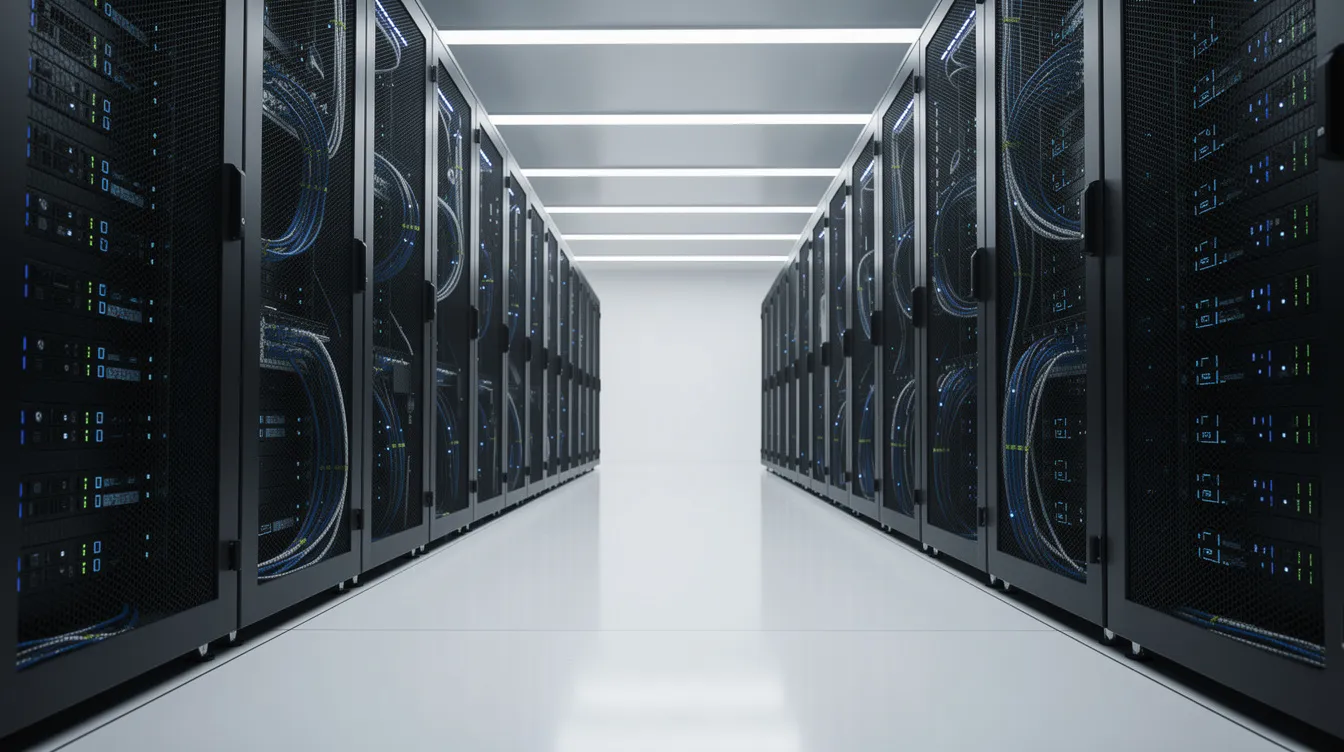
How HPC servers work: from single node to HPC cluster
One HPC server can solve demanding workloads. Many servers become computer clusters when one machine lacks enough memory, computing power, or processing speed.
An HPC cluster uses:
- Nodes: servers with CPUs, GPUs, RAM, and local NVMe storage.
- Networks: InfiniBand, RDMA, RoCE, or 100–400 Gbps Ethernet for low latency.
- Storage systems: local scratch disks, shared data storage, and parallel file systems.
- Schedulers: Slurm, PBS, or similar tools that decide which jobs run simultaneously.
This is called parallel processing: one large task is split into many smaller jobs that run simultaneously across processors and GPUs. High performance computing systems use specialized software, operating systems, and the message passing interface to coordinate thousands of tasks. Unlike web clusters, hpc clusters are built for high throughput, large scale simulations, and tightly coupled scientific workloads.
Key components that make an HPC server different
An HPC server is defined by compute, memory, storage, and networking tuned for performance.
CPU: AMD EPYC and Intel Xeon processors handle orchestration, I/O, preprocessing, serial code, and jobs that do not map well to GPUs.
GPU: NVIDIA RTX, data center GPUs, and other accelerators provide immense computational power for machine learning, computational chemistry, molecular dynamics, rendering, and complex calculations.
VRAM: 24–48 GB per GPU is common for many AI and simulation jobs. Larger models, 3D scenes, climate grids, and molecular modeling may need 96 GB or more.
System RAM: Many nodes use 256 GB to 2 TB. Capacity and bandwidth matter because GPUs stall when data cannot arrive fast enough.
Storage: NVMe SSDs hold datasets, checkpoints, temporary files, and intermediate results. Larger hpc systems often add shared parallel storage.
Networking: Once jobs leave one node, network latency becomes part of the runtime. High-performance links allow nodes to share information and collaborate, which is essential for large-scale computational tasks efficiently.
Power and cooling: A dense GPU server can draw 1–3 kW. In 2026, cooling, electricity, rack space, and reliability are part of the real system cost.
HPC server use cases: where high performance really matters
HPC applications are justified when they turn days into hours or make solving complex problems possible at all.
- Computational fluid dynamics simulations model fluids in real systems, such as air around an aircraft. HPC and GPU technology enable engineers to run more detailed CFD simulations for wind turbines, jet engines, and transportation vehicles. CFD applications also simulate aerodynamics to reduce air drag and friction, including automotive designs that improve battery performance.
- Drug discovery teams use high-performance computers for molecular modeling, protein analysis, and AI-assisted screening. CPUs and GPUs can accelerate suitable parts of these workflows, but the time saved depends on the software, dataset, and hardware.
- Climate modeling uses climate models to simulate the Earth’s atmosphere, oceans, and land surfaces. These workloads require large amounts of data and parallel computing. GPUs and other parallel techniques help scientists run more detailed simulations and process historical meteorological data plus millions of daily climate-related data points.
- Financial risk teams use Monte Carlo simulations, stress tests, and fraud engines. High-performance computing (HPC) applications are increasingly used for credit card fraud detection, helping organizations identify fraud faster and reduce false positives.
- Healthcare security teams use HPC applications to analyze large datasets and identify patterns that help prevent cyberattacks and other security threats.
- Other hpc use cases include genomics, data analytics, weather forecasting, higher education research, engineering, energy research, computer vision, rendering, digital twins, and systems that stream live events or analyze live events.
CPU-based vs GPU-based HPC servers
Classic high performance computing was CPU-heavy. CPU-based servers still fit legacy Fortran solvers, finite element codes, branch-heavy logic, and workloads needing huge memory per task.
GPU-based hpc servers fit parallel workloads: deep learning, image processing, molecular dynamics, ray tracing, computational fluid dynamics, and many simulations. GPUs contain thousands of smaller cores and high memory bandwidth, so they can perform complex calculations across many data points at once, which is why GPUs play a central role in modern computing and AI projects.
Most 2024–2026 hpc systems are hybrid. CPUs manage the system; GPUs do the parallel math. If a workload is vectorizable or “embarrassingly parallel,” GPU servers often deliver better cost efficiency per useful hour.
Buying vs renting: economics of HPC servers in 2026
Buying hpc servers gives control, but the real cost includes hardware, power, cooling, rack space, downtime, upgrades, and staff. Multi-GPU nodes can cost tens or hundreds of thousands of euros, then age quickly across a 3–5 year refresh cycle, so it helps to understand server costs, types, and cloud alternatives in 2026.
Idle time is the hidden cost. If your workloads arrive in bursts, owned servers may sit unused between research runs while depreciation continues.
Renting through cloud computing or hpc services changes the model. HPC in the cloud allows organizations to dynamically scale computing resources to meet workload demand, ensuring cost efficiency by using and paying only for resources needed at any given time. High-performance computing also provides access to newer technology without costly upgrades or downtime from aging infrastructure.
For historical context, Intersect360 Research estimated the worldwide HPC-AI infrastructure market at USD 85.7 billion in 2023, up 62.4% year over year, with growth driven primarily by hyperscale AI spending.
Cloud HPC servers and common trade-offs
High performance computing hpc in the cloud, often called HPCaaS, gives teams fast access to CPU and GPU nodes for AI training, batch rendering, data analysis, and climate modeling tests.
The trade-offs are real: complex pricing, quota limits, storage charges, data egress fees, and spot or preemptible instances. Interrupted runs can waste budget and reduce reproducibility. Sensitive healthcare, finance, and confidential simulation workloads also need careful security review.
Cloud remains useful for benchmarking. You can test GPUs, VRAM, storage, and scalability before buying infrastructure, especially with transparent neocloud GPU pricing models that make total cost easier to predict.

Where compute with hivenet fits into the HPC server landscape
Compute with Hivenet's distributed GPU cloud for AI and HPC gives access to GPU-based hpc servers without owning the hardware. It fits workloads that need strong GPU capacity but not a full institutional supercomputer or tightly coupled MPI fabric.
Compute offers RTX 5090 GPU instances, subject to available capacity. The RTX 4090 fleet has been retired from new Compute workloads. Check the current GPU documentation and Compute console for the GPU count, memory, location, availability, and active price before launching. Compute uses prepaid credits and per-second billing.
Good fits include machine learning, deep learning, inference, computer vision, computational fluid dynamics test runs, molecular simulations, data analytics, and research experiments. Choose a preset that meets your workload's memory and compute needs, and test it before committing to a long run. Its distributed infrastructure can also reduce reliance on large centralized data centers, aligning with the neocloud approach to GPU-first, AI-focused infrastructure and offering a practical alternative to traditional hyperscale cloud providers for AI workloads.
How to choose the right HPC server for your workload
Use a short checklist:
- Classify the workload: AI training, inference, CFD, genomics, drug discovery, finance, rendering, or mixed hpc applications.
- Estimate GPU and VRAM: 24 GB for smaller models, 48 GB for larger batches, 96 GB+ for large models or complex simulations.
- Plan memory and storage: dataset size, checkpoint frequency, scratch space, and data storage throughput.
- Check networking: single-node jobs may not need InfiniBand; multi-node clusters often do.
- Compare buying and renting: hours per month, 24/7 demand, staff capacity, reliability needs, and cloud costs.
Start with rented hpc servers when possible. Benchmark real workloads before committing to on-premises purchases.
Future trends in high-performance computing servers
HPC servers are changing quickly. AI demand is pushing more GPUs per node, larger VRAM, faster memory, and tighter CPU-GPU links. Cloud-native hpc patterns are also growing, with containers, Kubernetes, Slurm integrations, and hybrid models that mix owned clusters with cloud capacity.
Networking will keep improving through 200–400 Gbps links and better RDMA. Sustainability pressure will push better cooling, more efficient GPUs, and distributed infrastructure where it makes practical sense.
Accessible high performance computing is becoming available to smaller teams, startups, and independent researchers. If you need hpc capacity without buying hardware first, test your workload on Compute with Hivenet and measure the result against your real cost per completed job.

What makes HPC servers different from regular servers?
HPC servers are optimized for high-speed processing, large memory capacity, and fast networking to handle complex calculations and data-intensive workloads. Unlike regular servers, they often include powerful GPUs, large VRAM, and specialized storage to accelerate parallel computing tasks such as AI training, simulations, and rendering.
Why are GPUs important in modern HPC servers?
GPUs excel at parallel processing, allowing them to handle thousands of simultaneous calculations efficiently. This makes them ideal for AI, machine learning, computational fluid dynamics, and other workloads that benefit from massive parallelism, providing new insights and significantly reducing time-to-result compared to CPU-only servers.
When should I consider renting an HPC server instead of buying one?
Renting is practical if your workloads are bursty, require access to the latest hardware, or if you want to avoid upfront capital costs and maintenance. With Compute, compare the current preset and active rate before launching, then benchmark your workload to judge cost per completed job.
What types of workloads benefit most from HPC servers?
HPC servers are crucial for science and business applications that demand rapid processing of large datasets or complex simulations. Common use cases include AI training and inference, drug discovery, climate modeling, computational fluid dynamics, financial risk analysis, rendering, computer vision, and research experiments.
How does networking impact HPC server performance?
High-performance networking technologies like InfiniBand and RDMA enable low-latency, high-throughput communication between nodes in an HPC cluster. This is essential for multi-node workloads where tasks must share data rapidly to maintain efficiency and scalability.
What should I look for when choosing an HPC server?
Consider your workload’s GPU and VRAM requirements, system RAM, storage needs, networking capabilities, and whether you need single-node or multi-node clusters. Also, evaluate the cost model—buying versus renting—based on your usage patterns, budget, and support needs.
How does Compute with Hivenet differentiate itself from other cloud HPC providers?
Compute with Hivenet provides GPU and CPU instances with prepaid credits and per-second billing. Check available presets and test your workload before moving a long-running job. On-demand access does not guarantee uninterrupted operation; use checkpoints and plan for recovery.
Is HPC important for small businesses or startups?
Yes. HPC servers are increasingly accessible and affordable, enabling smaller teams to leverage powerful computing resources for AI, data science, and simulations without heavy capital investment. This democratization of HPC supports innovation in both science and business worldwide.
How does HPC contribute to sustainability?
By providing efficient, scalable computing resources and enabling distributed infrastructure, HPC solutions like Compute with Hivenet can reduce reliance on large centralized data centers, optimizing power and cooling usage and lowering the overall environmental impact.
Can HPC servers handle sensitive or regulated data?
Yes, many HPC providers and platforms implement strong security measures to comply with regulatory requirements. When working with sensitive data, it’s important to verify the provider’s compliance certifications and data protection policies to ensure secure HPC usage.
Your next workload belongs on Hivenet.
Pick one AI, compute, or storage workload and see the difference for yourself. Spin it up in minutes, or let our team map your fastest path to production.