
Sign in to Hivenet
Access your files and manage your storage account.
Store
Access your files and manage your storage account.
Compute
Launch instances and manage your compute resources.
Store and Compute still use separate accounts today. We’re working on a unified sign-in.
Just need to send a file?
Use Send directlyNew to Hivenet? Get Started
Get started with Hivenet
Choose what you want to use first.
Store
Back up photos and files across your devices.
Compute
Launch self-serve GPU compute for demanding work.
Store and Compute still use separate accounts today. We’re working on a unified account experience.
Need Hivenet for business?
Talk to salesNeed to send a file?
Open SendAlready have an account? Sign in
FP16 explained: 16-bit floating point precision in AI
FP16 is a 16-bit floating-point format that makes AI workloads faster and more memory-efficient by storing each number in half the space of FP32, but it also gives up precision and numerical range. That trade-off is why FP16 is widely used in deep learning, model inference, computer vision, large language models, and diffusion models-but rarely as a careless drop in replacement for higher precision formats.
What is FP16?
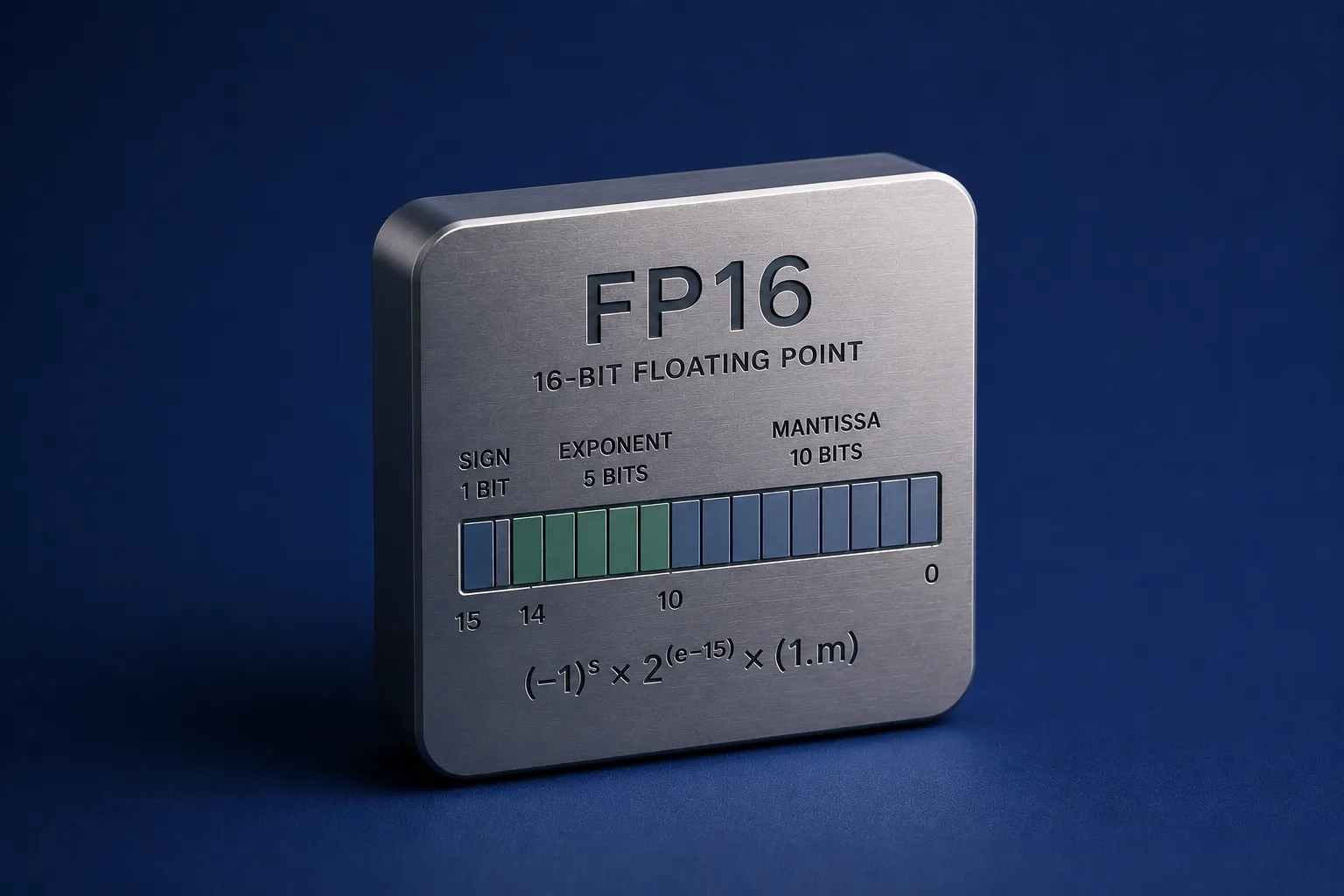
FP16 stands for 16-bit floating point. It is also called half-precision, half-precision floating point, half-precision 16-bit, float16, or IEEE 754 binary16. FP16 consists of one sign bit, five exponent bits, and ten mantissa bits, allowing it to represent numbers with approximately three to four decimal digits of precision.
That layout matters:
- 1 sign bit defines whether the value is positive or negative.
- 5 exponent bits define the number's scale or range.
- 10 mantissa bits define the significand precision, or how much detail is stored after scaling.
- The exponent bias is 15 in the IEEE 754 half-precision floating-point format.
The half-precision binary floating-point format (FP16) can represent a minimum strictly positive value of approximately 5.96 × 10⁻⁸ and a maximum representable value of 65504. In practice, this means FP16 can represent many real numbers used in neural network computations, but it cannot safely represent every value that FP32 or FP64 can.
FP16 uses 16 bits for representation, which is half the size of FP32 (32 bits) and a quarter of FP64 (64 bits), making it more memory efficient for certain applications. The use of FP16 allows for reduced memory requirements, as it only uses 16 bits per number, which is half the size of the standard FP32 format and a quarter of the size of FP64.
The core idea is simple: smaller values take less memory, move faster through memory bandwidth, and can be processed more quickly on hardware that supports half-precision arithmetic. FP16 has gained popularity in deep learning due to its ability to reduce memory requirements by half compared to FP32, which is particularly advantageous for large models and datasets.
FP16 is particularly useful in applications where moderate precision is acceptable, such as in computer graphics for storing pixel data, as it allows for a greater dynamic range compared to 8-bit or 16-bit integers. In AI, the same format offers a practical balance: enough precision for many deep learning applications, much lower memory required, and better computational efficiency on modern GPUs.
FP16 vs FP32: the core trade-off
FP16 and FP32 are both floating-point formats, but they make different engineering choices. FP32 uses single-precision floating point and stores each number in 32 bits. FP16 uses half-precision floating point and stores each number in just 16 bits.
The main trade-off is memory and speed versus precision and range.
| Strategy | What it does | How the batch changes | Main advantage | Main limitation |
|---|---|---|---|---|
| Static batching | Waits for a fixed number of requests before running them together | The batch remains constant until every request is finished | Simple and predictable | Static batching waits for a fixed number of requests to arrive before processing them together, which can lead to underutilization of GPU resources if requests finish at different times |
| Dynamic batching | Collects requests for a short time window or until a batch size limit is reached | Membership is usually fixed once the batch starts | Reduces latency compared with waiting for a full static batch | Dynamic batching improves upon static batching by allowing requests to be processed as soon as a maximum time window has elapsed, rather than waiting for a full batch, thus reducing latency, but it still does not usually replace completed sequences mid-generation |
| Continuous batching | Updates the active batch at decoding boundaries | New requests can enter as completed sequences leave | Keeps the GPU fuller across different iterations | Requires more advanced scheduling, memory management, and admission control |
FP16 can represent numbers with approximately three to four decimal digits of precision, while FP32 offers about seven decimal digits and FP64 provides around 15 to 17 decimal digits of precision. That additional precision is valuable when small rounding errors accumulate, when updating weights during training, or when a workload has strong precision requirements.
The memory difference is immediate. FP16 uses 16 bits for each value, while FP32 uses 32 bits. For model weights, activations, gradients, and intermediate tensors, the same number of entries can be stored in roughly half the memory when the data type changes from FP32 to FP16. This does not always halve the full runtime footprint because optimizer states, KV cache, batch data, framework overhead, and some higher precision buffers may remain, but it can still be a major reduction.
FP16 doubles your data throughput, which makes transferring large amounts of data much more efficient—especially for matrix multiplications. That matters because many AI workloads aren't just limited by how fast they can crunch numbers. They're actually bottlenecked by how quickly you can move tensors (the data structures that hold your model's information) in and out of GPU memory. That is important because many AI workloads are not limited only by arithmetic speed; they are limited by how quickly tensors can be read from and written to GPU memory.
The risk is numerical behavior. While FP16 is faster and requires less memory than FP32 and FP64, it has a limited dynamic range, which can lead to overflow or underflow issues when converting from FP32. Values that are too large may become infinity, and values that are too small may become zero or subnormal values. This is why FP16 is not just “FP32 but faster.” It is lower precision and reduced precision, and it changes how numbers are represented.
FP16 arithmetic can be significantly faster than single or double precision, sometimes up to 4 times faster, especially when hardware has instructions for half-precision math. But speed depends on hardware support, kernels, batch size, memory bandwidth, and whether the framework uses the right math mode. On modern NVIDIA GPUs, FP16 can be extremely fast. On older hardware, FP16 may save memory but deliver limited acceleration.
FP16 vs BF16: two approaches to 16-bit precision
FP16 and BF16 are both 16-bit floating-point formats, but they behave differently because they divide their bits differently.
FP16 uses:
- 1 sign bit
- 5 exponent bits
- 10 mantissa bits
BF16, short for bfloat16, is often described as the brain floating-point format because it was developed by Google Brain for deep learning workloads. BF16 uses:
- 1 sign bit
- 8 exponent bits
- 7 mantissa bits
The important difference is the exponent part. BF16 keeps the same number of exponent bits as FP32, which gives BF16 a much wider dynamic range than FP16. FP16 has more mantissa bits, so it has better significand precision than BF16, but BF16 can represent much larger and much smaller values.
That makes BF16 attractive for training deep neural networks. Gradients can become very small, activations can spike, and loss values can vary widely. BF16’s wider range helps avoid underflow and overflow. FP16 can still work very well, but it often needs mixed-precision training and loss scaling to stay stable.
FP16 may be preferable when:
- the model is already known to run safely in FP16;
- inference tasks are the priority;
- the GPU has stronger FP16 hardware support than BF16 support;
- extra mantissa precision is more useful than range;
- existing code, kernels, or model checkpoints are optimized for FP16.
BF16 may be preferable when:
- training stability matters more than fractional precision;
- gradients or activations are volatile;
- loss scaling is inconvenient;
- the hardware supports BF16 natively;
- the workload is a large transformer or large language model with wide numeric variation.
Hardware support is a practical deciding factor. NVIDIA A100, H100, and many newer GPUs support both FP16 and BF16 efficiently. Some older NVIDIA GPUs support FP16 well but have weaker BF16 support or none at all. Other hardware ecosystems, including CPUs and accelerators, may expose these formats through compiler features, libraries, or standards such as ARM C Language Extensions, but real performance depends on the actual instructions and software stack.
The right precision is therefore not only a math choice. It is a model, framework, and hardware choice.
FP16 vs quantization (int8, int4): floating point vs integer precision
FP16 is often discussed beside INT8 and INT4, but they are not the same kind of format.
FP16 is a floating-point format. It stores values with a sign bit, exponent, and mantissa, which lets it represent numbers across a dynamic range. INT8 and INT4 are integer formats. Quantization maps real numbers from a floating-point format into lower-precision integer values, usually with scaling factors.
In plain terms:
- FP16 is a lower-precision floating point.
- BF16 is another 16-bit floating-point format with a wider range.
- INT8 is 8-bit integer quantization.
- INT4 is 4-bit integer quantization.
- Fixed point formats use a fixed decimal point or binary point position, unlike floating point formats where the exponent changes scale.
Quantization can save more memory than FP16. INT8 uses half the space of FP16, and INT4 uses a quarter of the space of FP16. For inference, especially large language models, INT8 and INT4 can make models fit into much smaller VRAM footprints. That is why quantized LLMs in int8 and int4 are common on consumer GPUs.
But quantization usually has more conversion complexity. Converting FP32 weights to FP16 may be as simple as loading the model with torch_dtype=torch.float16 or casting tensors, assuming the operations are supported. Converting to INT8 or INT4 often requires calibration, representative datasets, quantization-aware training, special kernels, or careful evaluation layer by layer.
FP16 is often better than integer quantization when:
- accuracy preservation is more important than maximum compression;
- activations need floating point range;
- the model is sensitive to quantization error;
- the deployment stack has excellent FP16 kernels but weaker INT8 or INT4 kernels;
- the workload includes training or fine-tuning, not just inference.
INT8 or INT4 may be better when:
- the model is too large to fit in FP16;
- inference cost is the main constraint;
- a proven quantized checkpoint is available;
- small accuracy loss is acceptable;
- the hardware has optimized integer kernels.
A common production pattern combines formats: LLM quantization for weights in int8 or int4 with FP16 activations, FP16 KV cache, or FP32 accumulation for sensitive operations. The goal is not to choose the lowest precision everywhere. The goal is to use the right precision in the right part of the model.
Why FP16 matters for modern AI
FP16 matters because modern AI is often constrained by memory before it is constrained by raw math.
Large language models, diffusion models, and computer vision networks contain huge matrices of weights. Training also stores activations, gradients, optimizer states, and temporary buffers. During inference, transformer models may store a KV cache that grows with context length. If everything is stored in FP32, the memory required can quickly exceed available VRAM.
FP16 reduces this pressure. A model using FP16 weights usually takes about half the memory of the same model in FP32, although the total runtime memory footprint also depends on activations, KV cache, optimizer states, framework overhead, and batch size. This can make the difference between a model fitting on a GPU or failing with an out-of-memory error.
FP16 is particularly beneficial for deep learning applications as it allows for faster computations, performing more calculations per unit time, which is crucial for training and inference tasks. The use of FP16 in deep learning has been made possible by the introduction of specialized hardware, such as NVIDIA’s Tensor Cores, which can perform many FP16 operations in parallel, significantly increasing throughput.
Tensor Cores are especially important for neural network computations such as matrix multiplication and convolution. These operations dominate many deep learning workloads. When models use supported dimensions, kernels, and math modes, modern GPUs can process FP16 operations much faster than FP32 operations.
The economics matter too. Faster inference means more requests per GPU. Faster training means fewer GPU hours. Lower memory bandwidth pressure means better GPU utilization. Techniques like continuous batching for LLM inference can compound these gains. In production, this can reduce cost per token, cost per image, or cost per prediction.
FP16 does not make every workload exactly twice as fast. Some operations still run in FP32. Some models are memory-bound, others are compute-bound, and some are bottlenecked by CPU preprocessing, networking, storage, or small kernel overhead. But for many AI workloads, FP16 is one of the main reasons large models are practical outside the largest research labs.
FP16 in training: mixed precision and stability
Training is where FP16 needs the most care.
Pure FP16 training can be unstable because training repeatedly updates weights using gradients, and those gradients may be very small. If small values underflow to zero, the model may stop learning in some parameters. If activations, losses, or gradients overflow, training may produce inf or NaN values and fail.
This is why modern training usually uses mixed precision training rather than FP16 everywhere. Mixed precision combines FP16 computation with selected FP32 storage or accumulation. A common setup uses FP16 for forward and backward operations while keeping FP32 master weights, FP32 optimizer states, or FP32 accumulation for sensitive operations.
This approach gives much of the speed and memory benefit of half precision while preserving enough stability for deep neural networks.
Loss scaling is another key technique. In FP16 training, gradients can be too small to represent accurately. Loss scaling multiplies the loss by a scale factor before backpropagation, which makes gradients larger during computation. Before updating weights, the gradients are divided back down by the same factor. If overflow is detected, the scale is reduced. If training is stable, the scale can increase.
Frameworks handle much of this automatically:
- PyTorch supports automatic mixed precision with torch.autocast and torch.amp.GradScaler.
- TensorFlow supports mixed precision policies and loss scaling.
- Deep learning libraries and distributed training frameworks often include FP16 and BF16 paths by default.
- CUDA, cuDNN, and transformer-focused libraries include optimized kernels for FP16 attention, matrix multiplication, and normalization patterns.
Still, mixed precision is not a guarantee. Some operations are sensitive to small rounding errors or reduced dynamic range. Softmax, normalization, reductions, and accumulation-heavy code may need higher precision. Some training failures are obvious, such as NaN loss. Others are subtle, such as slower convergence or lower final accuracy.
The safe rule is: use FP16 training through a mature mixed precision stack, not by manually casting every tensor and hoping it works.
FP16 in inference: speed and efficiency gains
Inference is usually easier than training because the model weights are fixed. There is no backpropagation, no optimizer state, and no repeated updating weights step. That makes inference more tolerant of FP16 precision loss than training.
FP16 can reduce inference latency and increase throughput in several ways:
- model weights require less VRAM;
- activations can use less memory;
- memory bandwidth pressure decreases;
- Tensor Core acceleration can speed up matrix operations;
- larger batch sizes may fit on the same GPU;
- more requests can be served per GPU.
For LLM inference, FP16 is common for token generation when the model fits in memory and the GPU has strong FP16 support. For diffusion models, FP16 is widely used because image generation pipelines contain many convolution and attention operations that benefit from GPU acceleration. For computer vision, FP16 is common in classification, detection, segmentation, and embedding generation.
Inference cost improves when each GPU can serve more work. A production system that moves from FP32 to FP16 may fit a larger model, increase batch size, reduce latency, or lower memory use. The exact result depends on the model and serving stack, but the business effect is clear: lower cost per useful output.
There are still accuracy risks. FP16 can change outputs because floating point arithmetic is not associative; changing accumulation order can change the result. In LLMs, tiny numerical differences can eventually lead to different token choices. In vision models, small differences may be irrelevant for most images but important near decision boundaries.
So FP16 inference should still be validated. Compare output quality, classification accuracy, token behavior, image fidelity, latency, throughput, and memory usage against an FP32 or BF16 baseline.
When FP16 is the right choice
FP16 is the right choice when the workload benefits from lower memory use and faster GPU math, and when the model can tolerate reduced precision.
Good FP16 use cases include:
- large language models inference;
- transformer fine-tuning with mixed precision;
- computer vision models;
- diffusion model generation;
- embedding models;
- neural network inference services;
- GPU rendering and some simulation workloads;
- deep learning applications where moderate precision is acceptable.
FP16 works especially well on modern NVIDIA GPUs with Tensor Cores. NVIDIA GPUs from the Volta generation onward made FP16 central to AI acceleration, and later architectures improved support for FP16, BF16, TF32, and other formats. When kernels are optimized, Tensor Cores can provide major performance gains for matrix-heavy workloads, especially on the best AI GPUs of 2026.
FP16 is also valuable when memory constraints dominate. If a model barely misses fitting in FP32, FP16 may make it fit. If a batch size is too small to use the GPU efficiently, FP16 may allow a larger batch. If memory bandwidth is the bottleneck, FP16 can reduce the amount of data moved per operation, especially when you choose the right GPU for LLM inference.
Model architecture matters. Transformers and CNNs often map well to FP16 because they rely heavily on matrix multiplication and convolution. Models with many reductions, recurrent state, high condition-number calculations, or strong precision requirements may need more FP32 or BF16.
FP16 is not a universal default, but it is often the practical default for GPU-optimized deep learning inference and a major part of mixed precision training.
When FP16 can cause problems
FP16 can cause problems when a workload needs more precision, more range, or more stable accumulation than half precision can provide.
The most common issues are overflow and underflow. FP16’s maximum representable value is 65504, so larger values can overflow. Very small values can underflow toward zero. In training, that can affect gradients. In inference, it can affect logits, normalization, attention, or any calculation where small differences matter.
Numerically sensitive workloads may not be good FP16 candidates. Examples include:
- scientific computing with strong precision requirements;
- financial calculations;
- some medical imaging pipelines;
- simulations with cumulative error;
- operations that sum many small values;
- models where small rounding errors change control flow or decisions.
Training instability is another major risk. Without proper mixed precision implementation, FP16 training can diverge, converge more slowly, or reach worse accuracy. Master FP32 weights, loss scaling, autocasting, and careful operation selection are not optional details for many models.
Hardware limitations also matter. Some older GPUs can store FP16 values but do not accelerate FP16 arithmetic well. Some kernels fall back to FP32 or use inefficient paths. Some hardware flushes subnormal values to zero, which can make underflow worse. A model may look FP16-ready in code but fail to deliver performance because the actual hardware support is weak. Hivenet's linked Llama 3.1 8B inference benchmark uses BF16, so it should not be treated as evidence of FP16 throughput across the tested GPUs.
FP16 can also create reproducibility surprises. The same model may produce slightly different results depending on batching, kernel selection, accumulation order, KV-cache behavior, or math mode. These differences are often acceptable, but they should not be ignored in high-stakes systems.
Use FP16 where it improves computational efficiency without breaking the numerical assumptions of the model.
Testing FP16 performance in practice
The only reliable way to know whether FP16 helps is to benchmark it on the specific model, hardware, framework, and workload.
A practical FP16 test should compare at least:
- FP32 baseline accuracy and latency;
- FP16 accuracy and latency;
- VRAM usage;
- throughput at batch size 1 and larger batches;
- training time per step or epoch, if training;
- inference latency for first token and full generation, if testing LLMs;
- output quality for images, text, embeddings, or classifications.
For training, validate convergence. Compare validation loss, final metrics, gradient behavior, and stability over time. Watch for NaN, inf, sudden loss spikes, or silent degradation. If training fails in FP16, try mixed precision training with dynamic loss scaling, keep sensitive operations in FP32, or test BF16 if the hardware supports it.
For inference, compare outputs. In LLMs, check token sequences, benchmark prompts, perplexity, and application-level quality. In diffusion models, compare image quality and generation latency. In computer vision, compare classification accuracy, detection metrics, and edge cases near decision boundaries.
Controlled hardware matters. FP16 only matters if the GPU and software stack can use it well. For example, teams benchmarking FP16, FP32, BF16, INT8, and INT4 can use dedicated GPU resources such as Hivenet RTX 4090 cloud GPUs at €0.40/hr and RTX 5090 at €0.75/hr to test under consistent conditions. The point is not just hourly price; it is controlling variables such as GPU type, VRAM availability, drivers, CUDA versions, batch size, and framework configuration.
A simple testing checklist for FP16 on rented hardware like cloud GPUs for AI workloads:
- Use the same model, inputs, batch size, and random seed where possible.
- Record framework versions, CUDA or ROCm versions, drivers, and GPU model.
- Measure warm and cold latency separately.
- Track peak VRAM, not just model file size.
- Compare accuracy or quality, not only speed.
- Test failure cases and edge prompts, not only easy examples.
- Decide whether FP16, BF16, INT8, INT4, or FP32 gives the best trade-off.
Do not assume FP16 is a free upgrade. Prove it with measurements.
Conclusion: FP16 as a practical AI optimization
FP16 is one of the formats that made modern AI practical. It cuts memory per number from 32 bits to 16 bits compared with FP32, reduces memory bandwidth pressure, and can unlock major speed improvements on modern GPUs with Tensor Cores.
But FP16 is a trade-off, not magic. It has less precision, a narrower dynamic range, and higher risk of overflow or underflow than FP32. It works best when the model, hardware, framework, and kernels are designed for lower precision formats.
For most teams, the safest path is:
- start with FP16 inference;
- compare against FP32 or BF16;
- measure accuracy, latency, throughput, and VRAM;
- use mixed precision training rather than pure FP16 training;
- keep sensitive operations in higher precision when needed;
- consider INT8 or INT4 only when the extra compression is worth the added quantization complexity.
FP16 is essential because it changes the economics of AI. It helps models fit, improves throughput, reduces serving cost, and makes larger workloads possible on available hardware. Combined with top cloud GPU providers for AI workloads and smart card selection such as choosing RTX 4090 over A100 for many AI workloads, it can radically lower the barrier to deploying capable models in production. Use it carefully, test it thoroughly, and treat precision as an engineering decision.
Frequently asked questions
Is FP16 the same as half precision?
Yes. FP16 is commonly called half precision, half precision floating point, or 16-bit floating point. In IEEE 754 terms, it corresponds to the binary16 floating point format.
How many decimal digits does FP16 have?
FP16 can represent numbers with approximately three to four decimal digits of precision. FP32 has about seven decimal digits, and FP64 double precision provides around 15 to 17 decimal digits.
Does FP16 always make models twice as fast?
No. FP16 halves the storage size per number compared with FP32, but speed depends on hardware support, memory bandwidth, kernels, batch size, and model architecture. On the right hardware, FP16 can be much faster. On unsupported or poorly optimized hardware, the gain may be small.
Is FP16 safe for training?
FP16 can be safe for training when used through mixed precision training. That usually means FP16 computation for speed, FP32 master weights or accumulation for stability, and loss scaling to prevent gradient underflow. Pure FP16 training is more likely to fail.
Why does FP16 cause underflow?
FP16 has fewer exponent bits than FP32, so it cannot represent extremely small values as reliably. During training, very small gradients may become zero or lose meaningful detail, which can affect updating weights.
Should I use FP16 orBF16?
Use FP16 when you want strong FP16 performance, good memory savings, and the model is known to tolerate half precision. Use BF16 when training stability and dynamic range matter more, especially on hardware with native BF16 support. BF16 is often better for volatile training workloads, while FP16 is very common for inference tasks.
Is FP16 the same as int8 or int4 quantization?
No. FP16 is floating point. INT8 and INT4 are integer quantization formats. Quantization can reduce memory more than FP16, but it usually requires more calibration and may have a higher accuracy risk.
How do I convert an FP32 model to FP16?
For inference, many frameworks allow loading or casting weights to FP16, such as using torch_dtype=torch.float16 in PyTorch-based workflows. For training, use automatic mixed precision rather than manually converting everything. Always validate accuracy and stability after conversion.
When should I avoid FP16?
Avoid FP16 when the workload has strong precision requirements, unstable training behavior, large or tiny values outside FP16’s range, or hardware that lacks efficient half precision arithmetic. Scientific computing, some financial models, and sensitive medical or simulation workloads may need FP32, FP64, or carefully controlled mixed precision.
What is the main benefit of FP16 in AI?
The main benefit is efficiency. FP16 reduces memory required, lowers memory bandwidth pressure, and can accelerate neural network computations on modern GPUs. That helps deep learning models train faster, serve inference more cheaply, and fit into available VRAM.
Your next workload belongs on Hivenet.
Pick one AI, compute, or storage workload and see the difference for yourself. Spin it up in minutes, or let our team map your fastest path to production.