

Sign in to Hivenet
Access your files and manage your storage account.
Store
Access your files and manage your storage account.
Compute
Launch instances and manage your compute resources.
Store and Compute still use separate accounts today. We’re working on a unified sign-in.
Just need to send a file?
Use Send directlyNew to Hivenet? Get Started
Get started with Hivenet
Choose what you want to use first.
Store
Back up photos and files across your devices.
Compute
Launch self-serve GPU compute for demanding work.
Store and Compute still use separate accounts today. We’re working on a unified account experience.
Need Hivenet for business?
Talk to salesNeed to send a file?
Open SendAlready have an account? Sign in
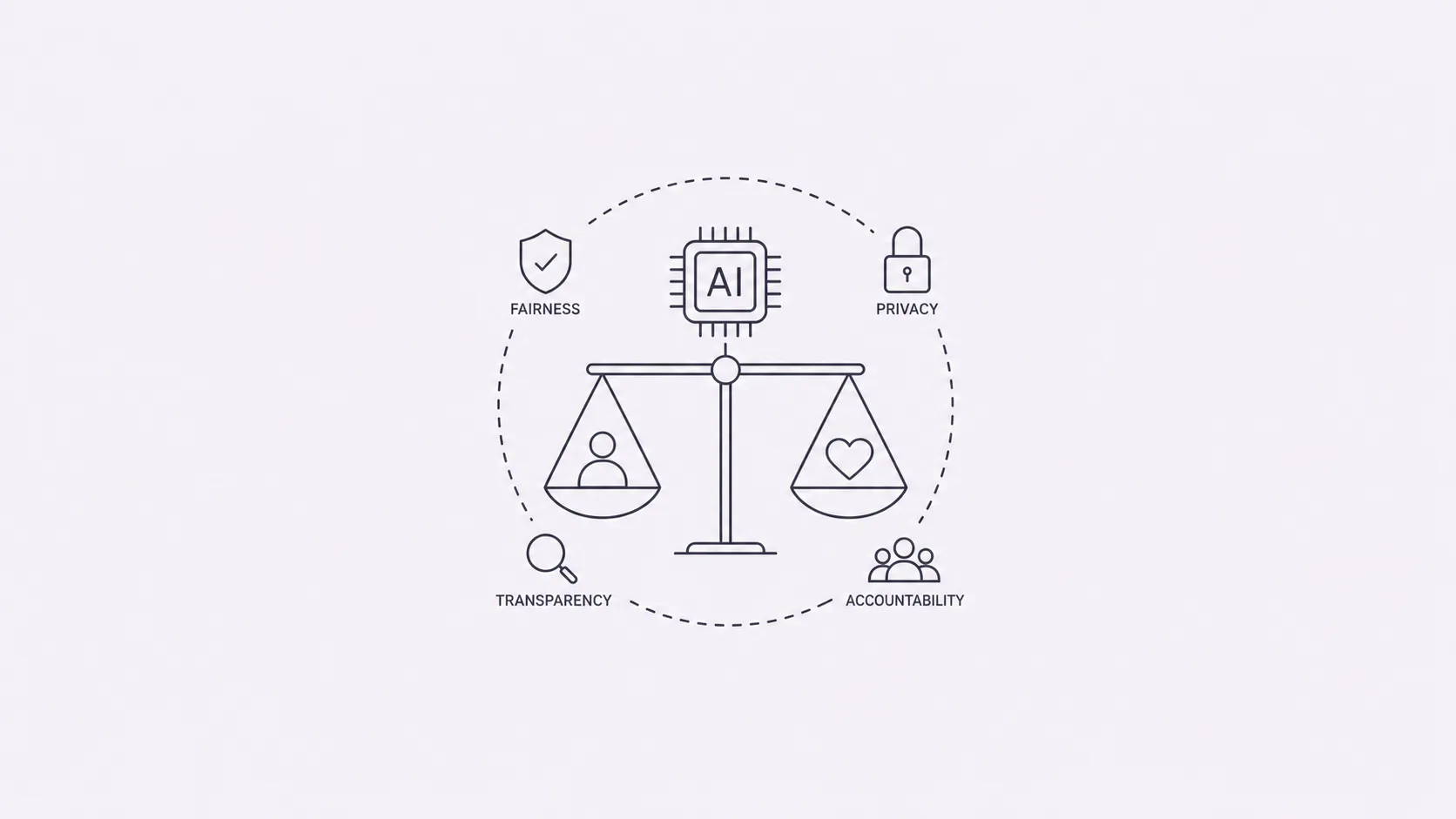
Ethical AI: guide to building AI systems that respect human values
Ethical AI means designing, building, deploying, and using artificial intelligence in ways that respect people, reduce harm, protect rights, and keep humans accountable for decisions. It is not about making ai systems “nice.” It is about making sure AI does not hide harm behind speed, scale, automation, or convenience.
What is ethical AI?
Ethical AI is a framework that emphasizes human or societal values in the adoption or development of AI models, focusing on aspects such as safety, transparency, fairness, accountability, and trust. In plain English, ethical AI asks whether an AI system should exist, how it should behave, who might be harmed, and what limits should be placed on its use.
For a founder’s perspective, our artinLeap interview explores a human-first approach to AI agents, smaller models, and product design.
A useful definition is this: ethical AI is the practice of designing, building, and deploying ai systems that respect people, reduce harm, protect rights, and maintain human accountability. That includes obvious concerns such as bias, privacy, and safety, but it also includes harder questions about power, consent, labor, surveillance, environmental cost, and democratic control.
Ethical AI is closely related to responsible ai, ai governance, and ai compliance, but the terms are not identical:
- Ethical AI focuses on moral and social questions: what artificial intelligence ought to do, what it should not do, and whose rights or dignity may be affected.
- Responsible AI focuses on organizational practice: how companies and institutions build, test, monitor, and manage ai systems with safeguards.
- AI governance covers the rules, roles, processes, documentation, and accountability structures used across the ai lifecycle.
- AI compliance means meeting legal requirements, such as privacy law, sector-specific regulation, or the eu ai act.
This distinction matters because legal compliance does not automatically make ai ethically sound. A system may be allowed under current law and still be unfair, manipulative, invasive, unsafe, or socially harmful.
Ethical AI is important because ai technologies now affect real decisions in hiring, healthcare, education, finance, insurance, policing, content moderation, workplace monitoring, government services, and access to information. When ai powered systems operate at scale, even a small design flaw or biased assumption can affect thousands or millions of people.
Why ethical AI matters: the real-world stakes
Ethical AI matters because ai systems increasingly shape decisions that affect people’s jobs, money, health, rights, opportunities, and dignity. The use of ai is no longer limited to research labs or experimental tools. Artificial intelligence ai is being embedded into everyday business decisions, public services, private sector products, generative ai tools, and automated decision making systems.
AI adoption is also growing into a massive economic force. As the artificial intelligence market expands toward hundreds of billions of dollars, business leaders and ai leaders face growing pressure to deploy ai tools quickly. That pressure can produce useful business outcomes, but it can also encourage organizations to cut corners on data governance, human oversight, privacy, testing, and affected-user consultation.
The real-world stakes are visible across sectors:
- Hiring: Biases embedded in training datasets and AI algorithms can lead to discriminatory outcomes, such as an AI recruiting tool that scored women lower than men due to being trained on a male-dominated pool of resumes.
- Law enforcement: Facial recognition software has been shown to have a harder time accurately identifying people of color, highlighting the presence of bias in AI applications beyond just hiring.
- Insurance: In the insurance sector, AI can lead to minority individuals receiving higher quotes for automotive insurance, demonstrating how biased algorithms can perpetuate socioeconomic disparities.
- Healthcare and government services: Poorly designed ai programs can affect access to care, benefits, triage, or public support.
- Education and work: AI detection tools, monitoring systems, and automated scoring can create unfair outcomes when people cannot understand or challenge the decision.
These are not only technical errors. They are ethical challenges because they affect fundamental rights: privacy, fairness, autonomy, civil liberties, non discrimination, and human dignity.
AI ethics examines the societal implications of widespread AI usage, including issues like fairness, accountability, and the potential environmental impact of AI technologies. That broader view matters because ai development is not just about models and code. It is also about who controls data, who profits, who is watched, who is excluded, and who carries the risks.
There are also serious business risks. Poor ethical design can lead to legal liability, regulatory penalties, customer trust collapse, reputation damage, employee backlash, and loss of public confidence. The European Union’s Artificial Intelligence Act, which entered into force in 2024, establishes binding obligations for certain AI practices, including transparency requirements and lifecycle governance rules for high-risk AI models. The European Union’s Artificial Intelligence Act (EU AI Act), which entered into force in 2024, establishes binding obligations for certain AI practices, including bans on unacceptable-risk systems and transparency requirements for AI-generated content.
Under the EU AI Act, prohibited practices can carry penalties of up to €35 million or 7% of global annual turnover, whichever is higher. That makes proactive ai regulation and ethical use not only a values issue, but a business continuity issue.
At a societal level, unmanaged ai use can amplify inequality, weaken democratic values, normalize surveillance, concentrate platform power, and shift decision making away from people who are affected by the outcomes. Ethical AI is the counterweight: it asks whether speed, efficiency, and profit are being bought at the expense of human rights.
Core ethical AI principles
Ethical principles are useful only when they shape design, deployment, and governance decisions. A company can publish a polished ai policy and still build harmful systems if the ethical guidelines have no authority. The core values of ethical ai must be connected to testing, documentation, monitoring, appeal rights, and real power to stop unsafe systems.
Fairness and non-discrimination
Fairness means ai systems should not reproduce or amplify bias against protected groups or vulnerable communities. Non discrimination requires more than removing obvious labels such as gender, race, age, or disability from training data. AI algorithms can still infer sensitive characteristics through proxy variables such as zip code, school, work history, browsing behavior, income patterns, or language use.
The Amazon recruiting tool is a well-known example. The system was trained on a male-dominated pool of resumes and learned patterns that favored male candidates. In practice, the ai recruiting tool scored women lower than men because historical data reflected unequal hiring patterns. The lesson is simple: biased training data can make biased automation look objective.
Fairness requires technical and organizational safeguards, including:
- bias testing before and after deployment;
- diverse and representative datasets;
- subgroup performance analysis;
- fairness metrics such as demographic parity, equalized odds, and counterfactual fairness;
- review of proxy variables;
- documentation of known limitations;
- meaningful appeal processes for affected people.
But fairness also involves trade-offs. Optimizing one fairness metric can worsen another. Maximizing predictive accuracy can deepen historical inequity. Ethical ai development means naming those trade-offs instead of hiding them inside a model score.
Transparency and explainability
Transparency means people should know when ai is being used and when it affects an important decision. Explainability means people can understand, at an appropriate level, how the system reached its output or recommendation.
In an era where AI systems increasingly shape business decisions, it is crucial for humans to understand the algorithmic priorities and rationales that drive AI decision-making to ensure fairness and transparency. Explainable AI refers to the logical approach to understanding an AI algorithm’s decision-making process, which is essential for building trust and accountability in AI systems.
The level of explanation should match the risk. A music recommendation does not need the same explanation as a loan denial, medical triage decision, fraud accusation, school disciplinary action, or welfare eligibility decision. High risk ai systems need deeper documentation, audit trails, model cards, data statements, human review procedures, and clear communication to affected people.
The rapid adoption of generative AI has intensified concerns around synthetic content, making transparency essential to preserve trust in digital ecosystems, which includes mechanisms like labeling and watermarking. This is especially important for generative ai systems that produce realistic images, voices, videos, text, or ai generated material that could mislead people, impersonate others, or distort public debate.
Accountability and human oversight
Accountability means a human being or organization remains responsible for what an AI system does. It is not enough to say “the algorithm decided.” If ai powered systems deny care, reject a job applicant, misidentify a person, manipulate users, expose sensitive data, or generate harmful content, someone must be able to investigate, correct, explain, and take responsibility.
Human oversight must be meaningful. That means humans need:
- authority to review decisions;
- enough time to intervene;
- enough information to understand the system;
- power to override outputs;
- clear escalation paths;
- shutdown authority when the system becomes unsafe.
A human-in-the-loop process is not ethical if the human is pressured to approve every recommendation, lacks context, or cannot challenge the model. To manage ai systems ethically, organizations need clear ownership of monitoring, incident response, correction, and system shutdown.
Accountability also applies across the full ai lifecycle. Product teams, model developers, vendors, procurement teams, business leaders, compliance teams, and executives are all ai actors with responsibilities. Ethical ai governance should define who owns the risk before deployment, during operation, and after harm occurs.
Privacy and data protection
Data privacy is a core concern in AI ethics, as AI models rely heavily on data, making the protection of personal information essential. Ethical ai should collect only what is necessary, use data for clearly defined purposes, and avoid exposing or inferring sensitive personal information without meaningful consent.
Sensitive data may include health information, biometric data, location history, financial data, political views, religious beliefs, sexual orientation, disability status, union membership, or behavioral patterns. Even when this data is not directly collected, ai models may infer it from related data.
Good data governance includes:
- data minimization;
- purpose limitation;
- consent management;
- secure storage;
- access controls;
- anonymization or pseudonymization where appropriate;
- privacy-preserving techniques such as differential privacy or federated learning;
- deletion and retention policies;
- documentation of data sources and intellectual property rights.
The EU’s General Data Protection Regulation (GDPR) provides individuals in the European Union with greater control over their personal data, which applies to AI tools as well as traditional software. California’s updated CCPA regulations took effect on January 1, 2026. Covered businesses using automated decisionmaking technology to make significant decisions must meet the ADMT requirements beginning January 1, 2027; other CCPA requirements have different schedules.
Privacy is not only a compliance matter. A system can meet minimum legal requirements and still violate user agency by making people feel watched, profiled, manipulated, or unable to opt out.
Hidden ethical issues AI must address
Many ethical ai discussions stop at fairness, transparency, accountability, privacy, and safety. Those principles are essential, but they are incomplete. The hardest ethical implications often come from labor, power, surveillance, infrastructure, environmental cost, and institutional incentives.
Labor and economic power
The rise of AI in the workplace presents a complex challenge for the global job market, with the potential to automate repetitive tasks and boost productivity while threatening white-collar jobs across various industries. AI can help workers by reducing repetitive tasks, improving research, summarizing information, and supporting complex workflows. But ai adoption can also displace roles, increase monitoring, suppress wages, and shift value from workers to owners of capital and platforms.
Historically, major technological changes have led to increased economic productivity, freeing workers from low-wage, rote work and allowing them to transition to higher-value roles, a trend that proponents of AI believe will continue. The World Economic Forum has projected that AI could create new job categories, leading to a demand for AI-experts in various fields in the coming years, despite concerns about job displacement.
That optimistic path is not automatic. As AI adoption accelerates, there is a risk that the pace of development will outstrip the availability of retraining and upskilling opportunities for workers, necessitating potential government intervention such as Universal Basic Income (UBI). Ethical ai should therefore include workforce transition plans, retraining, job redesign, fair compensation, worker consultation, and limits on exploitative workplace surveillance.
The ethical question is not only “Can this task be automated?” It is also “Who benefits from the automation, who loses bargaining power, and what support exists for people affected by the change?”
Surveillance and social control
AI enables monitoring at a scale that human intelligence alone could not sustain. Cameras, sensors, workplace software, digital platforms, predictive policing tools, biometric systems, and generative ai analysis can track behavior, movement, communication, productivity, emotions, and associations.
This creates serious risks for civil liberties, freedom of expression, freedom of association, and democratic dissent. People may behave differently when they believe they are constantly being watched or scored. In workplaces, ai tools can turn performance management into continuous surveillance. In public spaces, facial recognition can identify and track people without meaningful consent. In policing, predictive systems can reinforce historic enforcement patterns.
Examples include:
- workplace monitoring that tracks keystrokes, activity, location, or communication;
- social credit systems that connect behavior to access or punishment;
- predictive policing tools that direct enforcement toward already over-policed communities;
- biometric identification deployed in public spaces without proper oversight;
- emotion recognition or behavioral scoring systems with weak scientific grounding.
Ethical ai requires more than technical accuracy here. Even a highly accurate surveillance system may be unethical if it chills speech, removes consent, centralizes control, or gives institutions too much power over individuals.
Environmental and infrastructure costs
Ethical considerations do not stop at model behavior. AI depends on physical infrastructure: chips, data centers, water, electricity, networks, rare materials, and cloud platforms. Training large ai models and running inference at scale consume energy. Data centers may require significant water for cooling. Chip manufacturing has its own environmental footprint.
These environmental costs are often invisible to end users. A generative ai chatbot may feel weightless, but the compute behind it is physical and increasingly reliant on distributed computing for large AI and data workloads. Energy sources, water stress, data center location, hardware lifecycle, and carbon emissions are part of the ethical picture.
There is also an infrastructure power issue. Many ai applications depend on centralized cloud infrastructure controlled by a small number of companies, which is why comparisons between hyperscale clouds and AI-first neocloud platforms are increasingly relevant. That can create vendor lock-in, data sovereignty concerns, pricing dependence, and concentration of economic and political power. Platform independence matters because the people who control compute and storage can shape what ai development is possible.
Ethical AI therefore needs sustainable and distributed computing alternatives. That may include more efficient ai models, edge computing, renewable energy procurement from genuinely sustainable cloud providers, lifecycle assessments, transparent reporting, data localization choices, and privacy-preserving infrastructure that aligns with sustainability efforts in modern cloud networks.
In this context, alternatives such as Compute with Hivenet for decentralized GPU access—which provides secure, distributed GPU cloud capacity for AI workloads—and Store with Hivenet for privacy-first cloud storage are examples of infrastructure choices that can support privacy, sustainability, and reduced dependence on dominant cloud platforms. They are not a complete ethical solution, but infrastructure choices can either reinforce or reduce ethical risks.
Common ethical AI failures and how to avoid them
Ethical ai often fails not because organizations lack values, but because the values lose when they conflict with speed, profit, automation, or control. The hard part of ethical ai is not naming the principles. The hard part is deciding what to give up when an ai system is profitable but risky.
Common failures include:
- Principle-washing: Organizations publish ethical standards, ai ethics statements, or responsible innovation commitments without implementing meaningful safeguards. To avoid this, ethical guidelines must connect to product gates, audits, authority, and consequences.
- Weak oversight: Humans are given nominal authority but no real power, time, information, or support to intervene. To avoid this, human oversight must include review rights, override rights, escalation paths, and shutdown authority.
- Profit pressure: Teams sacrifice ethical standards for competitive advantage, cost reduction, faster deployment, or higher engagement. To avoid this, ai governance must make some use cases unacceptable even when they produce strong business outcomes.
- Poor monitoring: Organizations deploy ai systems without ongoing assessment of real-world impacts. To avoid this, monitoring should include subgroup performance, user complaints, drift detection, incident reporting, and independent review.
- Lack of affected-user input: Systems are designed without consulting people who will be subject to ai decisions. To avoid this, teams should include diverse perspectives from users, workers, civil society, domain experts, and communities that may carry the risks.
Other failure modes are just as important. A company may say it values privacy but still collect more data because it improves model performance. A hiring tool may optimize efficiency while making bias harder to detect. A chatbot may reduce support costs while making users unable to reach a human. A school or workplace may use AI detection tools that punish people based on weak evidence. A model may be impressive but trained on data gathered without meaningful consent.
Security risks also matter. AI systems can be vulnerable to adversarial attacks, data poisoning, prompt injection, model extraction, privacy leakage, and harmful outputs. Generative ai models can hallucinate, fabricate citations, or create convincing misinformation. Ethical use requires safety testing, red-teaming, access control, logging, fallback procedures, and clear limits on deployment.
The practical lesson is simple: ethical ai cannot rely on good intentions. It needs authority, incentives, documentation, monitoring, and refusal boundaries.
Practical framework for ethical AI implementation
Ethical ai should be applied across the ai lifecycle, from idea to retirement. It should not be added after the model is already built and the launch date is fixed. The following framework gives teams a practical way to evaluate ai applications before, during, and after deployment.
Pre-deployment assessment
Start by defining what the ai system is actually doing. Avoid vague claims like “improves productivity,” “supports decisions,” or “optimizes operations.” A clear purpose might be: “rank support tickets by urgency,” “summarize medical notes for clinician review,” or “flag potentially fraudulent claims for human investigation.”
Then identify who is affected. This includes users, customers, workers, creators, non-users, people whose data is included, and people who cannot reasonably opt out. Ethical ai requires attention to the people subject to the system, not only the people buying or operating it.
A strong pre-deployment assessment should ask:
- What is the AI system doing?
Define the task, decision, output, and level of automation. - Who is affected?
Include users, workers, customers, non-users, creators, and people who cannot opt out. - What could go wrong?
Consider bias, privacy loss, exclusion, manipulation, dependency, hallucination, surveillance, misuse, security risks, and adversarial attacks. - Who benefits and who carries the risk?
This is often the central ethical question. - Can people understand, challenge, or appeal the outcome?
This is especially important in high risk ai systems. - Who is accountable after launch?
Someone must own monitoring, incident response, correction, and shutdown. - What should not be automated?
Ethical design includes refusal boundaries, not only safeguards. - What infrastructure does the system depend on?
Compute, storage, data location, energy use, cloud lock-in, and vendor power are part of the ethical picture.
This stage should also include a risk assessment covering bias, privacy, exclusion, manipulation, misuse, environmental impact, legal requirements, and human rights. For teams planning to access rented GPU or TPU resources, understanding how to rent compute for AI workloads responsibly should be part of that assessment. Teams should analyze who benefits versus who bears the risks before deciding whether to proceed.
Design and development
Ethical considerations should be embedded from the start of ai development. If ethics is added only after launch, teams are usually left trying to patch problems that were built into the system’s purpose, data, incentives, or architecture—a theme echoed in many AI and cloud computing implementation guides that stress early design choices.
During design and development, teams should:
- use representative and well-documented training data;
- test for bias and subgroup performance;
- minimize collection of sensitive data;
- protect intellectual property and consent rights in datasets;
- implement output filtering where appropriate;
- build explainable ai features for high-impact decisions;
- create audit logs and traceability;
- test for robustness, misuse, and security risks;
- define what the system must not do;
- design human oversight with real authority.
This is also where teams should decide whether automation is appropriate at all. Some decisions should remain human-led, especially where dignity, rights, safety, liberty, or access to essential services is at stake. Technology that assists human judgment is often more ethical than technology that replaces it entirely, and this should inform even operational choices such as instance rental and service-level configurations on GPU clouds.
Design teams should include diverse perspectives. Engineers may understand model behavior, but domain experts, legal teams, affected communities, frontline workers, privacy specialists, and ethicists can identify risks that technical metrics miss.
Deployment and monitoring
Deployment is not the end of ethical ai work. It is the point where assumptions meet the real world. AI models can drift, user behavior can change, bad actors can exploit systems, and impacts can differ across communities.
Responsible deployment requires:
- continuous monitoring of performance and real-world impacts;
- subgroup analysis to identify hidden discrimination;
- user complaint and appeal channels;
- incident response procedures for harmful or unexpected outcomes;
- regular auditing by independent parties;
- consultation with affected communities;
- clear shutdown criteria;
- procedures for retiring harmful systems;
- documentation updates as the system changes.
Monitoring should include both technical metrics and human consequences. A system may perform well on average while failing badly for a subgroup. A chatbot may resolve many tickets while trapping vulnerable users in automated loops. A fraud model may reduce losses while wrongly burdening low-income customers. Ethical ai requires looking past aggregate performance.
Organizations should also ensure compliance with applicable ai regulation, privacy law, and sector-specific rules. But compliance should be treated as the floor, not the ceiling. Trustworthy ai must meet ethical standards even where regulation is incomplete or slow to catch up.
The infrastructure layer of ethical AI
Ethical AI extends beyond model behavior to the computing infrastructure underneath ai systems. A model’s ethics are affected by where it runs, where data is stored, how much energy it uses, who controls the platform, and whether people can meaningfully protect their information, which is why new concepts like the neocloud model for GPU-centric AI are increasingly part of ethics discussions.
The infrastructure layer includes:
- Energy efficiency: Training and inference require compute. Efficient model architecture, right-sized deployment, and workload optimization can reduce environmental impact.
- Water and cooling: Data centers may depend on local water resources, which can create community-level environmental burdens.
- Data sovereignty: Where AI models run and where data is stored matters for privacy, jurisdiction, surveillance risk, and legal control.
- Platform independence: Heavy dependence on dominant cloud providers can increase vendor lock-in and concentrate power.
- Privacy-preserving infrastructure: Distributed computing, edge processing, federated learning, encryption, and privacy-first storage can reduce exposure of sensitive data.
- Sustainable compute choices: Teams should consider whether every workload needs large centralized infrastructure or whether smaller, efficient, local, or distributed approaches are sufficient.
This is why infrastructure belongs inside ai ethics, not outside it. If an organization builds a privacy-sensitive ai application on infrastructure that creates unnecessary data exposure, the ethical design is incomplete. If a company deploys generative ai tools at massive scale without considering electricity, water, or hardware lifecycle, the environmental impact becomes part of the system’s ethical implications.
Compute with Hivenet and Store with Hivenet can be discussed as examples in this layer: distributed GPU access built on transparent, AI-focused neocloud economics can reduce dependence on centralized hyperscale cloud systems, while privacy-first cloud storage can support stronger data control. The broader point is not that any one vendor makes ai ethical. The point is that infrastructure choices can support or undermine privacy, sustainability, user agency, and platform independence.
Regulatory landscape and compliance
AI regulation is becoming more important as governments respond to the risks of ai technologies. Ethical ai and compliance are not the same, but organizations need both. Regulation sets minimum requirements. Ethics asks whether those requirements are enough.
The EU AI Act entered into force on August 1, 2024. It sets risk-based duties for AI systems and separate rules for general-purpose AI models. Requirements apply in phases; the European Commission’s implementation timeline distinguishes obligations already applicable from later deadlines for high-risk systems.
The AI Act uses a risk-based approach. Some uses are prohibited because they present unacceptable risk. High risk ai systems face stricter requirements around documentation, risk management, transparency, data quality, human oversight, accuracy, robustness, and lifecycle governance. Certain generative ai systems and ai generated content also face transparency duties, such as disclosure, labeling, or documentation requirements.
Penalties can be severe. Under the EU AI Act, prohibited ai practices can result in fines of up to €35 million or 7% of global annual turnover. Non-compliance with high-risk system obligations can lead to penalties of up to €15 million or 3% of turnover, while supplying misleading or incomplete information to authorities can carry penalties of up to €7.5 million or 1% of turnover.
In the United States, ai regulation is more fragmented. Rules may come from state laws, privacy laws, employment rules, consumer protection enforcement, health regulations, financial regulations, education rules, and sector-specific obligations. California’s updated CCPA regulations took effect on January 1, 2026. Covered businesses using automated decisionmaking technology to make significant decisions must meet the ADMT requirements beginning January 1, 2027; other CCPA requirements have different schedules.
International standards also shape ai governance. The OECD issued its OECD AI Principles to promote an innovative yet trustworthy use of AI that respects democratic norms, highlighting the need for global coordination in AI governance. AI governance frameworks, such as the NIST AI Risk Management Framework, provide organizations with guidelines to identify and mitigate AI risks while enabling responsible development and use of AI technologies.
Proactive compliance is better than reactive response. Organizations should map ai systems, classify risk, document training data and related data, establish review processes, monitor deployed systems, and ensure compliance before regulators, journalists, customers, or affected communities uncover harm.
Building ethical AI culture and governance
Ethical ai requires more than one review meeting or one policy document. It requires a culture where teams are allowed, expected, and rewarded for identifying risks early. It also requires governance structures with real authority.
A strong ai governance program should include:
- an AI ethics board or review committee with diverse stakeholders;
- clear decision-making authority, not only advisory status;
- representation from technical teams, legal teams, product teams, affected communities, civil society, domain experts, and business leaders;
- training programs for engineers, product managers, executives, procurement teams, and support teams;
- integration of ethical review into the ai lifecycle;
- documentation requirements for purpose, data, risk, testing, deployment, monitoring, and retirement;
- escalation paths for employees who identify harm;
- regular review of ethical guidelines as ai capabilities evolve.
AI ethics boards fail when they are symbolic. They need access to information, authority to delay or stop launches, and independence from teams whose incentives are tied only to speed or revenue. Ethical standards must be connected to budgets, product gates, vendor procurement, performance metrics, and leadership accountability.
Training also matters. Technical teams need to understand bias, explainability, privacy, safety, and security risks. Product teams need to understand affected-user impact and consent. Business leaders need to understand that responsible development may slow deployment, reduce data collection, limit automation, or block profitable use cases. That is not a weakness of ethical ai. It is often the point.
Stakeholder engagement is essential. People affected by ai systems often notice risks that internal teams miss. Workers can explain how monitoring tools change behavior. Patients can explain why a healthcare system feels unsafe or confusing. Students can explain how automated detection tools create fear. Communities can explain how surveillance or data centers affect daily life.
Ethical AI culture is not anti-innovation. It is responsible innovation: building ai ethically so useful systems can earn trust, reduce harm, and respect human rights over time.
What ethical AI should achieve
Ethical AI should produce systems that are genuinely useful while remaining accountable, understandable, limited, and open to challenge. The goal is not perfect automation. The goal is trustworthy ai that serves people rather than making people serve the system.
A good ethical ai system should:
- support human capabilities without replacing human judgment in critical decisions;
- respect human rights, privacy, dignity, and democratic values;
- distribute benefits broadly rather than concentrating power;
- make important decisions understandable enough for the level of risk;
- allow people to challenge, appeal, or seek human review;
- use only the data it needs;
- mitigate bias through testing, monitoring, and design;
- protect against misuse, security risks, and harmful outputs;
- operate within clear limits;
- be subject to meaningful human oversight;
- consider environmental and infrastructure impacts;
- preserve user agency and customer trust.
Ethical ai does not guarantee safe or fair outcomes. No framework can remove every risk from complex ai applications. But ethical ai can make harms more visible, decisions more accountable, and systems more responsive when something goes wrong.
The central question is not “Can we build this?” The central question is “Should we build this, under what conditions, with what safeguards, and who has the power to stop it?” That is the difference between using artificial intelligence as a tool for responsible development and allowing automation to become a shield for harm.
Your next workload belongs on Hivenet.
Pick one AI, compute, or storage workload and see the difference for yourself. Spin it up in minutes, or let our team map your fastest path to production.